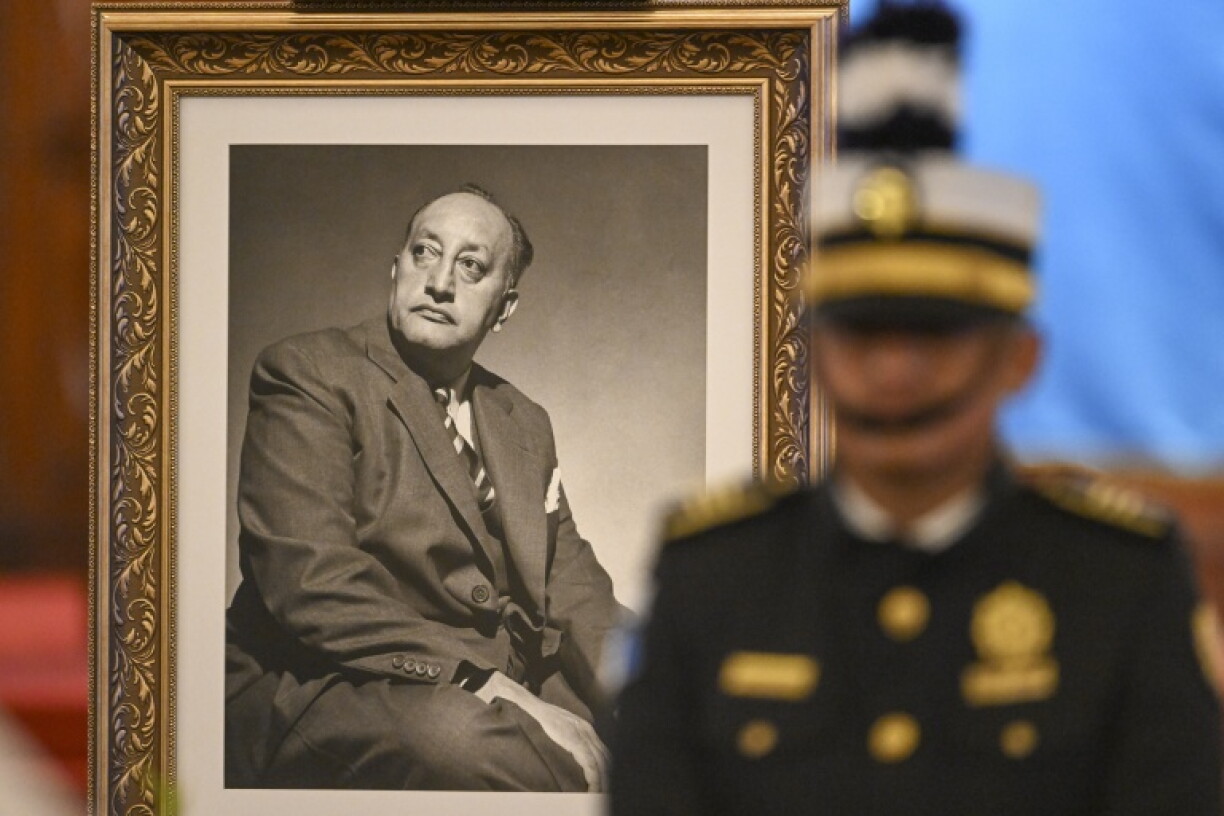
The ashes of Nobel literature laureate Miguel Angel Asturias were finally buried in his homeland Sunday, half a century after his death in exile, at a cultural complex bearing his name and with soil gathered from across Guatemala.
"I can tell you, old man, that you are with us, you are in your homeland, you will sleep beneath your own skies," said the writer's son, Miguel Angel Asturias Amado, before kissing the urn shaped like a kernel of corn that holds his father's ashes.
After several days of tributes, the urn was placed in a monument at the Miguel Angel Asturias Cultural Center, a complex in Guatemala City that includes theaters, plazas and gardens.
The urn, engraved with the writer's name, his birth and death dates and Mayan symbols, was carried along a red carpet during a solemn ceremony accompanied by traditional music.
Guatemalan President Bernardo Arevalo, the writer's relatives and various public figures attended the ceremony.
"Today is a historic day... he always wanted to be in Guatemala," but "political conditions did not allow him to," the writer's son said.
The Nobel literature laureate's ashes arrived in Guatemala on Thursday, repatriated from France half a century after his death.
As a writer, he is considered one of the early inspirations for Latin America's esteemed tradition of magical realism in literature, and his novels include "Mister President," a sharp critique of life under dictatorship, and "Men of Maize," a paean to Mayan culture.
A lawyer, writer and diplomat, Asturias died of cancer in Spain in 1974.
He was buried in Paris's Pere-Lachaise cemetery, where numerous prominent figures including author Honore de Balzac, chanteuse Edith Piaf and Doors singer Jim Morrison are laid to rest.
In 1954, after a US-funded invasion cut short a decade of democratic reforms in Guatemala, Asturias was stripped of his citizenship, his books were banned and he went into exile.
Asturias "produced a monumental body of work that erases the boundaries between the aesthetic and the ethical, the political and the spiritual" and "blazed the trails followed by so many other Latin American novelists and poets," Arevalo said.
"He has been our voice in the world. He deserved to rest in the land he named and reinvented in his pages," he added.
The urn had been on public display since Saturday at the Palace of Culture in the capital.
"Today we are celebrating something extraordinary...not only his eternal presence in Guatemala, but his eternal presence in the world, because he was a man who belonged to all humanity," human rights activist Rigoberta Menchu, the 1992 Nobel Peace Prize laureate, said Saturday.
bur-jjr/atm/pnb/sla


