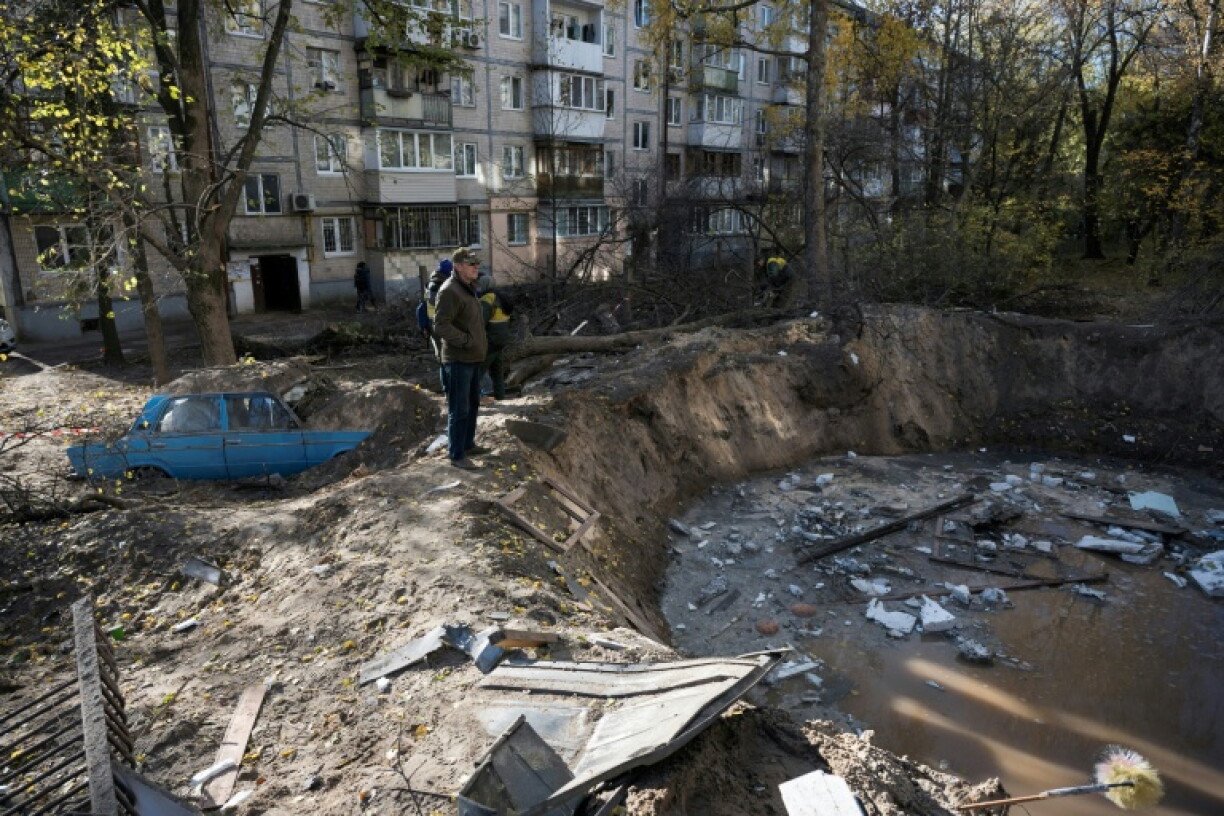
Ukrainian, Russian and American officials will meet in Abu Dhabi Tuesday for talks on ending almost five years of war between Moscow and Kyiv -- the first such negotiations in over nine months.
France announced last week that Europe will also send representatives to Abu Dhabi, with Kyiv's allies worrying that US President Donald Trump plans a deal on the continent's security with Moscow and will force a de-facto defeat on Ukraine.
Russia's 2022 Ukraine invasion has killed hundreds of thousands and displaced millions.
Here is what you need to know about the Abu Dhabi talks.
Russia has pummelled Ukraine as another winter of war approaches, devastating its already vastly destroyed energy sector and increasing deadly strikes.
At the same time, Ukraine has faced mounting pressure from Trump, with the US leader criticising President Volodymyr Zelensky and striking a diesel deal with Russia's Vladimir Putin.
Kyiv and its European allies have watched in horror as the White House appeared to pivot towards Moscow this year, and were alarmed last week by Trump floating a deal with Russia involving "all of Europe".
Zelensky warned against a "Yalta 2.0" ahead of the talks, referring to Western leaders dividing Europe with the USSR in 1945.
He also said Russia intensified attacks in the days leading up to negotiations to "lay the groundwork for putting pressure on Ukraine's position".
Kyiv's delegation will be led by intelligence chief Rustem Umerov and will also include the outspoken Zelensky aide Kyrylo Budanov.
Ukrainians are "very pessimistic" on the peace talks and moves by Trump's administration, political expert Volodymyr Fesenko told AFP.
"We are forced to adapt to the American strategy," he said, adding that Kyiv will try to push for partial or local ceasefires.
A recent ceasefire in the Kherson region was "a very positive precedent", Fesenko said, predicting Kyiv will likely push for more "de-escalation of the war through such local truces".
The Kremlin has so far refused broader ceasefires.
Putin, who unleashed Europe's worst conflict since World War II in 2022, has refused face-to-face talks with Zelensky.
Moscow's forces have been grinding westwards, but have been unable to seize the prized Donetsk region in more than four years.
Russia has throughout the war held up its maximalist demands and spoken of the "root causes" of the invasion -- the Kremlin's terminology for its grievances towards the West.
On the eve of the war, in December 2021, Moscow issued an "ultimatum" for NATO to roll back troops from eastern Europe.
Over the weekend, the Kremlin announced its negotiating team that included, for the first time, Sergei Ryabkov, who put forward the ultimatum.
The team is being led by Putin's nationalistic aide Vladimir Medinsky, and also includes diplomat Mikhail Galuzin, spy chief Igor Kostyukov and army general Yuri Zhygarlovsky.
"It's quite a serious team that can talk about a spectre of issues -- for the military side, solving territorial issues and security guarantees... and also European security," Alexander Gabuev, the director of the Carnegie Russia Eurasia Center, told AFP.
Moscow's stated position is the 2021 ultimatum but "we don't know if that is still relevant and where the red lines are -- it can only be established during the talks".
Previously sidelined by the Iran war, the US-led talks are resuming after Trump's son-in-law Jared Kushner and business partner Steve Witkoff went to both Moscow and Kyiv.
After holding an unscheduled meeting last week with Russian envoy Kirill Dmitriev, who was at the White House for talks with Ukrainian officials, Trump touted a "very big" deal with Russia that will "involve all of Europe".
He later also said that Ukraine will "end up with a little bit (of a) different shape".
Kushner and Witkoff have been accused by critics of being soft on Russia and the US media have reported that the Americans are pushing giant back-door business deals with Moscow.
Europe's role in the talks is unclear.
EU chief Ursula von der Leyen said "the EU will be present alongside our partners".
An EU official told AFP that national security officials for the bloc, NATO, France, Germany and the UK would be on site -- although how they would be involved is unclear.
The Kremlin insisted the talks will still be held in the Russia-Ukraine-US format while Zelensky said he coordinated his position with the EU ahead of the talks.
Most European leaders have had either no or very limited contact with Putin since 2022.
But last month, Finnish President Alexander Stubb and Norwegian Prime Minister Jonas Gahr Store held a rare call with Putin, calling their talks "frank and substantive".
oc/mmp/sbk


