
According to Météo France, after an "unusually mild spell for this time of the year", a noticeable shift towards colder conditions is "anticipated to persist throughout much of the upcoming week". Across the entire country, temperatures have plummeted by more than 10 degrees in just a span of a few days. Widespread frost is expected to set in on Monday.
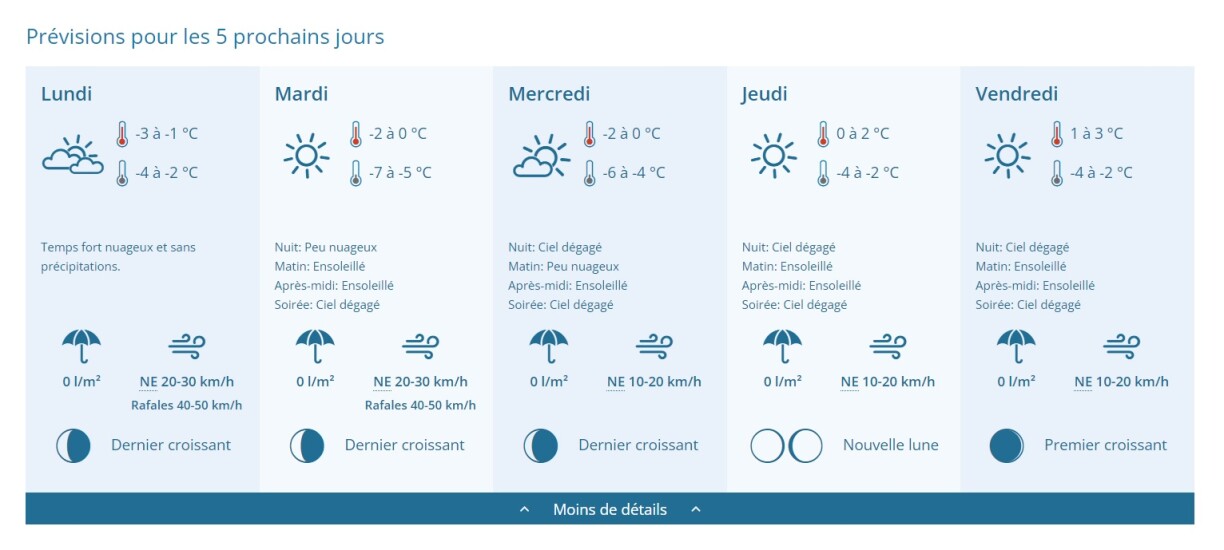
In Luxembourg throughout the entirety of Monday, Météolux has indicated that temperatures are expected to remain in the negatives, ranging between -1 and -4 degrees. The coldest days of the week are projected to be Tuesday, with temperatures dipping to -7 degrees, and Wednesday, where a marginal increase of 1 degree will be experienced. By Thursday and Friday, temperatures are set to slightly rise, reaching 2 or 3 degrees during the mildest periods of the day - temperatures should not drop below -4 degrees. Overall, the week is anticipated to be predominantly sunny, except for Monday, when overcast conditions will persist.
In French mountainous regions, including Saint-Flour in Cantal which is located at an elevation of 900 meters above sea level, temperatures dropped as low as -10°C on Sunday morning. The cold was intensified by brisk winds in these areas.
Tuesday is poised to become the coldest day of the week, with sub-zero temperatures in the morning across much of the country. Anticipate freezing conditions with temperatures of -5°C in Belfort, -3°C in Lille, -2°C in Paris, Bordeaux, and Rennes, and 0°C in Lyon and Toulouse. However, Marseille is expected to experience milder weather with a temperature of 9°C.
On that day, the national temperature indicator (the average of temperatures recorded in 30 meteorological stations across the territory), may dip below 0°C. This would mark the first occurrence since February 2018.
As early as Sunday, a yellow alert (the second of four levels) has been issued for 60 French regions due to snow and ice. The Atlantic and Mediterranean coasts are the only areas expected to be spared from these icy conditions.
In the village of Hauteluce in Savoie, a bus carrying 52 passengers reportedly "slid on the snow and overturned on its side", resulting in injuries to four individuals. This information was confirmed by firefighters to the news agency AFP, corroborating details from the regional newspaper "Le Dauphiné Libéré".
Additionally, eleven departments situated in mountainous regions in France are currently under a yellow alert due to a risk of avalanches. The Pyrénées have witnessed substantial snowfall, causing challenges in traffic conditions above 500 meters in altitude.
Starting from Monday, 40 departments will be placed on a yellow alert as part of the country's "plan grand froid" (cold weather plan), a series of measures implemented when temperatures drop significantly and persist at low levels for some time.
Certain prefectures, including Haut-Rhin, Meurthe-et-Moselle, and Cantal, have already activated their respective plans,
In departments such as the Hauts-de-Seine, Bas-Rhin, and Loire-Atlantique, authorities have put into place prevention and vigilance measures. These measures allow for the mobilisation of extra accommodation facilities, in particular for vulnerable people such as the homeless.
The departments of the north of the country and the department of Pas-de-Calais remain under an orange flood alert, and the decline in temperatures is causing concern among residents already affected by the floods.
Météo France notes that the "four longest and most severe cold spells" occurred over 30 years ago, specifically in February 1956, January 1963, January 1985, and January 1987.
Extreme cold weather places additional strain on the body, as explained by Santé Publique France (French Public Health Agency). The agency recommends thorough coverage, especially of body parts that lose heat rapidly such as the head, neck, hands, and feet. Additionally, it is advisable to cover the nose and mouth to prevent inhaling excessively cold air.





