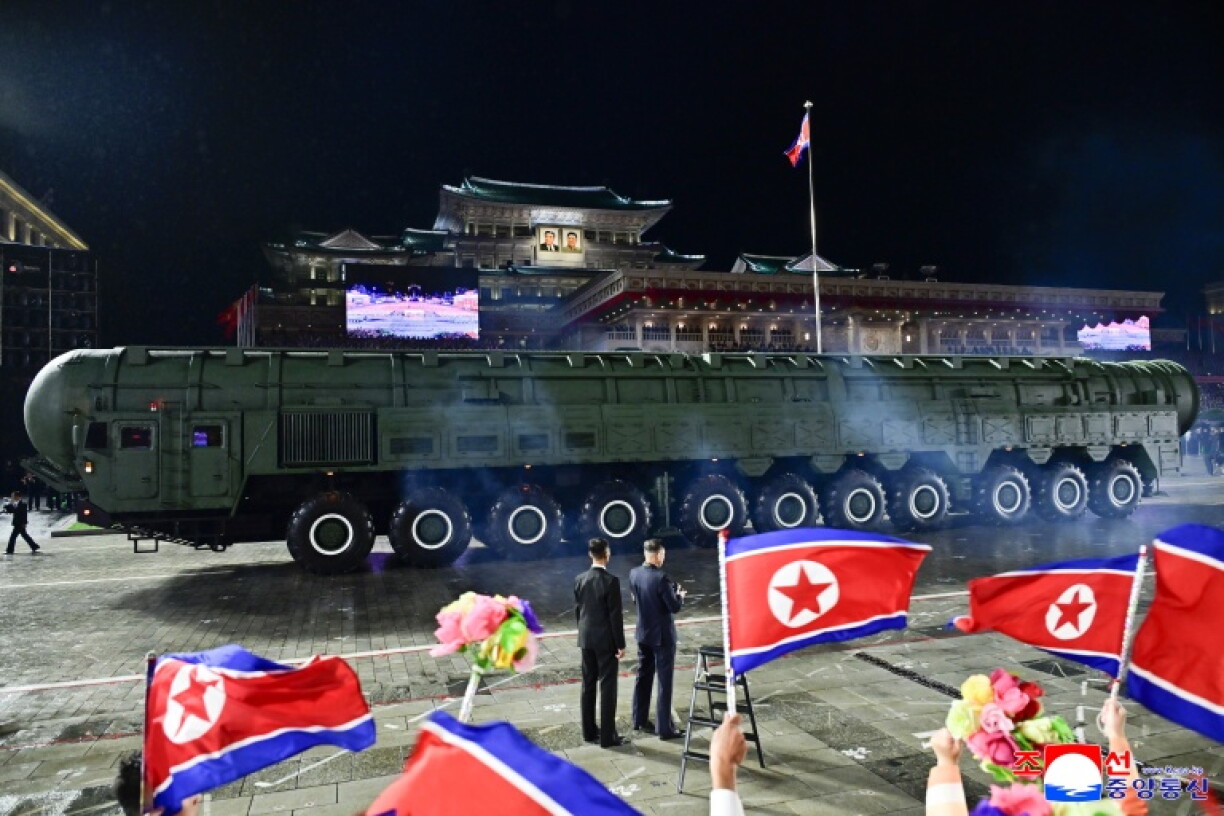
North Korean leader Kim Jong Un said his country should expand its ability to launch nuclear weapons from different platforms, state media reported Thursday, stressing that its nuclear capabilities were now a "reality".
Kim made the remarks during an inspection of a nuclear weapons research facility on Wednesday at an unspecified location, following repeated declarations that Pyongyang will not abandon its nuclear weapons.
"The nuclear weapons manufacturing sector should pay attention to utilizing the tactical nukes of different missions in multiple domains", the official Korean Central News Agency (KCNA) quoted him as saying, without elaborating.
It was "an important and urgent task raised from a tactical nukes' military value in modern warfare and from the inevitable reality facing the border with the most dangerous enemy state", he added.
Photos released by KCNA show Kim -- flanked by two officials -- looking at rows of what appear to be nuclear warheads, with parts of the objects blurred and some featuring red-painted nose cones.
Another image showed Kim inspecting a series of partially blurred metallic cylindrical devices mounted on wheeled stands.
Reiterating his country's commitment to nuclear weapons, Kim described its nuclear policy as "a core item for guaranteeing the sovereignty of the Republic enshrined in the supreme law of the state".
"No one has the right to force us to go against our Constitution or the right to attempt to amend it," he added.
"Our nuclear capability has now become a reality."
Kim also accused Washington of seeking to replicate its AUKUS security pact in Northeast Asia by encouraging its regional allies to acquire nuclear-powered submarines, in an apparent rebuke of Seoul's efforts to acquire such vessels.
Pyongyang enshrined its nuclear weapons policy in its constitution in 2023, a year after adopting a law declaring its status as a nuclear weapons state irreversible.
Kim's message underscores a fundamental shift in the North's approach to nuclear talks with Washington, Lim Eul-chul, a professor at Kyungnam University's Institute for Far Eastern Studies, told AFP.
"It effectively marks the formal abandonment of Pyongyang's previous approach of putting its nuclear arsenal on the negotiating table in exchange for diplomatic recognition or sanctions relief from the US," he said.
"It amounts to the North's declaration that even if Pyongyang and Washington return to the negotiating table, complete, verifiable and irreversible denuclearisation will be off the agenda, with talks limited to managing mutual nuclear threats and arms control," he added.
US President Donald Trump, who met Kim three times during his first term in an effort to curb the North's nuclear programme, said in August that Pyongyang had 57 "very powerful" nuclear weapons.
Seoul estimates that the North possesses between 80 and 120 nuclear weapons.
Trump has repeatedly expressed his willingness to meet Kim for a fourth time, with nuclear negotiations between Washington and Pyongyang having stalled since their 2019 summit in Hanoi ended without a deal.
kjk/tc