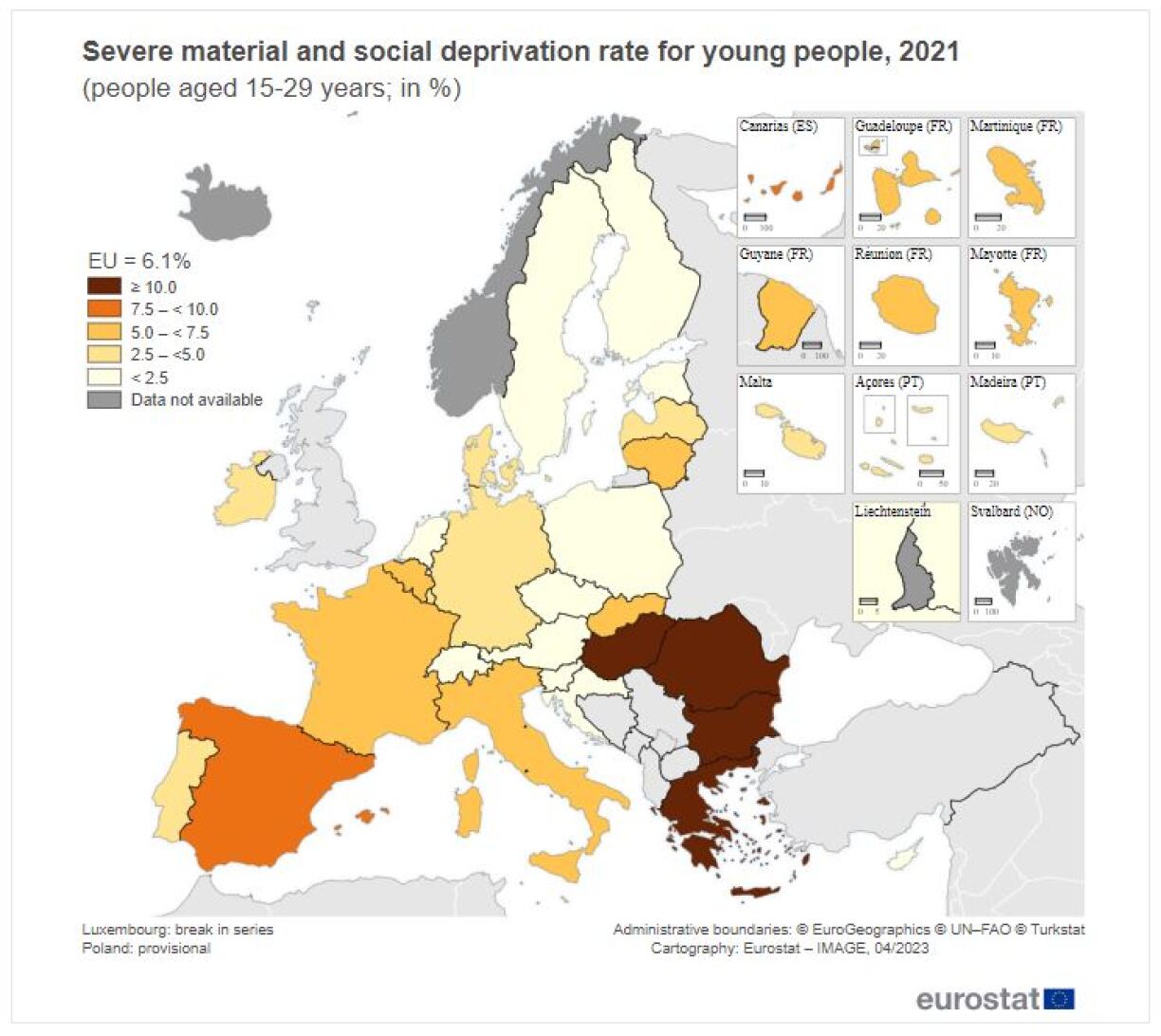
In 2021, the severe material and social deprivation rate among young people aged 15 to 29 was 6.1% in the European Union.
Severe material and social deprivation is defined as "the proportion of the population experiencing an enforced lack of at least 7 out of 13 deprivation items, with 6 items related to the individual and 7 related to the household."
In the same period, the severe material and social deprivation rate among the total population encompassing individuals residing in private households aged 0 and up was marginally higher at 6.3%.
In 2021, the highest rate of young people who were severely materially and socially deprived was recorded in Romania at 23.1%. Romania was followed by Bulgaria and Greece, who recorded 18.7% and 14.2% respectively.
Luxembourg was one of 11 EU of 26 member states with available data who's proportion was less than 3%. Also grouped with Luxembourg were Poland, Cyprus, Sweden, Netherlands, Czechia, Croatia, Slovenia, Estonia, Finland and Austria.
The at-risk-of-poverty rate in the European Union in 2021 was higher for young people (aged 15-29) than for the total population.
The at-risk-of-poverty rate is "the share of people with an equivalised disposible income below the at-risk-of-poverty threshold, which is set at 60% of the national median equivalised disposable income after social transfers."
Young people and total population were marked with a difference of 3.3 percentage points with young people recorded at 20.1% compared to the 16.8% of the total population.
Read also: Children's risk of poverty higher in Luxembourg than EU averageThis trend was seen in 19 countries within the EU, with the largest gap observed in Denmark, with 12.3% of the total population at risk of poverty compared to 25.6% of young people. Sweden followed closely behind, with 15.7% of the total population at risk of poverty compared to 24.6% of the youth population.
The risk of poverty rate in was marginally higher in Luxembourg than the EU average in 2021, at 20.3% and 20.1% respectively. Luxembourg also saw difference between young people (15-29) and the general population, with 18.1% of the general population classified as being at risk of poverty.
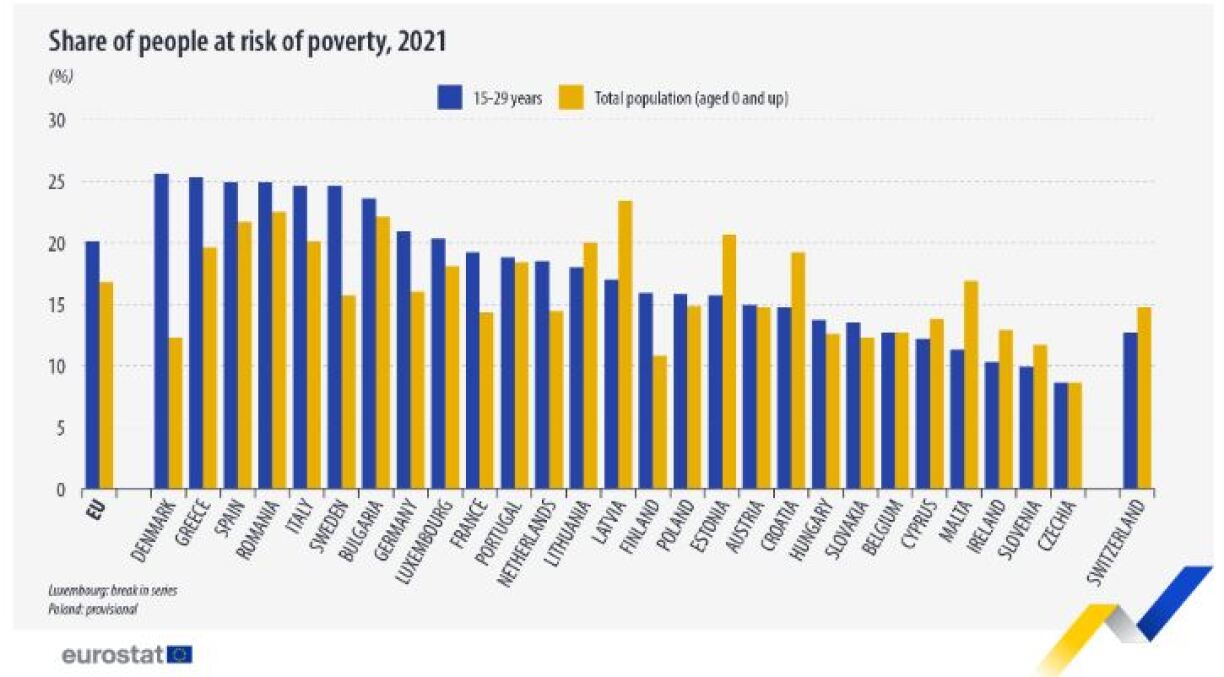
In eight EU countries, younger people were less at-risk of poverty than the population as a whole. The difference was most notable in Latvia, with 23.4% of the population at risk compared to the 17% of young people. Also in the group were Malta with a difference of 5.6 percentage points, Estonia with 4.9 pp and Croatia with a difference of 4.5 percentage points.





