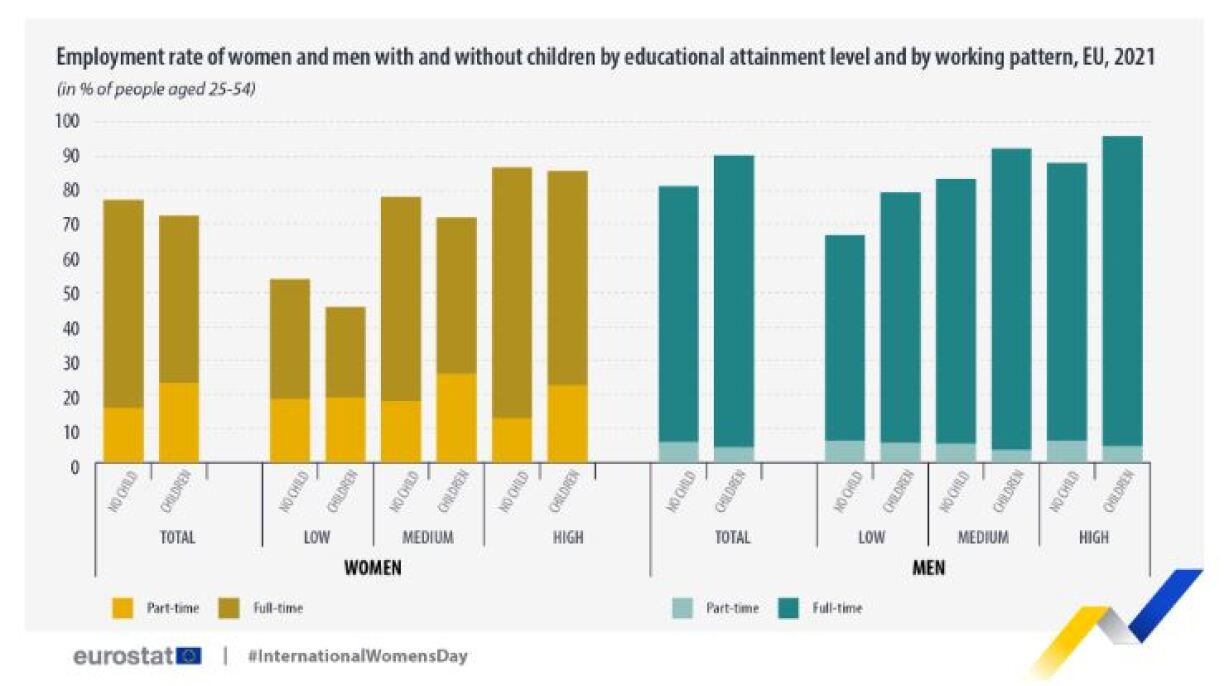
An estimated 77% of childless women in the EU aged 25-54 were employed in 2021. Women with children, on the other hand, were five percentage points less likely to be employed, at 72%.
On the other hand, the presence of children in the household had the opposite effect on the employment rate of men in the same age group. Men without children had a lower employment rate (81%) than those men who did have children (90%).
When men and women were compared, the gender employment gap reached four percentage points for people without children compared to 18 for individuals with children.
Education also played a role in the gender employment gap. Women with high levels of education were very likely to be employed, whether they have children (86%) or not (87%).
However, women with a lower level of education saw the largest difference in employment, with a rate of 54% for those without children compared to 46% for those with children.
A similar trend appeared among men with low levels of education. An estimated 79% of men with children were employed, in contrast to 67% for those without children.
For men at every level of education, the employment rate was higher for those with children.
Part-time employment of women with medium or high levels of education was more likely to be affected by the presence of children. In 2021, 16% of highly educated women without children worked part-time, while 26% of highly-educated women with children were working on a part-time basis.
Furthermore, the share of employed part-time men was higher for men without children than it was for those with children, regardless of education level.





