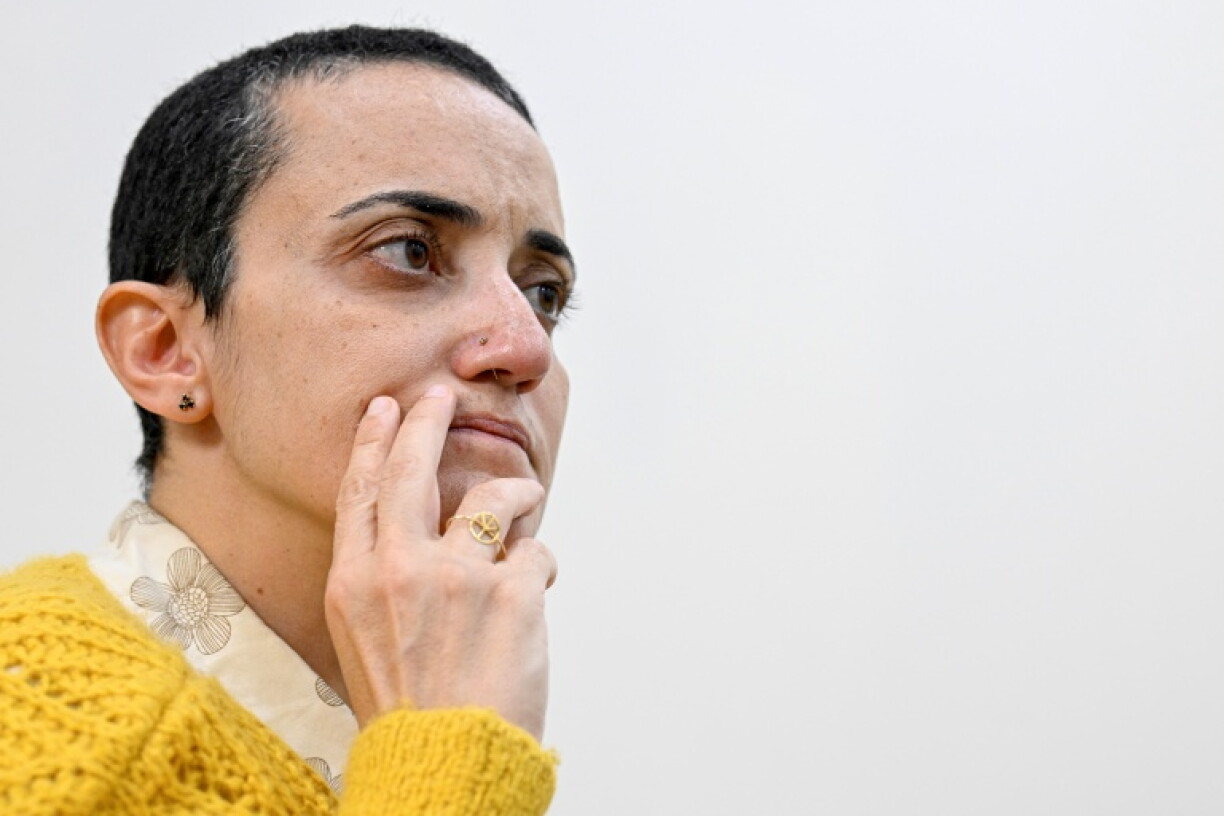
Egypt's latest prosecution of journalists attempts to "silence" the last surviving vestiges of the free press, Lina Attalah, head of preeminent outlet Mada Masr, told AFP days before she faces jail time in court.
In recent weeks, Egypt has detained the entire staff of fact-checking platform Matsadaash, ordered the closure of Mada Masr and informed its chief of a one-year prison sentence handed down in absentia.
"It's hard to separate between those two incidents," she told AFP.
"It seems to be a new chapter in trying to limit the already-limited space that there is for independent media."
As Egypt grapples with economic and political struggles amid regional upheaval, Attalah said there seemed to be a belief that "silencing the media is the solution to Egypt's problems".
Cairo has long been criticised for its rights record, and has for over a decade shuttered nearly all space for dissent.
Attalah is one of Egypt's most prominent journalists, 26 of whom are currently behind bars.
Her prosecution drew swift international outcry, including from the European Union and members of the US Congress.
The current crackdown has been described as "unprecedented" by 135 media organisations and rights groups, including Amnesty International and Human Rights Watch.
With Egypt's last surviving outlets under threat, "there are very few organisations left with expertise of rigorous reporting," she said.
"So we are left with silence."
Last month, a misdemeanours court fined Attalah three million Egyptian pounds (currently around $55,000) for operating the website without a licence.
"Ever since the law was passed in 2018, we have tried to apply," she told AFP, explaining that they went years without a response.
"We're not against regulation; we have a problem when the licensing becomes a tool of control, a tool of exclusion."
Attalah's eight-lawyer defence team described a rushed trial run by a judge who appointed her a defence lawyer himself, before "proceeding to write the defence statement" on that lawyer's behalf.
The small-framed Attalah was then lifted off the ground and detained by security personnel.
"It felt like I was being kidnapped from the courtroom," she said. "I did not hear the verdict as I was being pulled by the cops."
"I was panicked, I was scared," she said of her more than seven hours in detention, having turned up in court expecting to face a maximum penalty of a fine.
It was only upon her release that night, hours after the fine was crowdsourced from supporters and paid in full, that she learned the court had ordered Mada's shutdown. An appeal is scheduled for November 25.
She was also informed that, in 2024, she had been handed a one-year prison sentence in absentia for operating without a licence and "publishing false news" -- a charge commonly levelled against journalists.
On Wednesday, Attalah will face a retrial for the 2024 case.
"I'm hoping for this to be dropped, because journalists should not be in jail. I should not go to jail. The Matsadaash journalists should not be in jail. The rest of the 26 journalists should not be in jail."
"We should be allowed to go back to our newsrooms and not spend our days in courtrooms," Attalah said, frustrated that "until the cases are resolved, there isn't much journalism" she and her team of 50 can do.
Mada was established in 2013, in the aftermath of Egypt's 2011 uprising, which toppled longtime autocrat Hosni Mubarak.
"Precisely because I felt that something was deeply changing in Egypt, and that we are going to face something new and different... And a record needed to be created of it."
Since its inception with a handful of reporters, Mada has been buffeted by but survived the crackdown that has stifled nearly all local press.
Through multiple website blocks and closure orders, Mada has amassed a loyal following, in part for being a rare springboard for young journalists.
"The space has become deserted, as independent media. Nobody was there to report about what was really happening."
As a result, it is widely regarded as a crucial source of reporting and analysis on the Arab world's most populous country.
It is a role Attalah sees as even more vital given Cairo's strategic importance.
"Egypt is celebrated for being a haven of stability in the midst of a lot of instability in the region," with armed conflict across each of its borders and beyond the Red Sea in the Gulf.
"There is a lot of investment in its stability," she explained, but "a margin of political space for civil and political rights is part of the stability calculus."
A belief that "stability can happen by just investing in power and the status quo", she said, "is the wrong bet".
lom/bha/dcp


