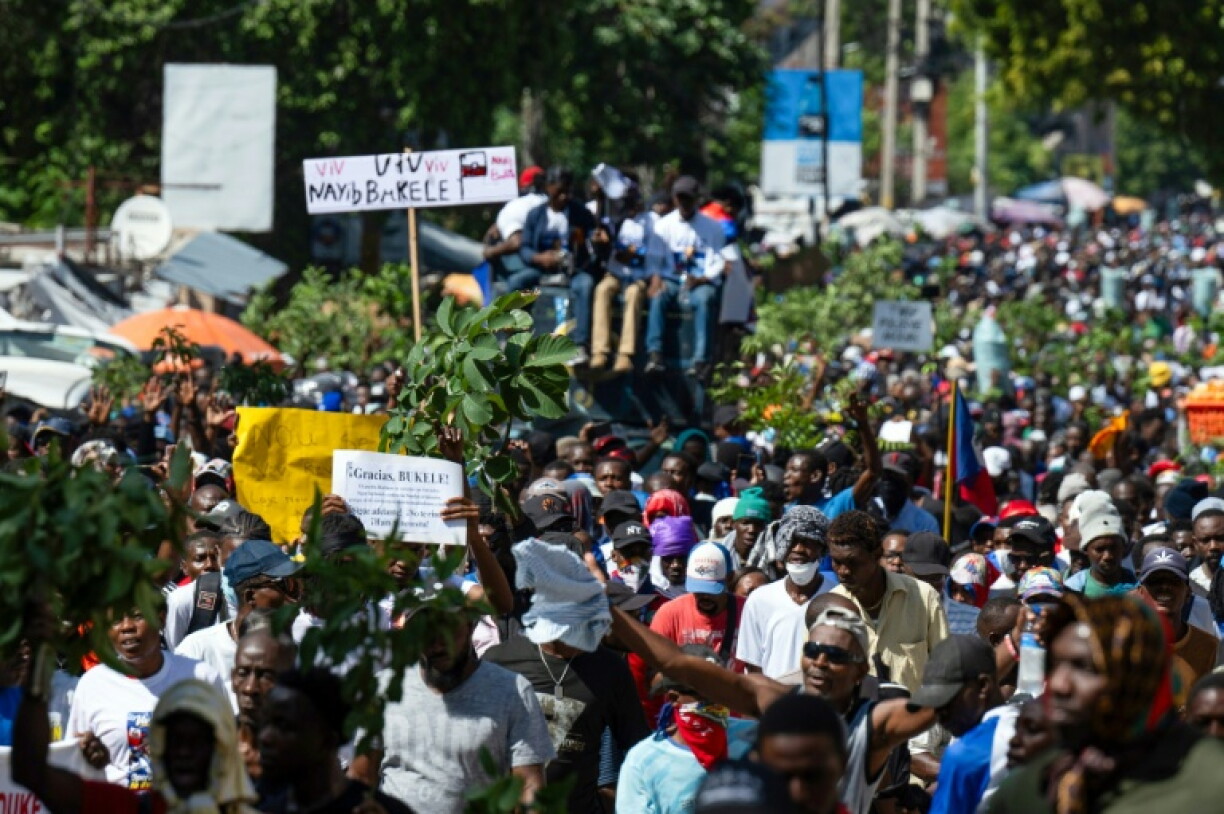
Salvadoran President Nayib Bukele said Wednesday that troops from his country deployed in Haiti destroyed the home of a gang leader, their second such strike against powerful crime groups that control much of the country.
Bukele released footage on X of two helicopters blasting the large Port-au-Prince house of a man that Haitian media identified as Jeff Gwo Iwa, a leader of a well-armed gang coalition called Viv Ansanm.
"My gift to the Haitian people on the anniversary of the Battle of Vertieres," he wrote in Haitian Creole, referring to a 1803 military clash during the country's revolution seeking to end French colonial rule.
Bukele has sent more than 2,000 troops into Haiti since late October, after four soldiers from his country went missing during an operation of a UN-backed unit called the Gang Suppression Force (GSF).
Haiti has a very weak government trying to take on the well-armed, violent gangs and has been saddled for decades with poverty, corruption, crime, natural disasters and other woes.
Haiti has not held any election since 2016 and its last president was assassinated in 2021 and never replaced.
The first round of presidential and legislative elections has now been set for July 18, 2027.
The new Salvadoran deployment, despite being separate from the GSF, has been welcomed by Haitian authorities, who have long sought reinforcements in efforts to assert control over the Caribbean country.
Thousands of Haitians took to the streets of Port-au-Prince on Tuesday to show their support for the soldiers from El Salvador.
The first Salvadoran attack on the alleged home of a gang leader came earlier this month, when Bukele posted footage of helicopters firing on the supposed headquarters of the 400 Mawozo gang.
Salvadoran forces also helped Haitian police recapture a soccer stadium in the capital that had been occupied by gangs for two years.
The two governments on Tuesday signed a "cooperation agreement" regarding the deployment of Salvadoran troops.
Neither side has disclosed the scope of Tuesday's accord.
The deployment has raised the alarm among human rights groups, which have questioned the troops' rules of engagement.
Haiti, the poorest country in the Americas, has faced a deep political and security crisis for years, with gangs seizing control of much of the island nation through a campaign of violence marked by murder, kidnapping and rape.
Numerous armed forces are now operating in Haiti, with uncertain levels of coordination, including the Haitian police and army, the multinational GSF, foreign mercenaries and most recently, the Salvadoran soldiers.
On Tuesday, the Office of the UN High Commissioner for Human Rights called on all security forces to protect the population and resort to lethal force only as a last resort.
In the first 10 months of 2026, the UN recorded 4,595 deaths and 2,050 injuries to armed violence in Haiti.
mp/mis/dw/acb


