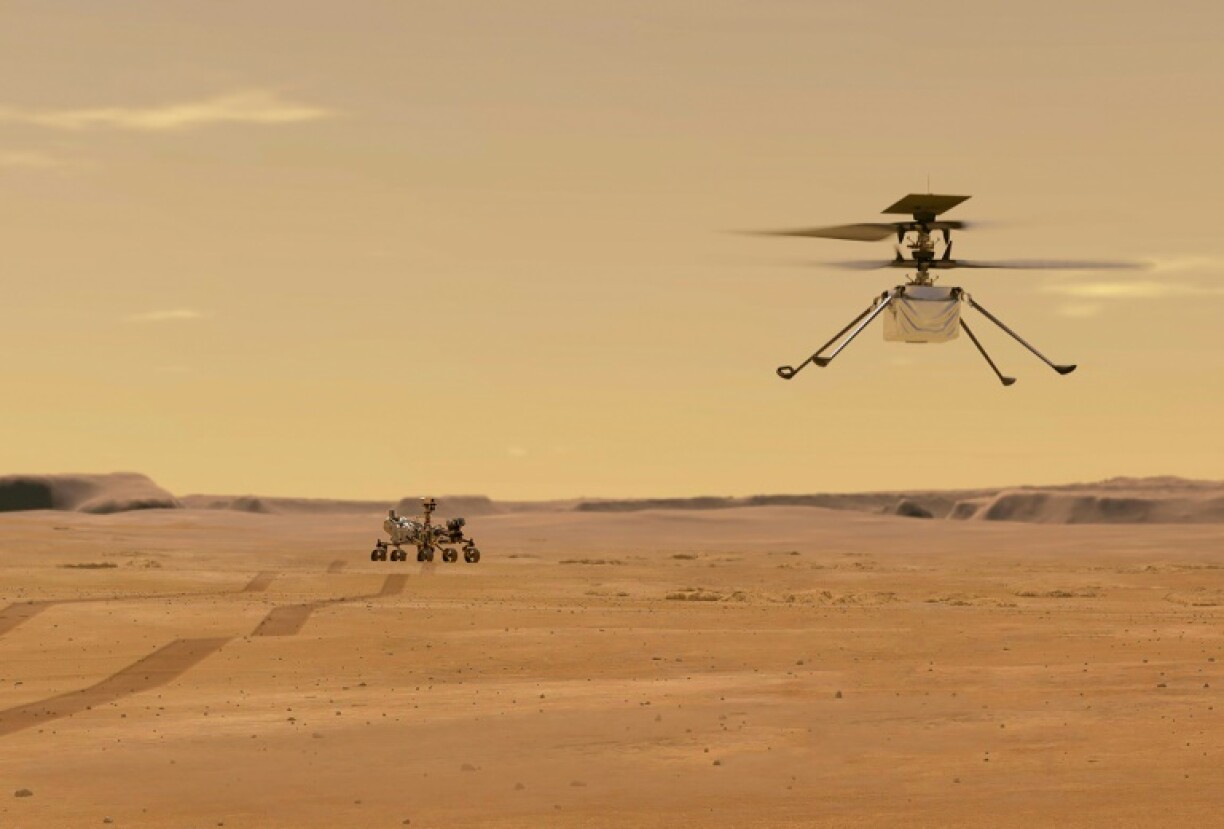
"Altimeter data confirms that Ingenuity has performed the first flight of a powered aircraft on another planet," announced an engineer in the Jet Propulsion Laboratory as the control room cheered.
The space agency had originally planned the flight for April 11 but postponed it over a software issue that was identified during a planned high-speed test of the aircraft's rotors.
A short clip sent back by the Perseverance rover showed the four pound chopper grounded at first, hovering three meters above the Martian surface, then touching back down.
Ingenuity itself sent back a still black-and-white image from its downward pointing camera, showing its own shadow cast on the surface.
Watch the moment NASA control room finds out the news:
"We can now say that human beings have flown a rotorcraft on another planet!" said lead engineer MiMi Aung to her team.
"We've been talking so long about our Wright brothers' moment on Mars, and here it is," she added.
The first powered flight on Earth was achieved by the Wright brothers in 1903 in Kitty Hawk, North Carolina. A piece of fabric from that plane has been tucked inside Ingenuity in honour of that feat.
The helicopter travelled to Mars attached to the underside of the rover Perseverance, which touched down on the planet on February 18 on a mission to search for signs of extraterrestrial life.
Ingenuity's goal, by contrast, is to demonstrate its technology works, and it won't contribute to Perseverance's science goals.
But it is hoped that Ingenuity can pave the way for future flyers that revolutionize our exploration of celestial bodies because they can reach areas that rovers can't go, and travel much faster.
The timing of the helicopter flight is chosen with the weather on Mars in mind. Wind is the big unknown and could jeopardize the mission.
The flight is challenging because the air on Mars is so thin -- less than one percent of the pressure of Earth's atmosphere.
That makes it much harder to achieve lift, even though it will be partly aided by a gravitational pull that is a third of Earth's.
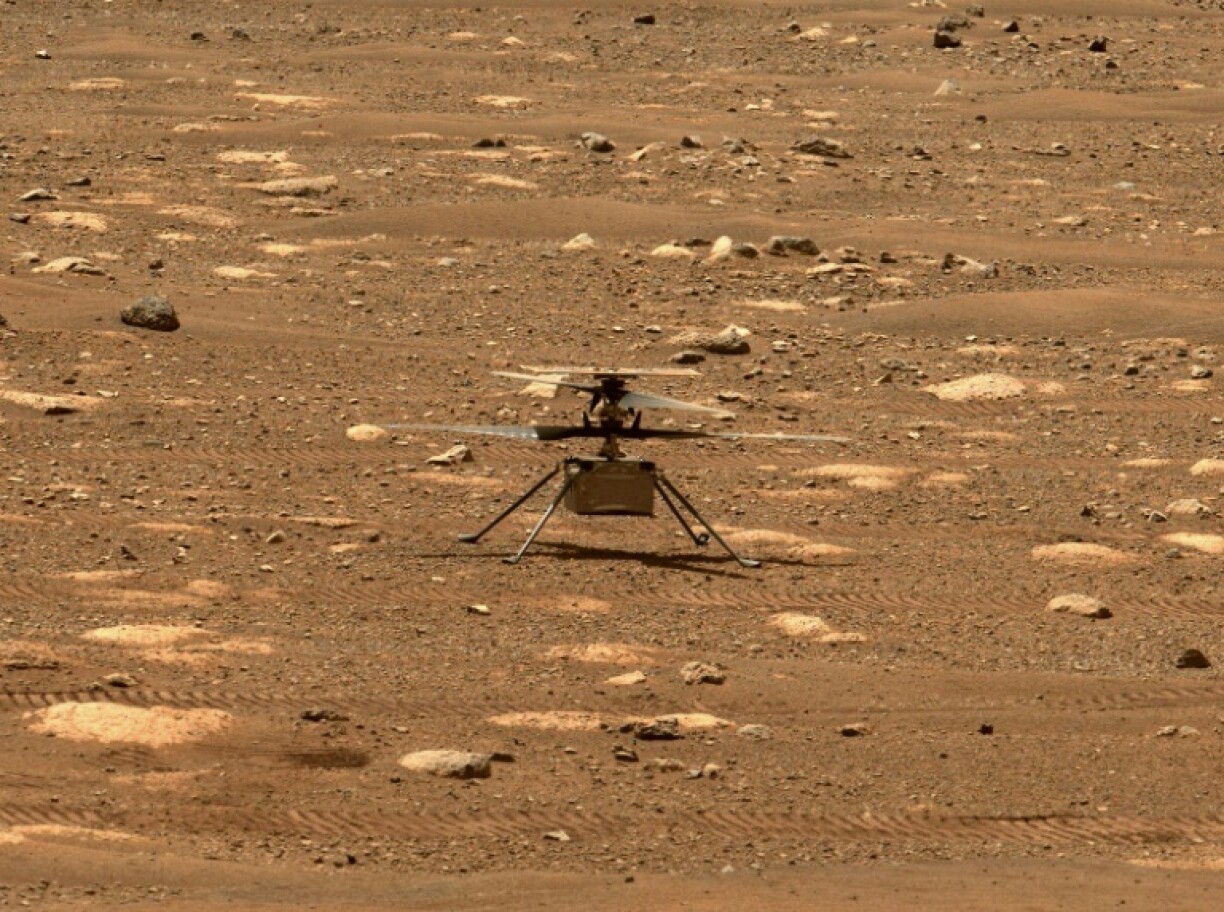
After the flight, Ingenuity will send Perseverance technical data on what it has done, and that information will be transmitted back to Earth.
This will include a black and white photo of the Martian surface that Ingenuity is programmed to snap while flying.
Later, once its batteries have charged up again, Ingenuity is to transmit another photo -- in color, of the Martian horizon, taken with a different camera.
But the most spectacular images are supposed to come from the rover Perseverance, which will film the flight from a few meters away.
Shortly after this filming, six videos of 2.5 seconds each will be sent to Earth. NASA hopes at least one of them will show the helicopter in flight.
The entire video will be sent over the following few days.
"There will be surprises, and you will be learning about them right at the same time that we will. So let's all get the popcorn," said Elsa Jensen, who oversees the cameras on the rover.
Following the successful flight, NASA plans another no more than four days later. It plans as many as five altogether, each successively more difficult, over the course of a month.
NASA hopes to make the helicopter rise five meters (16 feet) and then move laterally.
Ingenuity's "lifetime will be determined by how well it lands" each time, said Aung -- meaning whether it crashes.
"Once we get to the fourth and fifth flight, we'll have fun," she said. "We are going to take very bold flights and take high risk."





