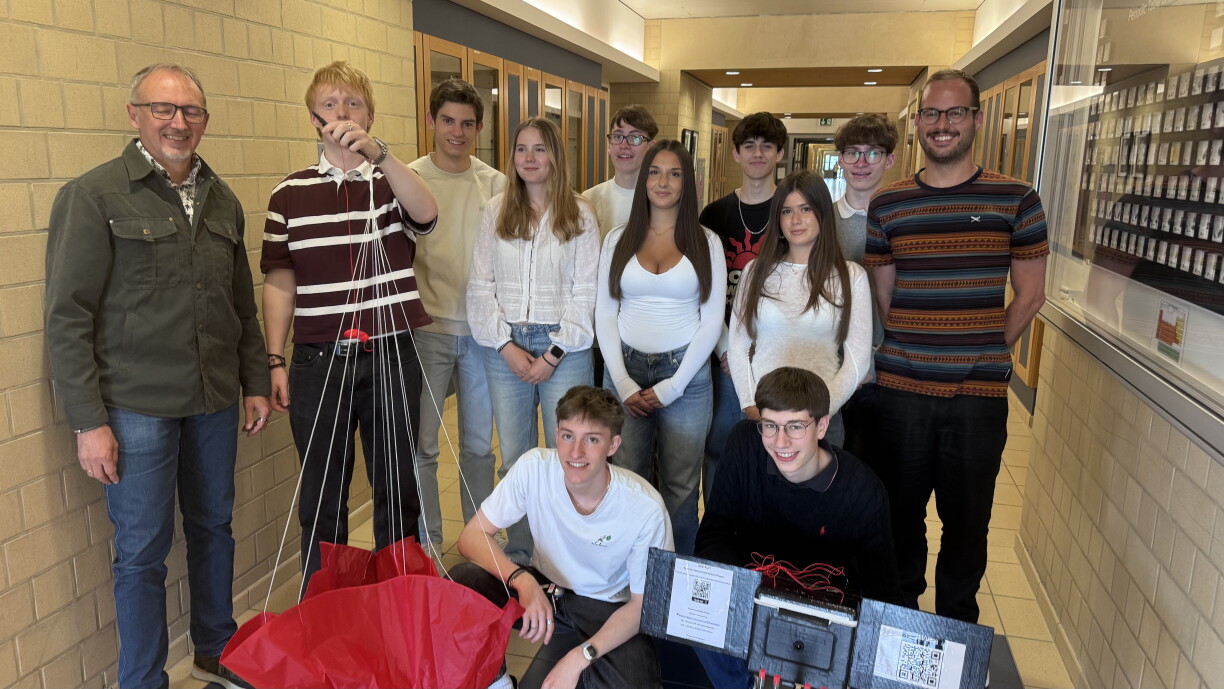
As part of the JosyFly! project, students at Josy Barthel High School in Mamer spent months developing, building, and testing a scientific probe before launching it into the stratosphere using a helium balloon.
The stratosphere is the second layer of the atmosphere, beginning at an altitude of about 10 to 15km and extending up to around 50km. With a planned altitude of 36km, the probe flew deep into the stratosphere, nearly reaching the edge of space.
The JosyFly! project goes beyond classroom theory. By combining physics, chemistry, computer science, electronics, meteorology, and data analysis, it gives students hands-on experience across a range of scientific disciplines.
The students were in charge of every aspect of the mission, from building and programming the probe to documenting its journey and interpreting the data it returned.
The probe was designed to record key atmospheric data, such as altitude, temperature, air pressure, and GPS coordinates, as well as to capture photographs of Earth from the edge of space.
As launch day approached, preparations entered their final phase. Each cable, sensor, camera, and electronic component was checked repeatedly because, once the probe was on its way to the stratosphere, nothing could be fixed, and conditions there are extreme.
At an altitude of over 30km, temperatures can drop to minus 60°C, the air becomes thinner, and the pressure drops sharply, making the mission as challenging as it is exciting.
In addition to the technical teams, a dedicated team of students was responsible for communications, documenting the project on social media and sharing it with the public.
After months of preparation, the moment of truth had arrived. In Holzem, the balloon was filled with helium in preparation for its launch. Shortly afterwards, the countdown began. Within seconds, the probe lifted slowly into the sky, marking the grand finale of the students' long-term project.
During its ascent, it continuously collected data on temperature, air pressure, altitude, GPS position and UV radiation. At the same time, its cameras captured images of Earth from a perspective usually only seen on space missions, highlighting the scale and ambition of the project.
Once the balloon had reached its maximum altitude, it expanded in the increasingly thin atmosphere until it eventually burst. The probe then began its descent back to Earth, attached to a parachute. It was later recovered using a GPS tracker, successfully completing the mission and returning its data safely.





