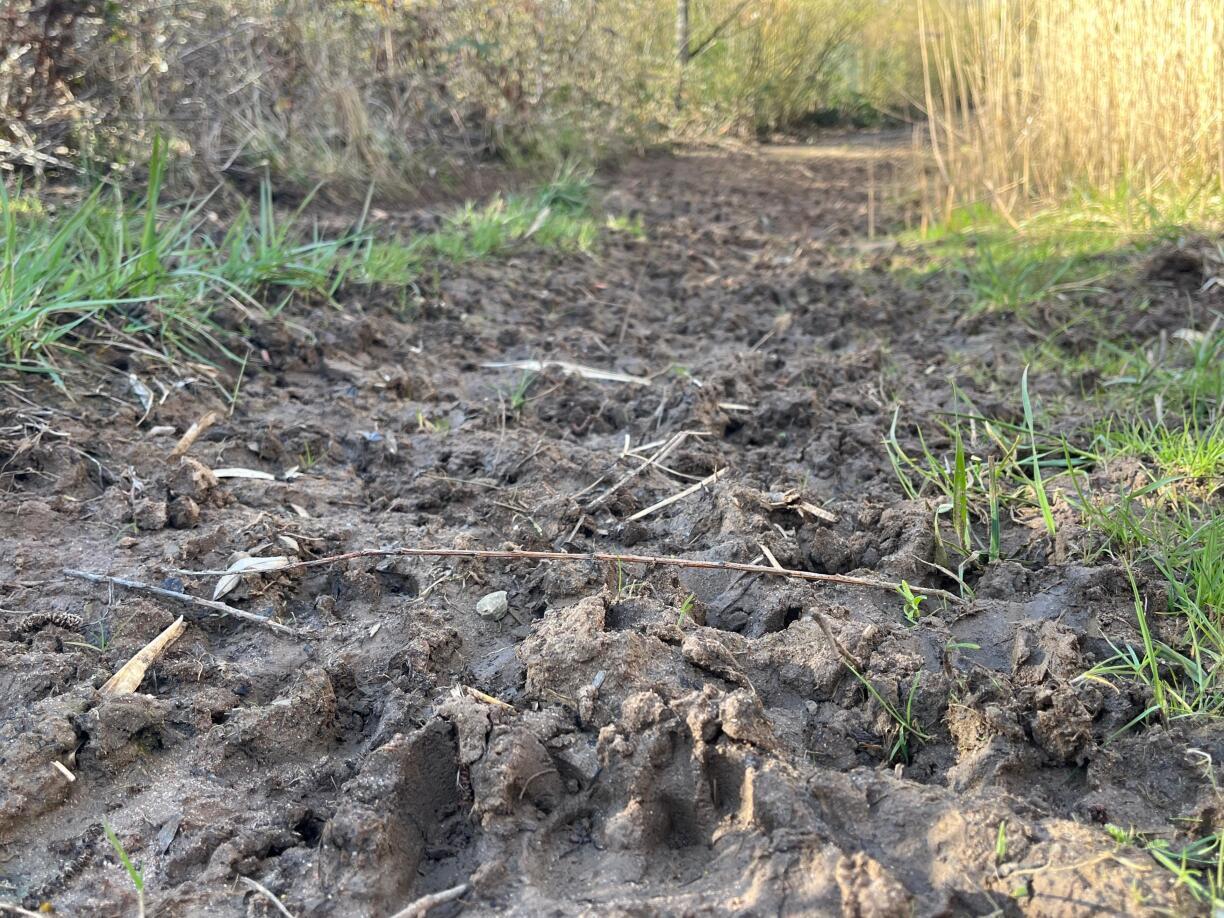
An increasing number of wild boar in the Haff Réimech nature reserve is raising safety concerns and causing widespread damage, prompting the municipality of Schengen to call for action.
This is far from the first year that there have been too many wild boar along the Moselle, but for mayor Michel Gloden it is clear that their numbers can no longer be sustained. The municipality has contacted the relevant authorities as well as the Environment Ministry, insisting that action is needed because "the biological balance is no longer there".
According to Gloden, wild boar are causing significant damage and, unlike people, are no longer afraid, increasingly venturing closer to residential areas. He added that many residents have reported sightings of the animals even within neighbourhoods.
According to Ramon Hemmer of the Baggerweier nature experience association Erliefnis Baggerweier, the nearby nature reserve has effectively become an ideal breeding ground for the animals. With no natural predators and hunting restrictions in place, wild boar can reproduce undisturbed, giving birth twice a year, he said.
The problem goes beyond that. Hemmer said that children encounter wild boar on their way to school, adding that road accidents have occurred and that the animals are particularly drawn to the dredging ponds at Haff Réimech.
He explained that the animals have pushed through fencing to gain access, causing extensive damage that requires costly repairs.
Vineyards are also affected. Winemaker and hunter Serge Klinker said wild boar are damaging vines and even overcoming electric fencing. He stressed that the situation poses risks for machinery and tractors, and repeated damage forces growers to carry out constant repairs.
The animals are also clever, he added, targeting the best grapes and even climbing onto wires to reach them.
The ban on shooting wild boar at night while they are feeding could be lifted from next year, and the municipality has requested a driven hunt. However, the Nature and Forest Agency has warned that such an approach would not be suitable in the Haff Réimech nature reserve, due to the wetlands and reed beds.
A driven hunt could damage the habitat of other plant and animal species, meaning it is not considered a viable option, they said.
Gloden stressed that the aim is not to hunt wild boar for its own sake, but to address a real and growing problem, ensuring that the animals do not continue to dominate the area.





