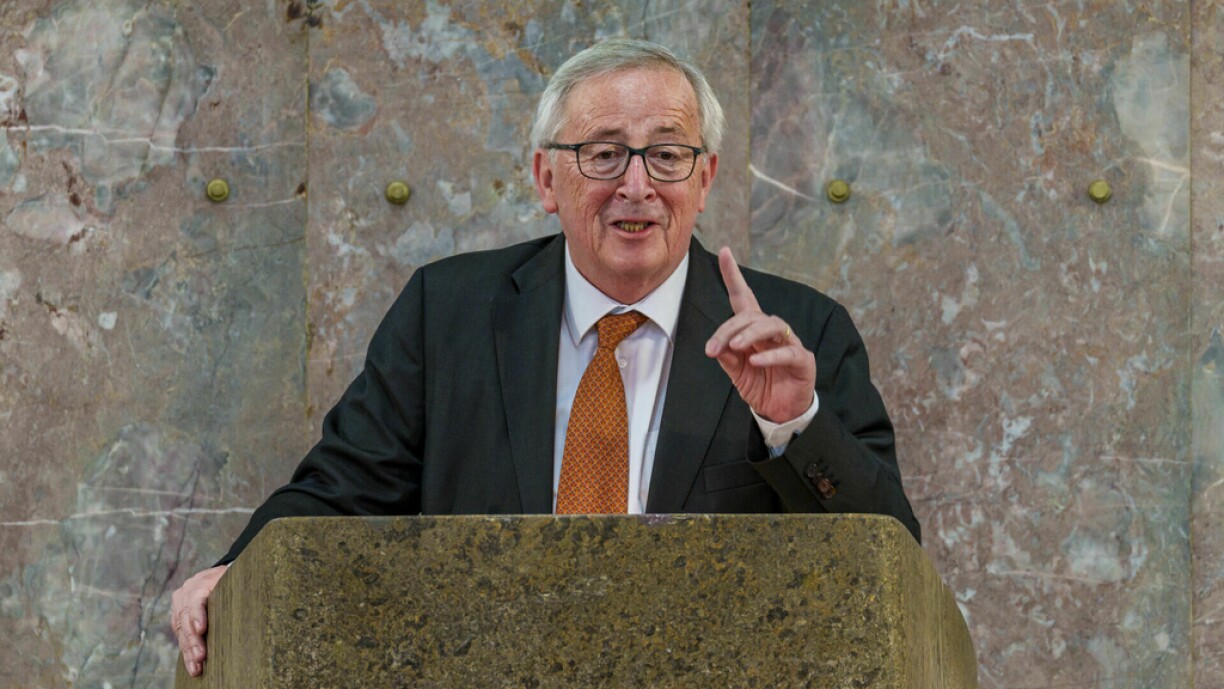
Donald Trump's erratic and transactional rhetoric against Ukraine and its President evoked astonishment and anger from Jean-Claude Juncker. He deems President Trump's purely transactional approach toward Ukraine, particularly with regard to his calls for compensation for US aid in the form of access to Ukraine's rare earth minerals, as disrespectful to the Ukrainian people.
French President Macron's recent visit to the US failed to erase the glaring differences between the US and Europe in the matter of the war in Ukraine. In this regard, Juncker states that a solution of the conflict negotiated without Ukraine or the European Union would be a crass misunderstanding of the geostrategic balance that must be achieved in the European continent. However, Juncker is cautious about offering Ukraine NATO membership, discarding this option as long as the war rages on, while keeping it as a future possibility.
As former EU commissioner, Juncker also finds sharp words against the claim that the European Union remained too passive over the last ten years, explaining that there are two strategies at play: Russian interests that rely on denying Ukraine's right of existence and dismissing Europe's principles of territorial integrity, and US interests against Europe, both seeking to divide EU member states.
Following US Vice-President JD Vance's speech at the Munich Security Conference and recent diplomatic events between the EU and the US, the transatlantic alliance is perceived to be under extreme strain. However, Juncker sees much continuity in US interests, stretching back to Clinton's presidency in the 1990s, with regard to European defence. The novelty is, according to Juncker, Trump's hostile manner of communicating such interests, expressing much disregard for European stances.
The repercussions for NATO are currently unforeseeable, with Juncker suggesting that they will become clear in the next NATO summit in summer. He nevertheless places much doubt on a quick peace deal in Ukraine, suggesting that a fragile ceasefire without security guarantees will turn the war into a frozen conflict that may thaw at any given moment. Juncker equally places doubt on the possibility of a Russian attack on a NATO member country, believing that NATO capabilities are a strong deterrent against this decision.
In this regard, Juncker clearly acknowledges that Europe is incapable of defending itself without US military capacity, a fact that Russia knows too well. He gives reconnaissance systems in Europe as an example of its dependence on US military equipment and calls for more investments in defence.
Yet, the matter of financing defence spending lingers on. For Juncker, the solution lies in sharing the burden through the issuance of common debt at the EU-level – a proposal he previously put forward in 1999.





