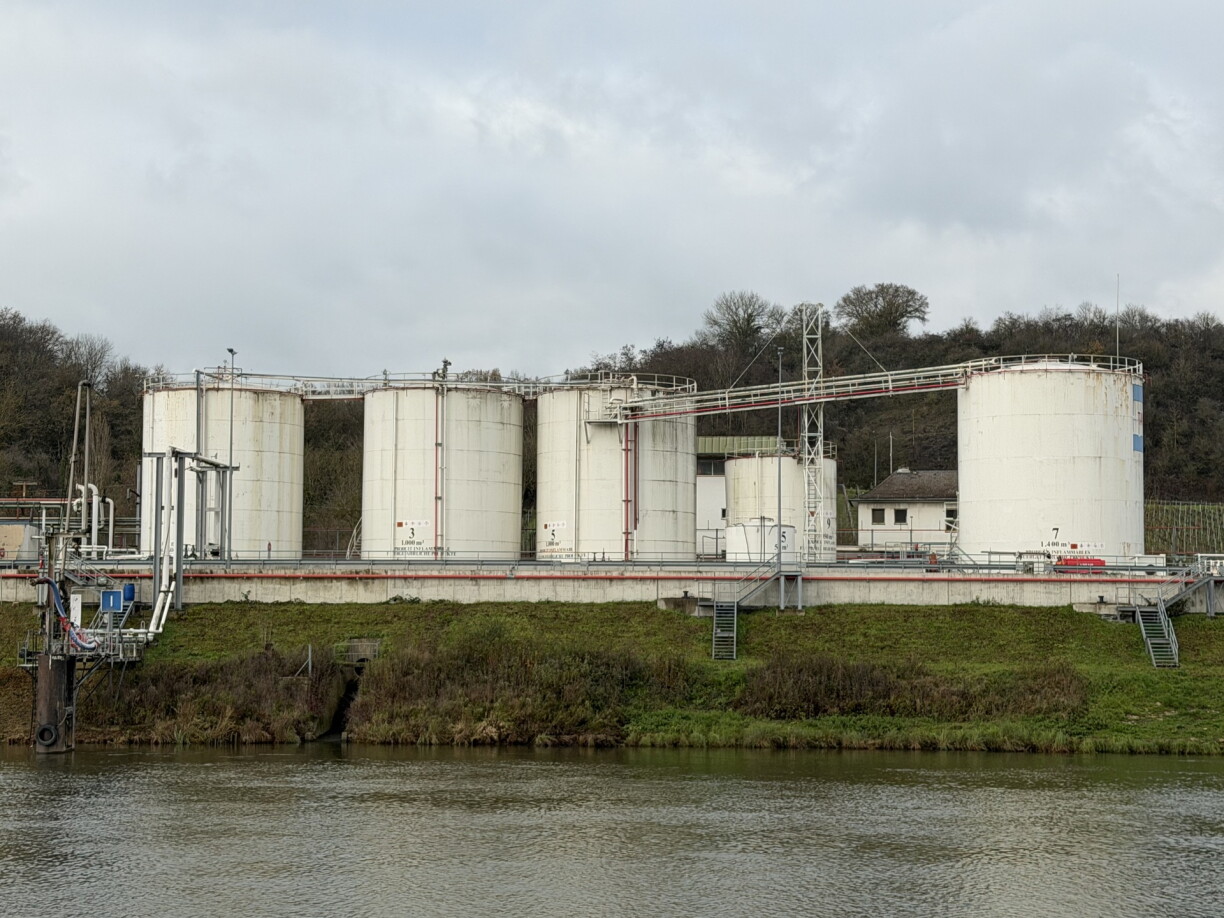
The fuel storage company Tanklux is standing by its plan to expand fuel storage at Mertert port, even as Luxembourg’s overall consumption of petroleum products has been declining in recent years.
Minister for the Economy and Energy Lex Delles said in an interview with RTL that as Luxembourg continues its transition away from fossil fuels, future demand for petrol and diesel, and therefore the required level of reserves, will decrease. Reduced reliance on fossil fuels will naturally lead to "smaller reserve needs".
European Union rules require each member state to maintain emergency reserves equivalent to 90 days of average daily imports, or for oil-producing countries, 61 days of domestic consumption.
Luxembourg, which does not produce oil, currently meets this obligation with reserves covering 93 days.
The EU directive does not require that these reserves be stored domestically. Luxembourg, after Malta, stores the smallest proportion of its reserves within its own borders, about ten days’ worth, primarily at storage sites in Mertert, Bertrange, Dippach, and Leudelange, all of which are visible on Google Maps.
Findel Airport also has storage facilities, mainly for kerosene, which are likewise due for expansion.
Luxembourg maintains a further 45 days of reserves within a radius of 185km. Including reserves kept outside this area brings the total to 93 days.
The amount of fuel corresponding to either 10 or 93 days of reserves is not fixed, but fluctuates in line with consumption.
Data from the National Institute of Statistics and Economic Studies (STATEC) shows that diesel consumption nearly halved between 2014 and 2024, dropping from almost 2 billion to 1.2 billion cubic metres.
Although petrol consumption rose from around 400 million to 545 million cubic metres over the same period, this increase has not reversed the overall downward trend in fuel use.
One factor behind falling fuel sales is a rebate system in Belgium that allows truck drivers to reclaim taxes on diesel, thus making fuel cheaper there compared to Luxembourg.
STATEC data highlights a sharp decline in diesel sales at Luxembourg’s motorway service stations, while other petrol stations saw a less pronounced drop.
Another major contributor is the growth of electric mobility. In the first nine months of this year, nearly one third of new vehicles registered in Luxembourg were fully electric, according to a parliamentary response from Minister for Mobility Yuriko Backes to a question from Déi Gréng (The Greens).
The government is actively supporting the shift to electric vehicles, with the aim of achieving CO2 neutrality by 2050.
Road transport currently accounts for about 57% of Luxembourg’s greenhouse gas emissions, but figures from the Ministry of the Environment indicate a reduction of approximately 6% last year compared to the year before.
The energy transition, including efforts to cut greenhouse gas emissions, is aimed at slowing global warming and limiting extreme weather events caused by climate change.
Since Russia’s invasion of Ukraine more than four years ago and the rise of protectionist US trade policies, European leaders have also prioritised greater energy independence.
From Luxembourg’s perspective, this approach reduces the necessity for large-scale fuel storage.
Luxembourg’s constitution guarantees the right to conduct business. As long as companies comply with regulations, they are permitted to establish or expand their operations, a process referred to as "commodo-incommodo".
Tanklux completed all required legal and procedural steps.
Minister Delles explained that the expansion was initiated by Tanklux itself. The company sees an opportunity in the market and, operating in a free economy, is entitled to pursue its plans.
However, he stressed that the Ministry of Energy did not ask Tanklux to expand the facility; the decision rested entirely with the company.
Tanklux, for its part, stated on its website that the project aims to combine supply security, compliance with legal requirements, and development towards new energy products.
The company maintains that expanding the facility will strengthen Luxembourg’s contribution to European mandatory reserves and enhance regional solidarity and resilience.
With demand for petroleum products on the decline, questions have been raised about the long-term viability of the expansion.
Petroleum products still make up 60% of overall energy consumption in Luxembourg, and the country retains only ten days’ worth of reserves on its own territory.
This situation has sparked debate about whether Luxembourg should increase its domestic reserves for reasons of solidarity, or if it remains acceptable to keep the majority of reserves abroad, as is currently the practice.
It is also noted that local populations in other countries may not be enthusiastic about hosting such storage facilities either.
Sixteen years ago, then Minister for the Economy Jeannot Krecké was asked at a press conference why fuel storage was being expanded even as the energy transition was being pursued.
He responded that while it was impossible to predict the future, Luxembourg could not expect to sell fuel and collect taxes while relying on neighbouring countries to handle storage obligations.
Lex Delles says that now, sixteen years later, the government continues to gradually reduce its reliance on "fuel tourism", including through the introduction of a CO2 tax, which is offset by a tax credit for annual incomes under €80,000 as a social measure.
He acknowledged that the retreat from fuel tourism has been slow, but suggested it could perhaps have progressed faster.
In connection with this debate, RTL will host two guests on Wednesday: Jérôme Laurent, Mayor of Mertert, and Monique Hermes, Mayor of Grevenmacher.


