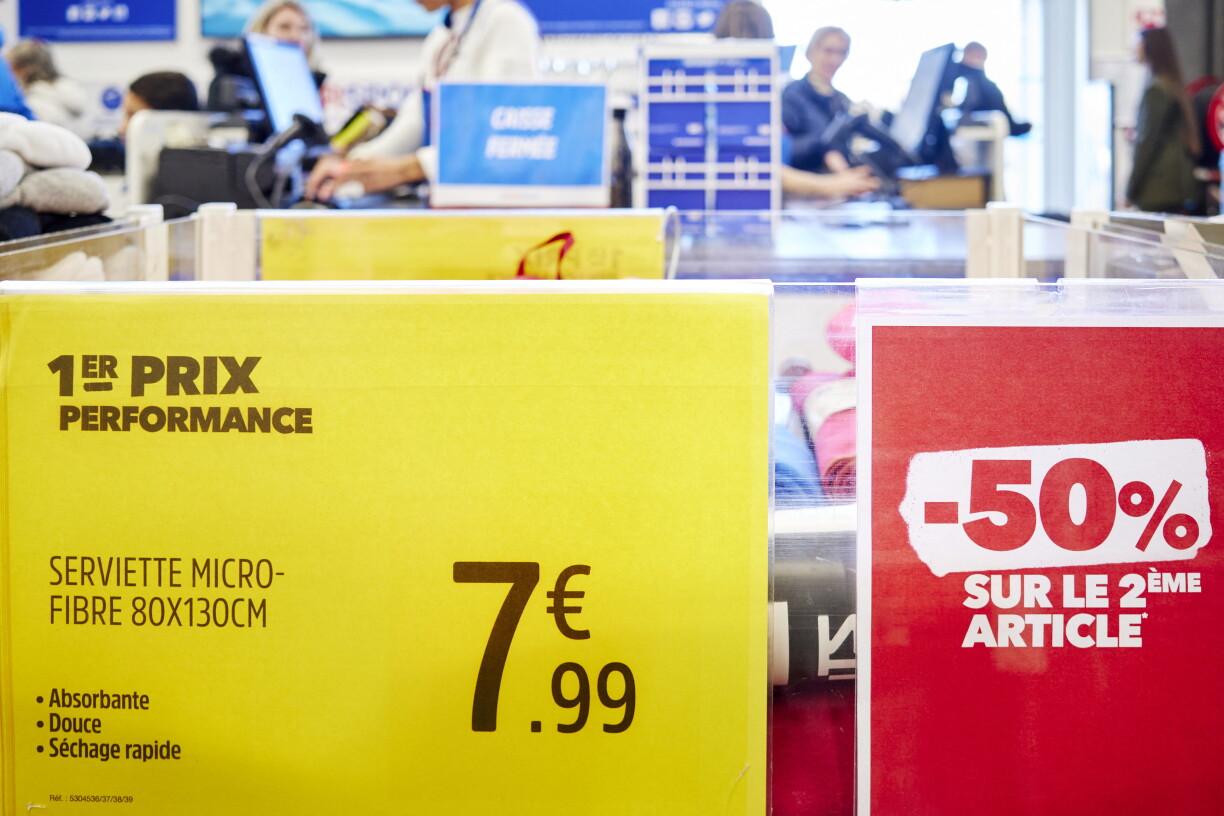
There's a reason to be watchful. Last year, the European Commission coordinated a 'sweep', an EU-wide check, focused on price-marketing practices in online shops across 25 countries, including Luxembourg. The results showed that only 40% of traders fully complied with EU price reduction rules, and among those who used price comparisons, most did not display them properly.
The Directorate aims to avoid this. Its head of enforcement, Patrick Wildgen, explains that their mission is to ensure prices are correctly displayed across the country, whether online or in brick and mortar stores. At any given time, two agents travel from shop to shop, checking whether shops respect consumer protection law.
Among its many duties, the directorate helps negotiate European draft law, which it then transposes on a national level into the Code of Consumption – a framework Wildgen underlines is stricter and clearer than the EU baseline.
In 2025, the Directorate, which is attached to the Ministry of Agriculture, Food and Viticulture, received 494 consumer complaints, 24 of which specifically concerned price displays. As of 31 August, complaints in 2026 had reached 439, of which 36 related to price displays.
Whether a sale is ongoing or not, the principle is simple: a consumer should instantly know what an item costs, without having to ask – whether it is a service or a product.
Beyond requiring an unequivocal, easily identifiable and legible price, the law reserves particular scrutiny for discounts. Under a rule adapted from the Omnibus directive, when a discount is shown, the previous price must be shown too – and that reference price must be the lowest price applied in the 30 days before the sale began.
The measure exists to stop traders from quietly raising a price just before a sales period, and then "cutting" it back to normal, tricking shoppers into thinking they are getting a deal.
Then there are unfair commercial practices, for which consumers should watch out, including those where a consumer could be pushed into a purchase they would not have made had they held the correct information.
Highlighting a sale is not illegal, Wildgen stresses. What matters is that the information and the way it is displayed is accurate.
The possible consequences of breaking these rules on a large scale became clear in 2024, when the European Court of Justice found that the German grocery chain, ALDI Süd, breached consumer law by advertising discounts through inflated sales prices. A case of that magnitude would be improbable in Luxembourg, Wildgen explains – Germany has particularly active consumer protection organisations that do not hesitate to go to court as soon as new, stricter legislation is adopted.
Luxembourg works differently. "We don't have that culture of going to court", he underlines, adding that the Ministry and Directorate would rather businesses respect the rules and adapt upon being made aware of mistakes.
The directorate's agents stay vigilant. Traders, Wildgen points out, are more often than not receptive and make the necessary changes when asked to. Prices are added when they are missing without having to directly resort to sanctions.
The same applies online, shops are sent an official notice, and often come back to the directorate to know what exactly should change.
For international chains with Luxembourg locations, little changes. "Anyone who owns a shop here in Luxembourg must have an establishment authorisation", Wildgen says – which requires an administrative presence in Luxembourg as well as a manager responsible for the Grand Ducal locations. "We have actually never had a problem reaching anyone."
His advice to shoppers is to document anything they suspect could breach their consumer rights and report it – ideally by keeping receipts and taking pictures. Where no proof is attached, the trader is still notified of the complaint and an agent follows up, though often the mistake has already been fixed by then.
The authority also raises awareness among professionals by offering a "Guide for the retailer", clarifying an otherwise dense legal framework, through simple information sheets and checklists.





