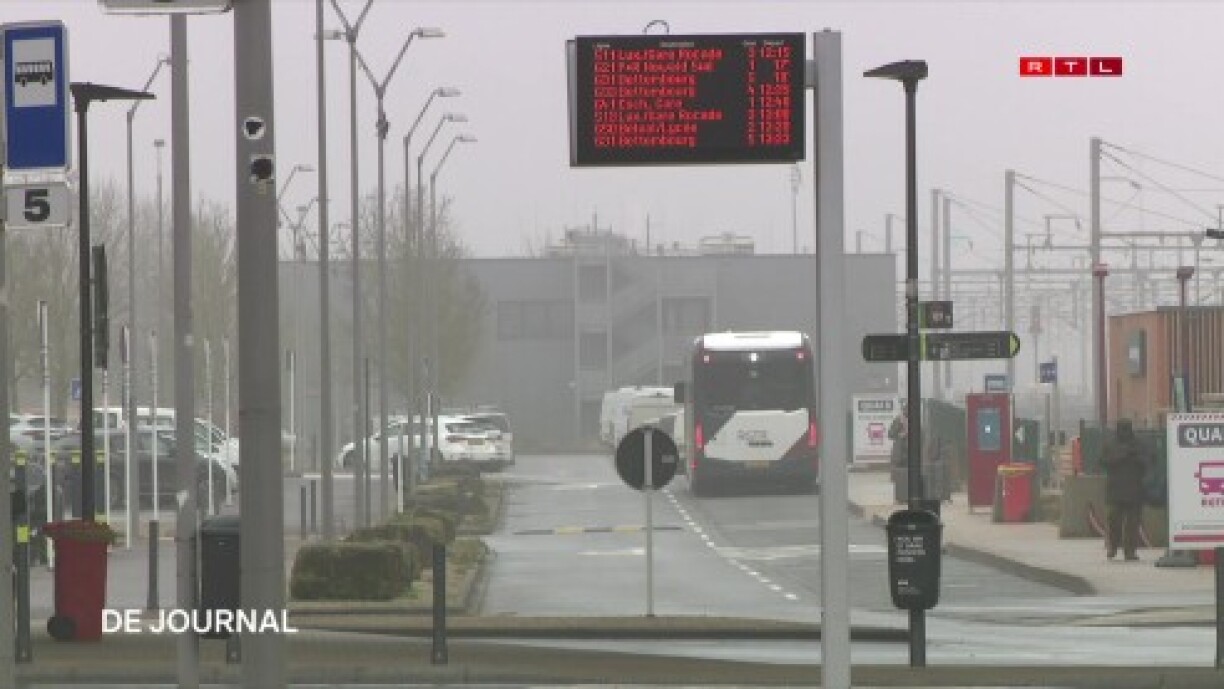
A new government bill seeks to enhance safety on Luxembourg’s public transport networks amid a rise in verbal aggression, according to official statistics. While reports of physical assaults remain relatively constant, incidents of verbal abuse are increasing.
On the Luxembourg City bus network (AVL), the overwhelming majority of incidents involve verbal abuse, primarily insults. In 2025, there were 163 reported acts of aggression against drivers, 152 of which were verbal.
While the figure may seem high, Patrick Goldschmidt of the Luxembourg City Council provided context, noting it averages to less than one incident per day across the entire network. The AVL fleet includes both its own buses and those operated by subcontractors, and Goldschmidt outlined several measures in place to address aggression.
“In the tender documents, it is made clear that training is important, specifically anti-aggression training”, he said. Subcontractors are also required to report all incidents. “And we're finding that the subcontractors report a great deal. And that's a good thing”, Goldschmidt added.
Additionally, AVL buses are equipped with emergency buttons. When activated, police or a municipal agent are typically on the scene within two to three minutes.
A key point of discussion is the installation of protective safety cabins for drivers. The Independent Luxembourg Trade Union Confederation (OGBL) is demanding their implementation to shield drivers from being physically assaulted or spat on.
Goldschmidt stated this measure is unnecessary for Luxembourg City buses. “We don't need them in Luxembourg City”, he said, explaining that cabins are more suited to rural routes with longer distances between stops. He noted the debate has persisted for over a decade in the capital and that, “a priori”, local unions have not demanded them.
The approach differs on the national RGTR network, where contracts stipulate that every new bus must be equipped with either a cabin or a protective screen. The Ministry for Mobility and Public Works confirmed it is examining installation methods.
However, implementation faces hurdles. There is no universal standard for this equipment, as designs vary by manufacturer. “Retrofitting older buses with protective screens is not technically possible on all models and therefore cannot be implemented across the board straight away”, the ministry stated.
As of January, approximately 59% of all RGTR bus journeys were reportedly operated with some form of protection for the driver.
Security on Luxembourg City’s tram network has been bolstered since August by agents from an external company, who support staff both at termini and on board the vehicles.
Helge Dorstewitz, Director of LuxTram, expressed satisfaction with the initiative. While acknowledging that it does not prevent all acts of incivility or aggression, he believes the measure leaves LuxTram “quite well-equipped.” Dorstewitz did not rule out hiring “one or two” additional security agents but confirmed that no major changes to the current strategy are planned.
The broader legislative response comes in the form of Bill No. 8335 from the Ministry for Mobility and Public Works. The proposed law aims to establish a national guideline for public transport staff, clarifying how to handle incidents of aggression.
According to a written statement from the ministry, the bill will introduce a standardised system for enforcement. “For the first time, there will be a concrete catalogue of infractions with precise fines. The rules of conduct on public transport will therefore be very clearly defined, so that everyone knows what is and isn't allowed. A clear system of checks, on-the-spot fines, and fixed penalties will be introduced”, the statement explained.





