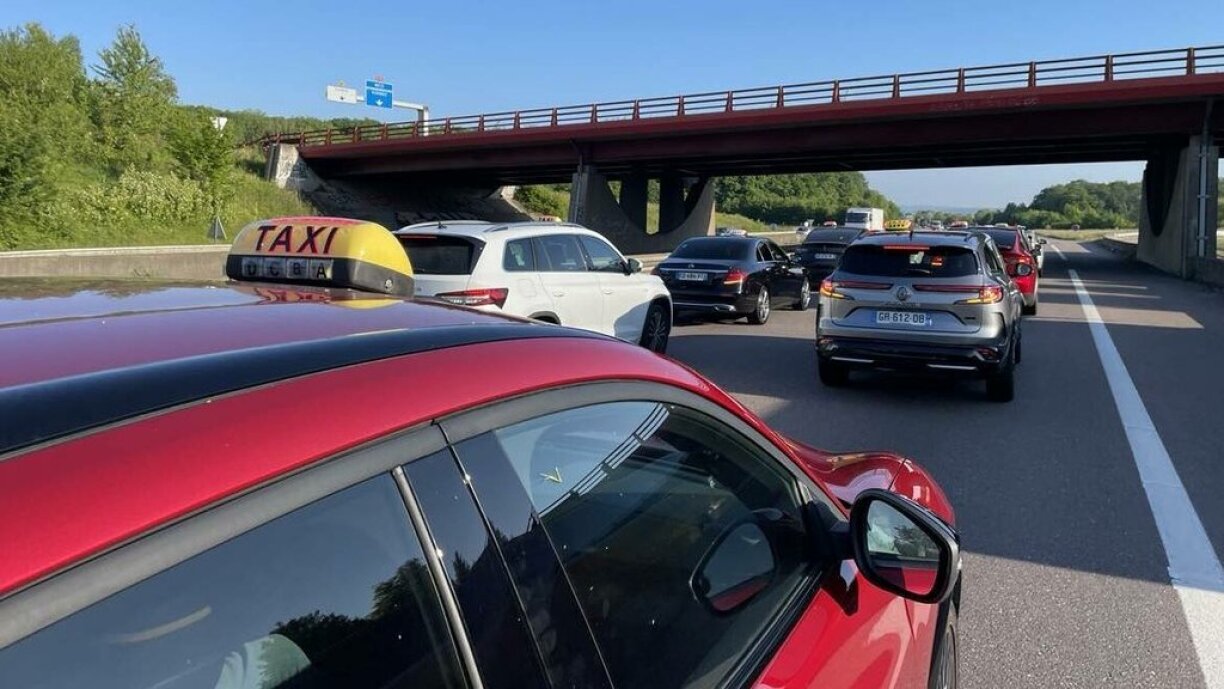
The Moselle region has been affected by a nationwide protest movement organised by the National Taxi Federation (FNDT), which planned to block several key roads across France.
Taxi drivers are once again taking to the streets to oppose a proposed pricing reform from the national health insurance system, which would affect how medical transport is reimbursed for licensed taxi drivers.


This marks the eighth demonstration in recent months, reflecting their deep concerns over the impact of the proposed changes.
A go-slow protest that had been announced for 6am on the A31 between Moulins-lès-Metz and Thionville, as stated by the Moselle prefecture the night before, got underway around 7am.
The prefecture had specified that the protest would affect traffic in both directions. Taxi convoys set off from Metz, Thionville train station, and Bel Air Hospital.
The prefecture had warned that the protest would have a significant impact on traffic. Indeed, a major traffic jam stretching several kilometres was observed by RTL around 7.20am near Richemont, heading from Metz towards Luxembourg.
Commuters, particularly cross-border workers, are advised to make arrangements to avoid getting stuck.
The scale and consequences of the protest remain uncertain and will depend on several factors, including how long it lasts. According to radio station ici Lorraine, the demonstration could continue throughout the day.
The National Taxi Federation confirmed the protest through an official statement, citing frustration over the proposed pricing model and the perceived lack of accountability for ride-hailing platforms like Uber.
Protests are expected across much of the country, especially in major urban areas. Demonstrations are set to take place in Paris on Boulevard Raspail – close to the government ministries – as well as in Pau, the hometown of Prime Minister François Bayrou, according to FNDT secretary Dominique Buisson, speaking to AFP.
In Paris, demonstrators plan to gather daily on Boulevard Raspail starting at 7am. The road will be closed to traffic for the duration of the protests.
The new pricing model is still pending government approval but is scheduled to take effect on 1 October, according to the national health insurance agency.
Currently, around 85% of taxis provide reimbursed medical transport, and in some rural areas, this can make up to 90% of a driver's income, according to FNDT’s Dominique Buisson.





