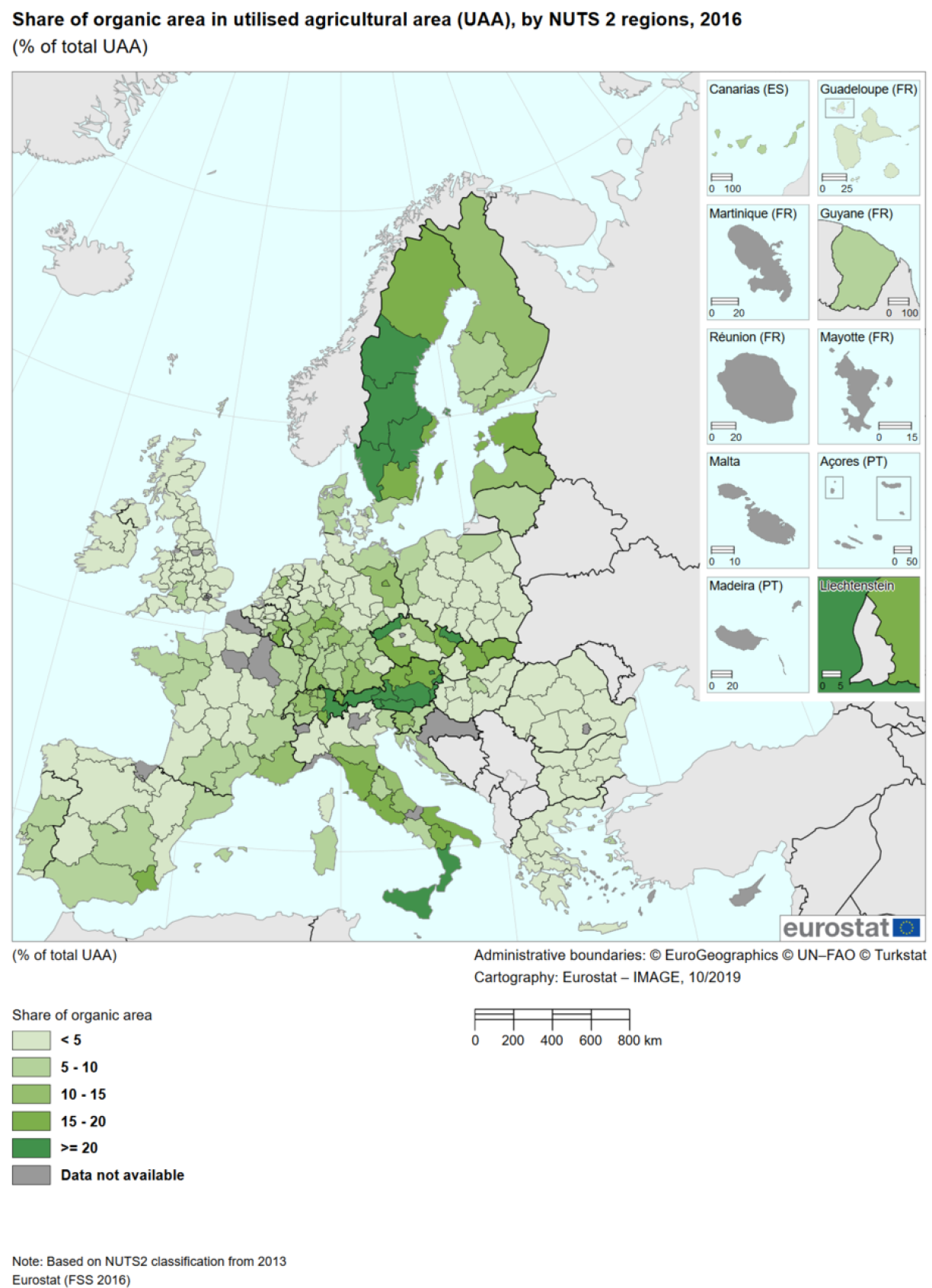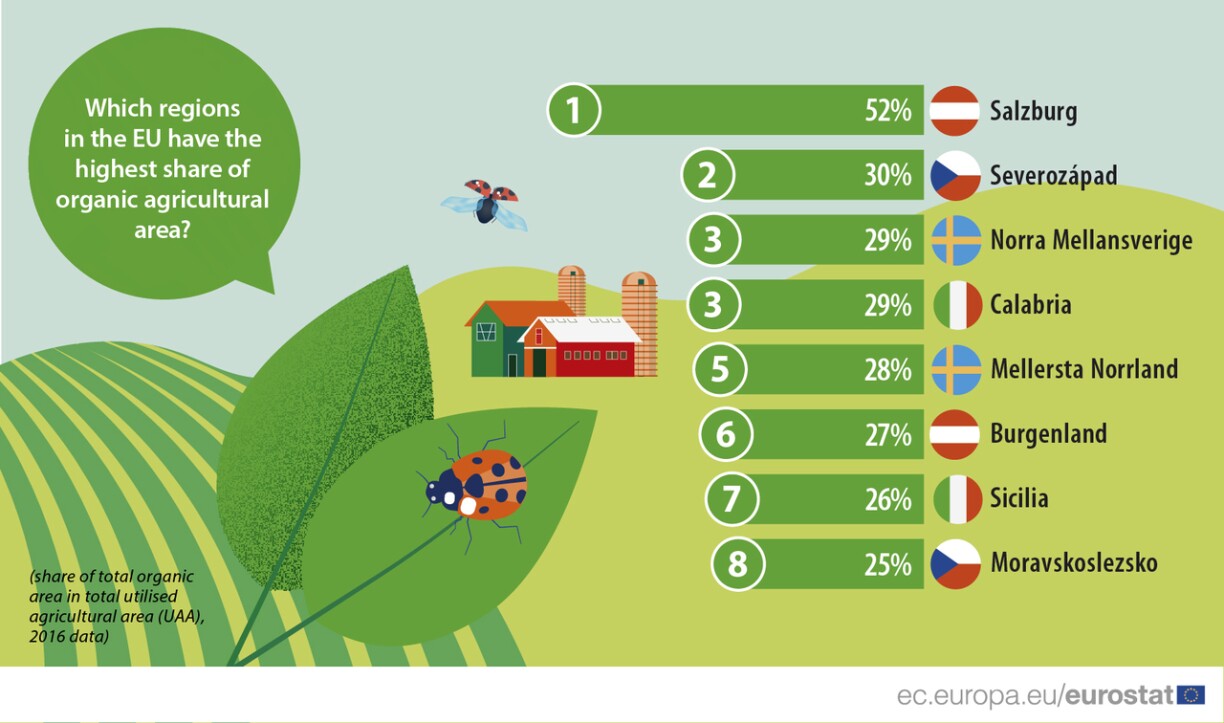
The extent of organic farming depends significantly on the given EU region. According to Eurostat, the highest share of organic farming was reported in the Salzburg region of Austria: 52% of the total agricultural area was used for organic farming in 2016.
There were a further seven regions where organic farming accounted for upwards of one quarter of total utilised agricultural area: Severozápad in Czechia (30%), Norra Mellansverige in Sweden (29%), Calabria in Italy (29%), Mellersta Norrland in Sweden (28%), Burgenland in Austria (27%), Sicilia in Italy (26%) and Moravskoslezsko in Czechia (25%).
Compared with 2013, the largest increase in share of organic farming was observed in Calabria in Italy and Salzburg in Austria, closely followed by Sicilia in Italy and Région de Bruxelles-Capitale in Belgium, as well as Åland in Finland.
Only 3.5% (4,540 hectares) of agricultural lands in Luxembourg are used for organic farming. In the Lorraine region, the percentage lies at 5.1% while the Belgian province of Luxembourg even attains 19.9%. In the Saarland region of Germany, surfaces used for organic farming make up 15% of agricultural lands.