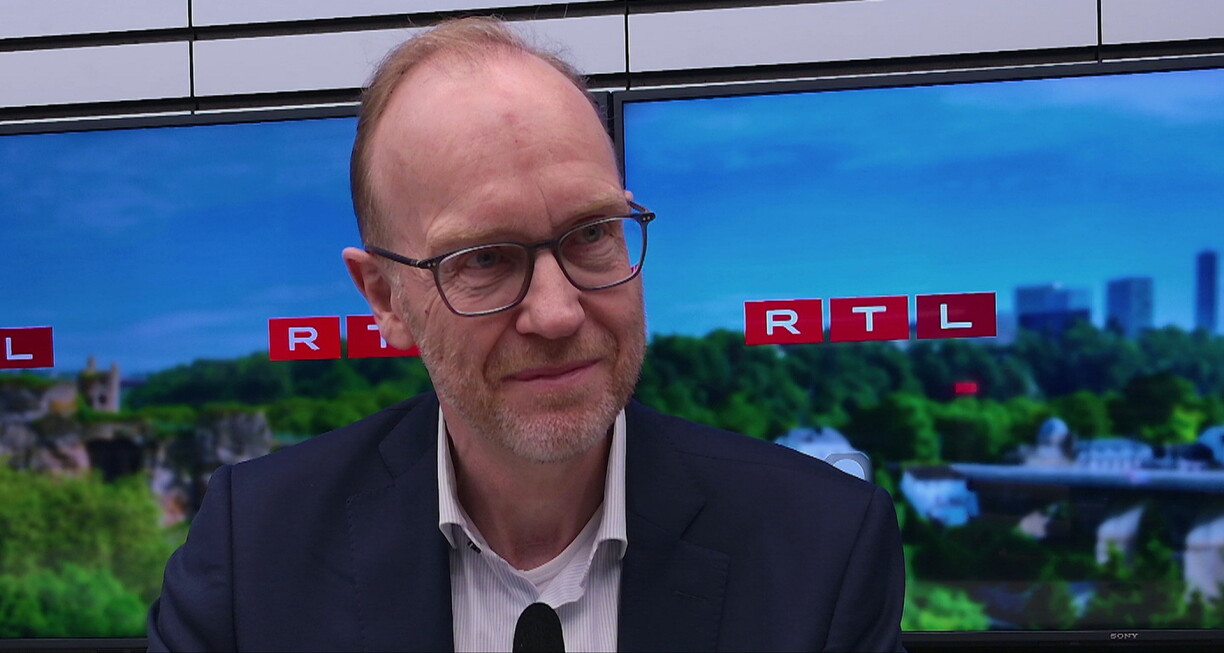
Luxembourg can be proud of its multilingualism, said linguist and scientific director of the Leibniz Institute for the German Language in Mannheim, Prof. Dr. Henning Lobin. While the Grand Duchy has made great efforts to anchor the Luxembourgish language in society, the professor is concerned about language use in times of AI and digitalisation.
For a linguist, Luxembourg is something of a paradise. For example, the Luxembourgish language has developed from a dialect into a national language and thus also has a major identity function, rendering it a rarity in recent European history. But Luxembourg is also unique because of the many different languages spoken in the country.
According to the 2021 census, only 49% of residents indicated that Luxembourgish was their main language. This is a decrease of 7 percentage points compared to 2011. However, this is no reason to worry, says Professor Lobin:
"In Luxembourg, I think, you are aware of the challenge to a very high degree, due to this multilingual nature. And I believe that this also leads to the fact that you also have experience and have a good and pragmatic view of the measures that are necessary to deal with such challenges."
The different languages in Luxembourg are used functionally and simultaneously, rather than geographically, as in Belgium or Switzerland, for example.
Multilingualism is a strength, but it also has its limits. When it comes to teaching children to read and write in different languages, the linguist considers the risk of children becoming divided into separate language groups to be relatively low:
"At the same time, we cannot ignore the fact that there are different linguistic backgrounds, and families speak different languages of origin. These differences must be reconciled with the realities of the school system to ensure that children are offered the best possible opportunities to grow up multilingual."
Language is a living thing: In times of "ragebait", "peak", and "cringe", language is constantly adapting, particularly through the digital space. It is not up to linguists to determine whether a new term is necessary or not, explained the professor, as that is decided by the use of language itself.
Lobin sees a challenge, however, in artificial intelligence. If the AI writes and summarises texts, the language will no longer be sufficiently practised:
"Language can only truly become firmly established in our brains if we practise it. This is particularly true of written language. We naturally practise spoken language in everyday life, but written language, its forms and structures, requires deliberate practice. That is what we learn throughout our school years and continue learning afterwards. If these activities are partially, or perhaps increasingly completely, replaced by AI technologies, then something important is lost."
Keeping young people away from screens is a key challenge here.
Professor Lobin was visiting Luxembourg to attend an exhibition at the Centre for the Luxembourgish Language titled
"Lëtzebuerger Sprooch(en)" (Luxembourgish Language(s)).





