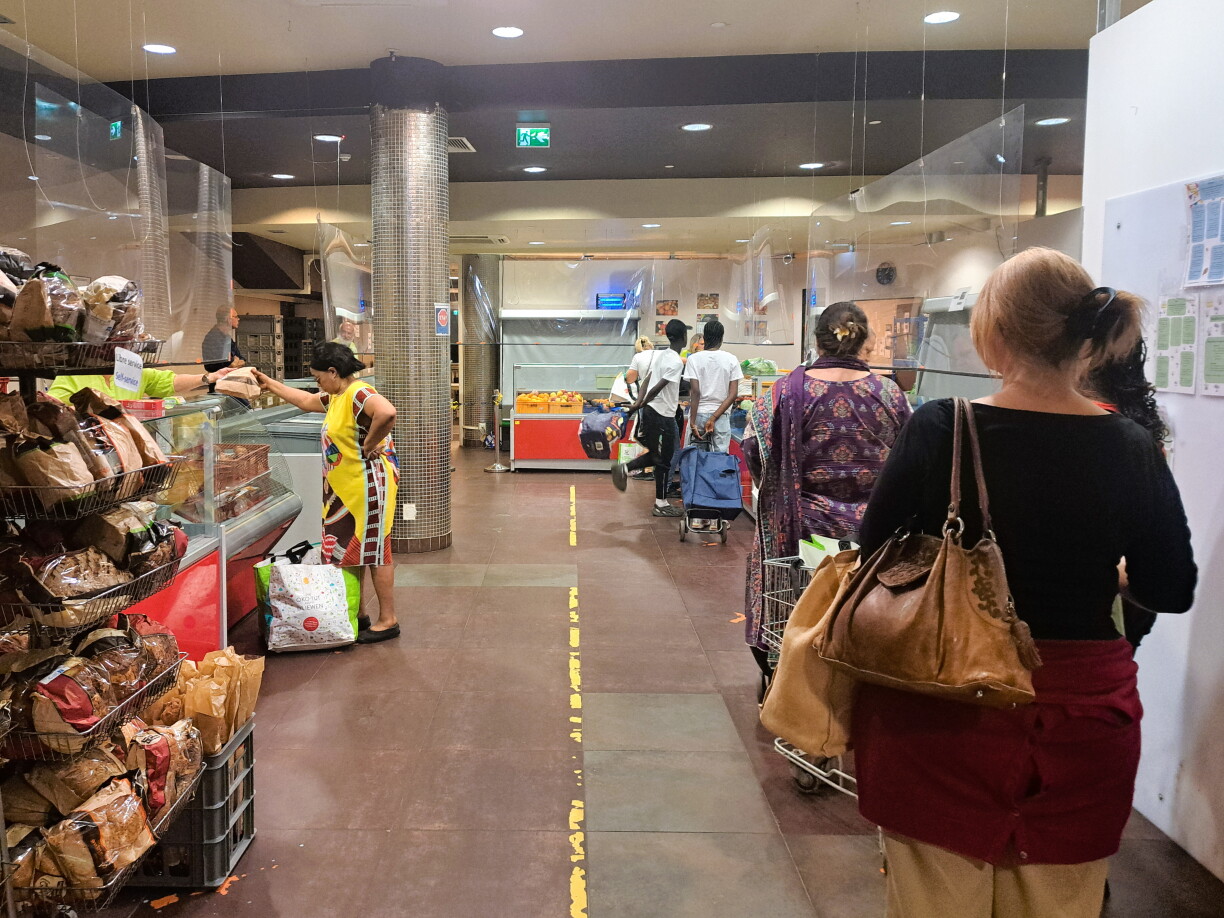
What does social work look like in Luxembourg? In our summer series 'Between Prevention and Emergency', we take a closer look at the country's social services. For the first instalment, we visit the Cent Buttek in Bettembourg, a social grocery shop run entirely by volunteers.
Twice a week, Luxembourg's largest 'Cent Buttek' (cent shop) opens its doors in Bettembourg. Even before the shop opens at 2pm, people can already be seen waiting outside.
One father of two explained that people do not arrive early because they fear there will be nothing left, but because they hope for a wider choice.
The volunteers working at the shop have to carefully divide up what is available. If the cheese counter is well stocked, for example, the first customers can be offered more.
When supplies are limited, volunteers have to estimate how many people are still likely to come and make sure enough is kept aside, even if that means those arriving later have fewer options.
Around 80 people visit during a typical afternoon to shop for their families. According to Monique Richter, who has been involved with the Bettembourg shop for 15 years and is now responsible for running it, numbers peaked during the pandemic, when as many as 120 people came through the doors in a single day.
Richter volunteers around 20 hours a week, and there is no shortage of work to be done.


For fresh products in particular, 'Cent Buttek' relies heavily on participating supermarkets donating food approaching its use-by or best-before date.
Drivers such as André Eiden are responsible for collecting those products. Having volunteered with the organisation for many years, he has noticed that the amount being donated has fallen recently. Supermarkets are buying more precisely and are also increasingly trying to sell products through promotions before donating them.
"When we get the goods, they really are right at the end, when they have to be taken off the shelves", Eiden explained.
Sorting everything after collection is therefore an important part of the work. Richter said around 15 volunteers may be on site in the morning, followed by another 12 in the afternoon.
In total, around 60 volunteers take turns helping at the Bettembourg branch.
Across the association's three shops in Bettembourg, Luxembourg City, and Pétange, around 130 volunteers are involved. Most are retired, according to Romaine Goergen, vice-president of the Cent Buttek association.
"We naturally lose people because of age, when they become too old or can no longer lift very much", she said. That means we are always dependent on finding new volunteers."
René Casagrande was one of those newcomers three and a half years ago. Speaking from behind the counter during a quiet moment, he said many customers remained understandably reserved about their personal circumstances.
But, he added, people do not necessarily come only for the food. "They also come for the social side of it, just to exchange a few words. That's nice."
The social grocery shop is therefore more than simply a place to pick up food.
Nearly 500 families visit the Bettembourg branch each month, according to association president Arthur Besch. Across all three locations, the figure rises to around 900 families, with the shops supporting approximately 5,600 people in total.
Customers can shop for themselves and their families twice a month. In Bettembourg, only one adult per household is allowed into the shop at a time, which means relatives can often be seen waiting outside to help carry the groceries home afterwards.
That makes accessibility particularly important, both volunteers and beneficiaries agree, especially for people arriving on foot or by public transport.
The municipal authorities of Bettembourg confirmed to RTL that the Cent Buttek will remain in its current central location near the railway station for the foreseeable future, with its lease having been extended.


Eligibility to shop at Cent Buttek is determined by the local social welfare office.
According to Richter, officials assess how much money a household has left at the end of the month after fixed costs such as rent have been deducted.
Eligible households receive a card, which must be presented at the entrance. When scanned, the system registers only an anonymous number and tells volunteers how many people the customer is allowed to shop for.
The household's situation is reassessed every three months, with the card renewed where necessary.
The Bettembourg branch serves residents from several municipalities. Older people, single parents, and large families are among those most frequently relying on the service.
Customers at the shop expressed considerable gratitude for the support. Some have been coming for years, while others only began using the service a few months ago.
For Casagrande, however, the best outcome is when someone no longer needs to return.
"The best moment is when people have been coming for a while and then tell you that it's their last day", he said. "It means they've found a job, they're earning enough and they no longer depend on coming here. That's the goal."





