Luxembourg offers the lowest fuel prices across the Greater Region, with the additional unique feature of identical prices at all the country's service stations. In neighbouring France, for example, the price of diesel varies by several cents, or more, depending on the station. In Luxembourg, it's quite different: whether in Belval, Troisvierges, or Grevenmacher, all stations adhere to the "maximum prices" set by the government.
Admittedly, a few rare stations deviate from the rule, but only symbolically. For example, Lukoil in Remich usually sells its fuel one cent cheaper than elsewhere. The new BC Energies station in Remich was offering diesel at €1.939 instead of €1.95 on 18 November, saving just 55 cents for 50 litres of fuel.
But recently, a newcomer to the Luxembourg market has been shaking things up: Leclerc. The French retailer is offering up to 21 cents per litre less than other service stations, according to price data taken from 14-15 November. The biggest discount was on diesel, which was sold for €1.779 (compared to the maximum price of €1.987). SP95 unleaded was sold for €1.419 instead of €1.595, saving consumers nearly €10 on a full tank.
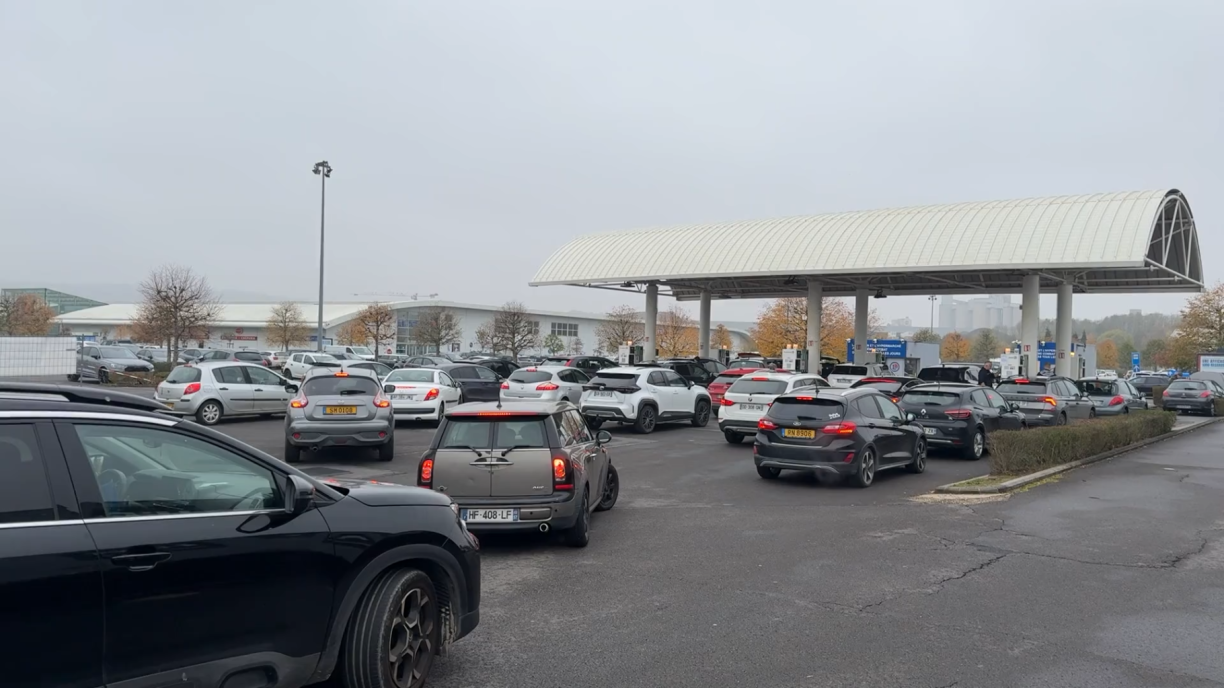
Those who benefit the most are cross-border commuters. On the morning of Saturday 14 November, a large majority of French license plates could be seen at the Leclerc station. And some had travelled quite a distance: "We came from Haute-Marne, two and a half hours from here," says Geoffroy, petrol cans in hand. "I often come for gas and tobacco, and now I stop here. It's much cheaper," explains Isabelle, who drove three hours from Troyes.
These are exceptionally long distances, of course, and the majority of people come from places closer to the border, such as Metz or Thionville. With savings of 50-60 cents, it's understandable. During the first few weekends the offer was in place, massive traffic jams caused chaos in Foetz. A one-way system had to be implemented to prevent another wave of overcrowding. "These low prices are great, but they bring in a lot of people, especially cross-border commuters," complains Armando, a student from Luxembourg.
But the traffic does not discourage many motorists, who are ready to wait as long as it takes to save money: "With the standard of living we have, we have to make the most of every penny!" says stay-at-home mother Ana.
The French retailer has been offering this sales strategy almost every weekend since September, with increasing frequency. "These prices are a choice made by our store here. It reflects the Leclerc brand, since it allows us to offer attractive prices to bring in customers," explains Stéphane Canossini, director of the Leclerc Foetz store.
One of the goals is to attract new customers, particularly cross-border commuters but not exclusively, by offering promotions on fuel or other types of products at lower prices. As an exception, the offer was even extended to Wednesday 11 November, a public holiday in France. But how can the retailer justify such low prices? While a difference of 1 or 2 cents from the maximum price doesn't significantly affect a petrol station's revenue, the impact of a 20-cent difference must surely be hefty.
"Quite simply, we don't make any profit," says Canossini. "We sell it at the purchase price, plus the cost of transport and VAT." This PR move seems to be working, and Canossini intends to continue the promotion at least until the end of the year.
Since its introduction in the Grand Duchy in 2024, the French brand has relied heavily on its social media for advertising. The announcement of the low prices every weekend provoked numerous reactions of all kinds on the store's Facebook page: "Is this AI?," asked one user, while another suggested the fuel was "Diesel cut with water?"
The prices are certainly hard for some to believe, particularly French readers imagining the service station to be in France. But social media combined with word of mouth has made the place famous. "It attracts a lot of people to our hypermarket, but also to Foetz in general," the manager concludes.
But why is the Leclerc petrol station the only one displaying such prices ? Is it permitted? RTL Infos contacted the Luxembourg Energy and Mobility Group (GEML), which represents most of the country's active oil companies.
However, Leclerc isn't listed. "We're not aware of any specific reason," GEML secretary general Jean-Marc Zahlen cautiously replied. He declined to comment specifically on Leclerc's entry into this market. "GEML has no insight into Leclerc's commercial strategy or its purchasing structure."
He explains, however, that "the number of service stations has remained relatively stable over the last few years, around 230 to 240 stations," although the energy transition "will continue to fundamentally change the sector." This includes the surge in electric vehicles, which is forcing service stations to adapt to new demand.
The maximum prices charged in Luxembourg are calculated based on several parameters: the cost of the product leaving the oil refineries (based on international quotations, the exchange rate between the euro and the dollar, etc.), as well as distribution costs (transport, logistics), excise duties and VAT.
But while Luxembourg service stations are not authorised to sell above the maximum price, "each operator is free to set prices below the maximum price, provided they respect the legal framework," Zahlen explains.
So why don't they? Eric Bleyer, president of GEML, says it is difficult to replicate a model like Leclerc's: "This operator can attract customers to its hypermarket to make profits. But it's a difficult approach for most service stations to achieve."
Does this mean there is some form of collusion between distributors to agree on the highest price? No, replies the Secretary General: "GEML has no oversight of the prices charged by member companies or their commercial strategies. Any anti-competitive agreement is obviously illegal. In Luxembourg, as in the European Union, agreements between companies that have the object or effect of distorting competition are prohibited."
He continues: "To my knowledge, there are no decisions or sanctions from the competition authority" on anti-competitve agreements. As recently reported in Le Quotidien, "while anti-competitive agreements led to sanctions against oil companies in France and Italy in 2025, we found no trace of a similar decision in Luxembourg."
It remains to be seen whether Leclerc Foetz will remain an exception in the well-disciplined market of service stations in Luxembourg, or whether others will imitate this strategy to increase footfall.


