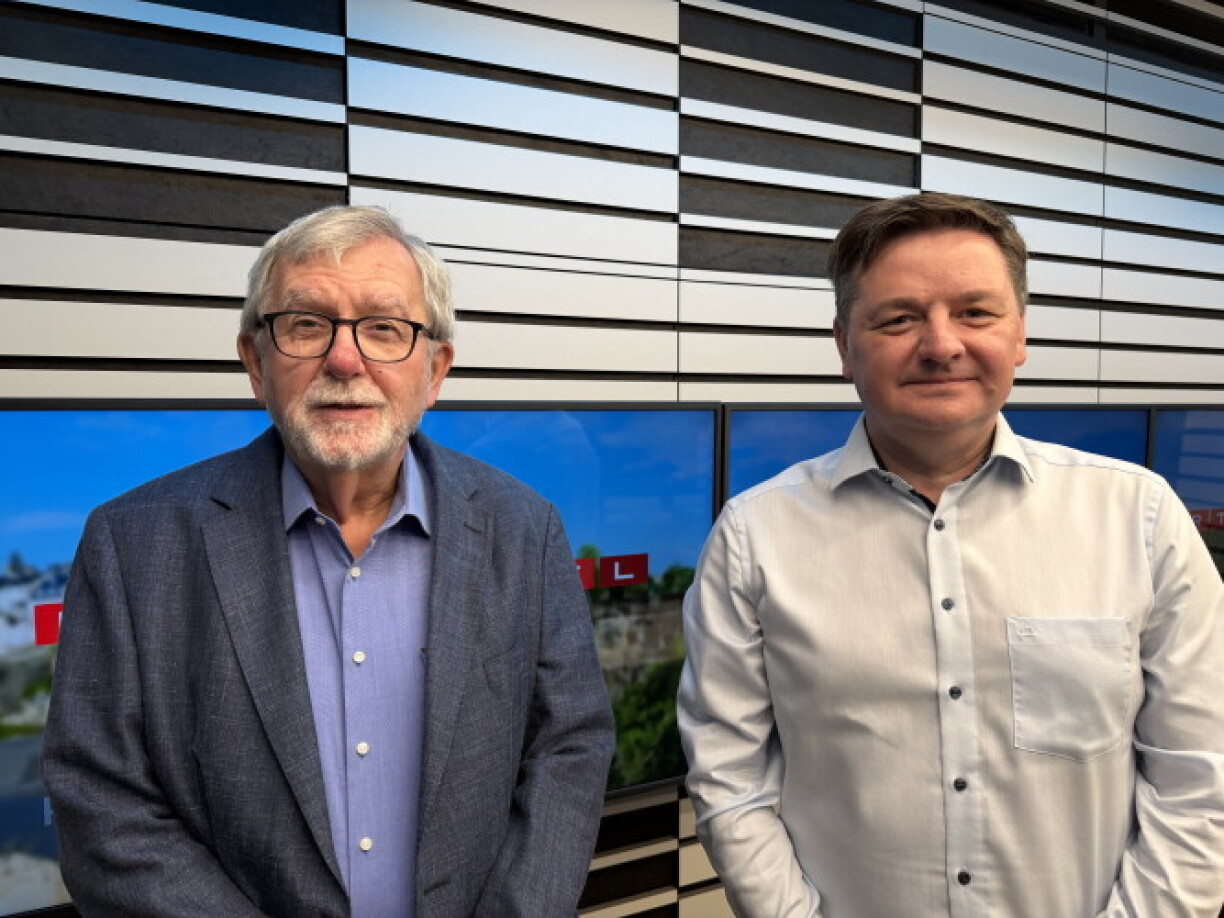
The former director of the Finance Ministry's Inspectorate of Finance (IGF) sat down with RTL on Saturday. The conversation covered plenty of ground, from cracks in the state budget, a swelling public sector and sluggish productivity to capping the index, the Grünewald forest debacle, the workings of the monarchy and the state of the country's rail network.
With Jeannot Waringo, who also spent more than four decades helping to steer Luxembourg's railway strategy and was called on by the previous government to examine the organisation of the Grand Ducal court, the topics never run dry.
Sometimes a sacred cow has to be prodded to keep it alive. That, in essence, was Waringo's message on Saturday about the country's index system.
In theory, every salary, however high, should be adjusted in line with inflation. As far as Waringo is concerned, however, it is time to have a proper conversation about capping the index. Above a certain salary threshold, he suggested, workers could reasonably do without the automatic bump. Waringo described it as a gesture of solidarity.
The Christian Social People's Party (CSV) and Democratic Party (DP) government, according to the former IGF director, has handled the cyclical crises and the economic knock-on effects of the current wars well, through a raft of measures. It nevertheless has to face up urgently to the country's structural problems, from the climate crisis and an ageing population to housing and the risk of poverty, in a sensible way. It is also time, he said, to bring the public finances back into balance. The state deficit, which is not coming down, worries Waringo.
In his view, you could even talk of a two-tier society opening up between civil servants and workers in the private sector. That, he said, is a worrying trend, since some 10,000 extra civil servants have been added to the payroll in the space of ten years, putting real strain on the budget, while private employers simply cannot match those starting salaries.
For that reason, Waringo has argued for an evaluation-based system within the state, in which pay would not need to sit at a high level from the outset but could be improved through performance-linked bonuses. At Luxembourg's rail company CFL, he pointed out, that model works well, according to the former CFL president.
Waringo, who wrote the special report on the court, finds that the Maison du Grand-Duc, which was created in the wake of that report, works well as an administration. He is a monarchist, he said, and the monarchy gives the country stability.
He nevertheless finds it a pity that Grand Duke Guillaume is now asking for an early return of the Grünewald back, which is 850 hectares of forest. He would have expected more tact from the Grand Duke and his advisers on that question. The government, he said, had responded well, and does not intend to terminate the Grünewald forest convention before 2034.
He also finds it a shade regrettable that he was never thanked by the Grand Ducal family, even though he had, in his view, helped the monarchy along the road to modernisation with his report.
A direct train line between Luxembourg and Brussels, however sorely needed, looks like a train that has left the station, with the former CFL president no longer really believing it will ever come off. Waringo said he was a little disappointed that the chance to build a fast route along the Saar motorway had slipped through the country's fingers.
Jeannot Waringo spoke to RTL on his 74th birthday. He was born in Luxembourg City on 11 July 1952. Engaging with people has always been important to him from the very start, beginning with his father, a craftsman who ran a small workshop in Mondorf-les-Bains, where he mixed with plenty of locals. Later at the Ministry of Finance and, in particular, at the railways, Waringo always enjoyed working alongside others. During his time examining the court, he was also able to have a meaningful conversation with Grand Duke Henri. But what passed between him and the Grand Duke in that private exchange, Waringo intends to keep to himself.





