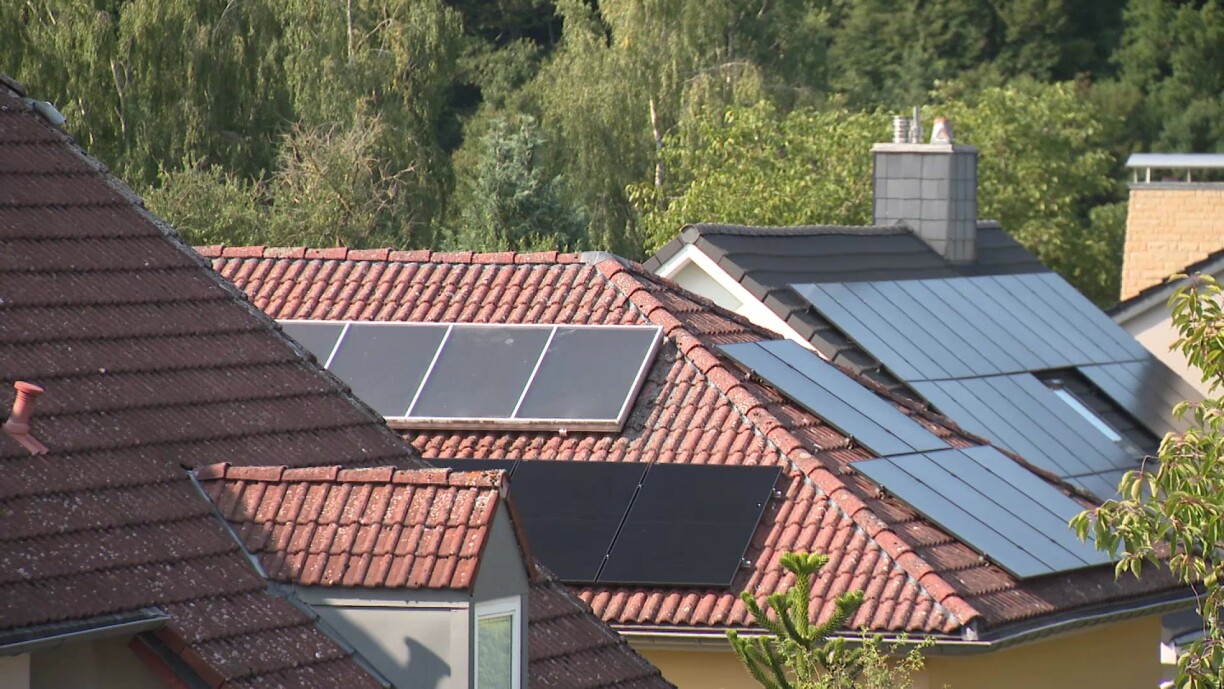
In Blaschette, a village of about 500 residents in the municipality of Lorentzweiler, solar power isn’t just being generated, it’s being shared among neighbours. Thanks to a 2023 change in the law, households can now band together in "energy communities", pooling their renewable energy production. Blaschette has four such communities already.
The first was founded last year by seven friends – an idea, they admit, that was born "over drinks". "We decided to set this up together", recalls the group’s president, André Degraux. For Degraux, who works at the Climate Agency, the concept was a natural fit.
The small founding group began handing out flyers, gradually winning over more residents. Today, more than 40 households are part of the initiative.
In Blaschette’s energy communities, participation isn’t limited to those with solar panels on their own roofs. Anyone can join – the only requirements are living within 300 metres, sharing the same grid operator, and forming a legal entity such as a non-profit or cooperative. Members also avoid grid fees, making the model even more attractive, says Andy Hendriks, treasurer of the Blaschette Energy Community.
"Sharing electricity is always a win-win", notes Sarah Juchems from the Climate Agency. Producers feeding power into the grid today receive only a modest payout, while consumers can access electricity at prices below the market rate. The goal, Juchems explains, is also to take pressure off the wider power grid.
Within the community, the roles of producers and consumers aren’t fixed. Even households that usually produce surplus power sometimes draw on their neighbours’ supply. "If my solar panels aren’t generating enough at the exact moment I’m charging my electric car, the extra I need comes from the rest of the group", says community president André Degraux.
No changes are needed to the electricity metre to participate. The digital metres everyone now has transmit consumption data every 15 minutes. "What I’m producing at that moment and what my neighbour is consuming is simply offset against each other", explains community president André Degraux. Members can track production and consumption almost in real time through the Leneda platform provided by Creos.
The community sets its own electricity price, and each group can decide how power is allocated: by percentage, proportionally to consumption, or by prioritisation, says Sarah Juchems. In Blaschette, the Energy Community agreed on 14 cents per kilowatt-hour for one year, eliminating network costs of 7.5 cents.
Electricity billing is handled annually by treasurer Andy Hendriks. "We don’t have much experience yet, but with the data from the grid operator, it looks manageable within the committee", he says. Projects like this, he adds, can also help bring neighbours closer together.
The energy community isn’t the only way for neighbours to save on network costs. There are two other options that don’t require forming a legal entity. One is sharing electricity within an apartment building; another is sharing solar energy with up to three neighbours within a 100m radius.
It’s also possible to share energy if you own multiple houses or sites, such as municipal buildings or businesses. In these cases, no legal entity is needed, but network costs still apply. You can even share electricity from your photovoltaic system with anyone, though then a legal entity must be created and network fees paid.
For guidance on the different ways to share energy, the Climate Agency offers advice and support.





