The Grand Ducal Fire and Rescue Corps (CGDIS) responded to nearly 76,000 incidents last year, with the SAMU (Service d'Aide Médicale Urgente) called out in around one in seven cases, or 10,500 times.
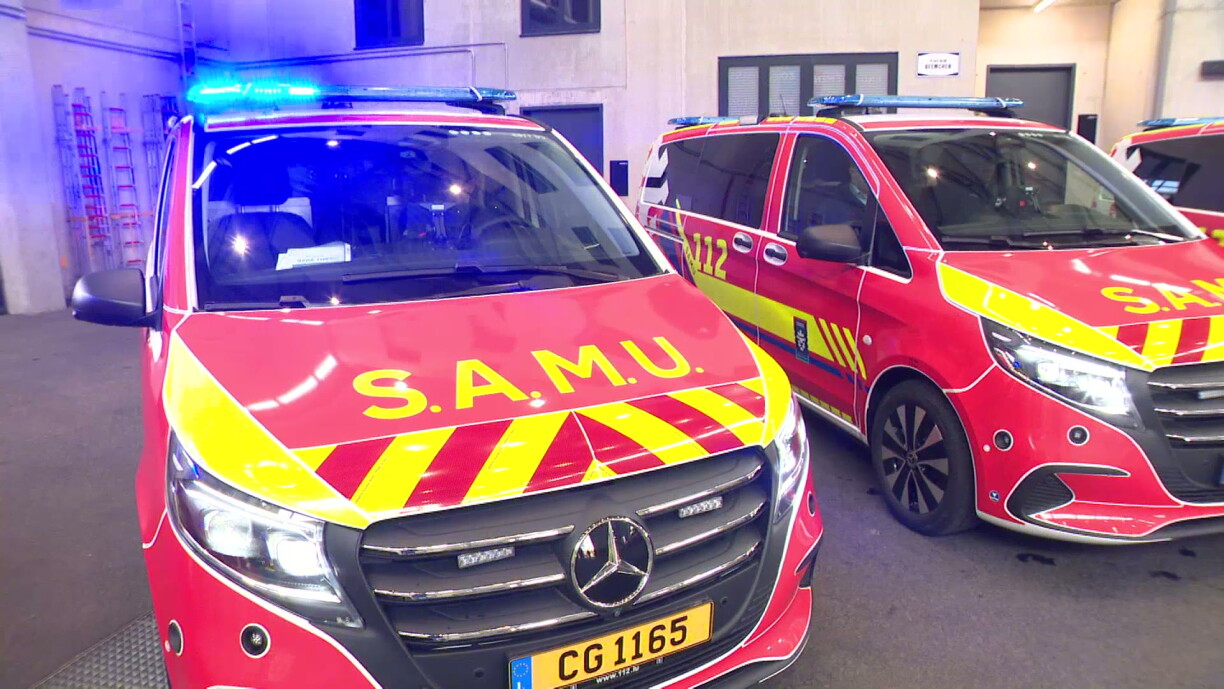
To meet the growing demands of emergency medical care, the SAMU now operates from five bases across Luxembourg; and, in a major upgrade, received 10 brand new vehicles on Tuesday, helping to ensure their teams remain as efficient and well-equipped as possible in the years ahead.
Standing side by side, the new SAMU vehicles make an impressive sight, and even when deployed individually, they are hard to miss. The new models are significantly larger than their predecessors, but that does not mean they will transport patients; that role remains the responsibility of ambulances.
The SAMU vehicles continue to serve as mobile bases for medical teams, who are pleased to have more space for their work and equipment.
Patricia Stremler, a SAMU nurse anaesthetist, explains that with each new piece of advanced equipment, the team's bags got bigger, but the old vehicles did not offer more space. Now, they finally have enough room to store all their equipment comfortably.
The increased capacity is not just for existing gear; the new vehicles are also equipped with entirely new medical equipment.
The most notable upgrade is the adoption of the Hamilton-T1 ventilator, replacing the older Oxylog 3000. The Hamilton-T1 is certified for all transport types, including transfers by helicopter, which adds flexibility to the SAMU team's operations. A team member explains that it is a specialised intensive care ventilator that adapts to the patient's lung capacity, improving patient comfort significantly.
The prominent Mercedes-Benz star on the bonnet catches the eye, but these vehicles are not standard factory models. They were supplied as basic white vans by Merbag and then sent to the WAS company, which won the public tender, to be refitted and customised for emergency use. WAS handled everything from the internal fittings to the blue lights and external markings, according to CGDIS logistics chief Christian Schmitz.
Each of the new vehicles is expected to remain in service for five to six years, covering up to 200,000 kilometres during that time. While this may not sound like much, the demands of emergency response are far greater than normal road use. The total investment for the 10 vehicles is €3 million.
For Minister for Home Affairs Léon Gloden, the introduction of these new vehicles is the next step in an ongoing process to improve emergency services in Luxembourg.
Gloden explains that since 2018, the number of SAMU bases under CGDIS has increased from three to five, stressing that the SAMU handles a large proportion of medical emergency interventions. Therefore, this investment is not just about acquiring state-of-the-art vehicles; instead, it is also an investment in the service quality for citizens.
The time required to prepare a SAMU vehicle for deployment has also been reduced by several seconds since 2018, reflecting a drive for increased responsiveness.
CGDIS Director Paul Schroeder says the 10 new vehicles place the service in a strong position, though he acknowledges there is always room for further improvement.
Schroeder explains that while emergency response capabilities could always be further improved, at some point it becomes a question of balancing costs and benefits. Nevertheless, he concludes that with the resources now in place, emergency response teams are certainly not in a bad position.


