Aggression on public transport remains a recurring issue in Luxembourg, particularly on the rail network, where staff continue to face verbal abuse and, in some cases, physical attacks.
In response, national railway company CFL has gradually expanded its security measures over the years, combining private security staff, police patrols, surveillance infrastructure, and awareness campaigns.
Across Luxembourg's public transport network, including trains, buses, and trams, more than 1,100 incidents of aggression were recorded last year. These included both aggression directed at staff and incidents between third parties. A total of 533 cases targeted public transport employees.
Railway staff were the most affected, with the CFL recording 284 incidents involving employees in 2025. Most were verbal, although 39 escalated into physical assaults.
One of the most visible measures introduced by the CFL has been the use of external security agents on trains, a system that has now been in place for more than a decade.
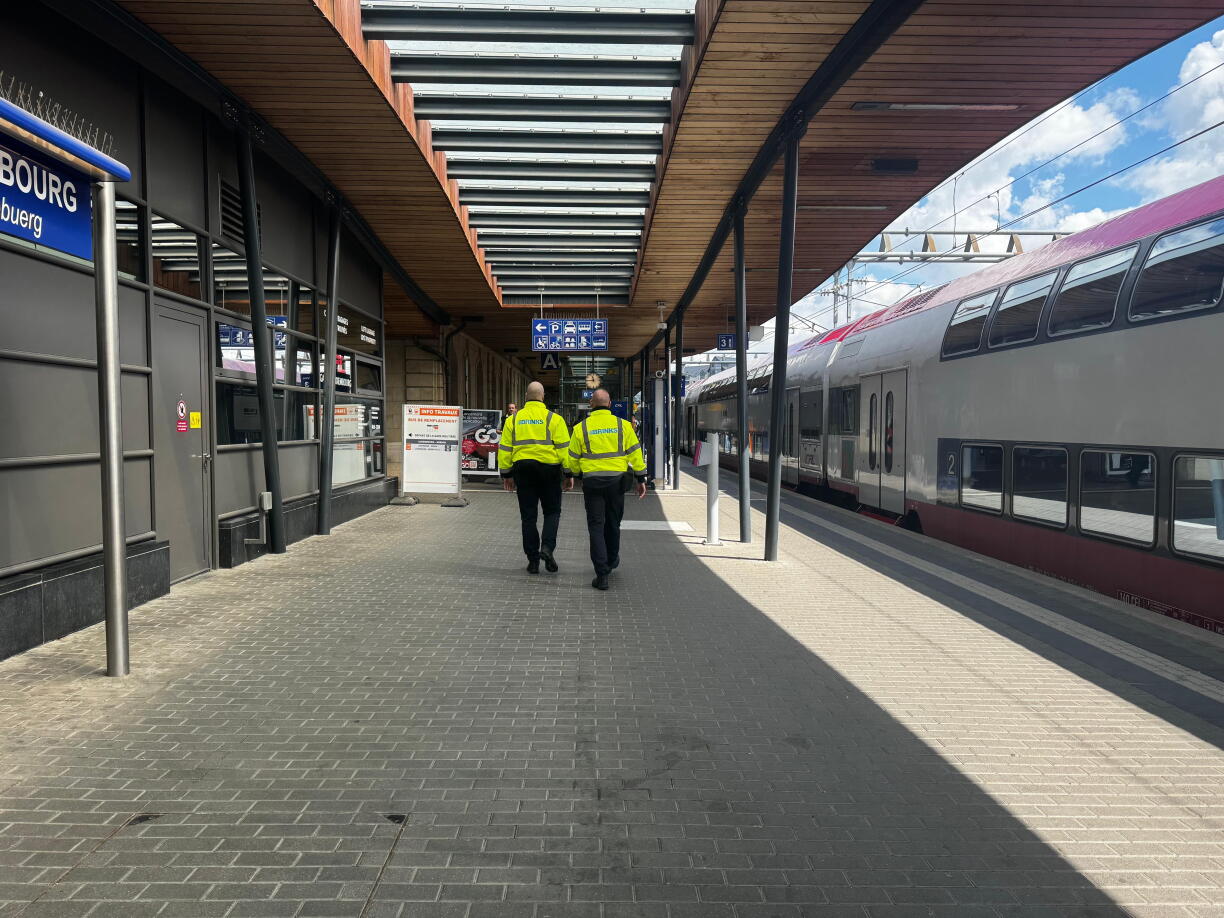
Last year, the proportion of train journeys accompanied by security agents increased from 12% to 14%, meaning roughly one in every seven trains now includes a security presence. Among those regularly patrolling the network are Nabil Gharnouti and Gregory Vansdeene, two security agents easily recognisable by their yellow jackets.
Their role is to assist train attendants, maintain visibility, and help de-escalate tense situations.
"We sometimes encounter people who are asleep, heavily intoxicated, or behaving aggressively", explained Gharnouti, adding that in such situations, they try to keep things calm.
The agents are only authorised to speak with passengers and are not allowed to intervene physically. According to Gharnouti, situations often calm down as soon as people notice the agents arriving.
"Generally, people calm down once they see the agents arrive. It always works when you seek dialogue", he said.
The decision on whether a passenger may remain on board or must leave the train is always taken by the train attendants. If a passenger refuses to calm down or leave voluntarily, staff can decide to call the police.
Alongside private security staff, the CFL also relies on regular police patrols across the rail network.
In its report, RTL accompanied two police patrols on a line heading south. Officers always patrol in pairs and, on double-decker trains, two teams are needed to monitor both levels simultaneously. The patrol observed by RTL focused on general crime, drug trafficking, and irregular immigration.
According to Chief Commissioner Patrick Strauch, almost any scenario can unfold during these operations, ranging "from a simple report to an international arrest warrant".
Such patrols are organised every month across the national network, particularly on routes identified by CFL staff as sensitive. The aim is not only to detect offences, but also to reinforce the sense of security among passengers and employees, Strauch said.
Beyond personnel on trains, the CFL says it is also working on measures aimed at improving passengers' general feeling of safety throughout the network.
This includes avoiding dark corners at stations and expanding video surveillance systems. Awareness campaigns also form part of the strategy.
Alongside its current campaign promoting respectful behaviour, the CFL is running a separate campaign aimed at tackling violence on public transport.





