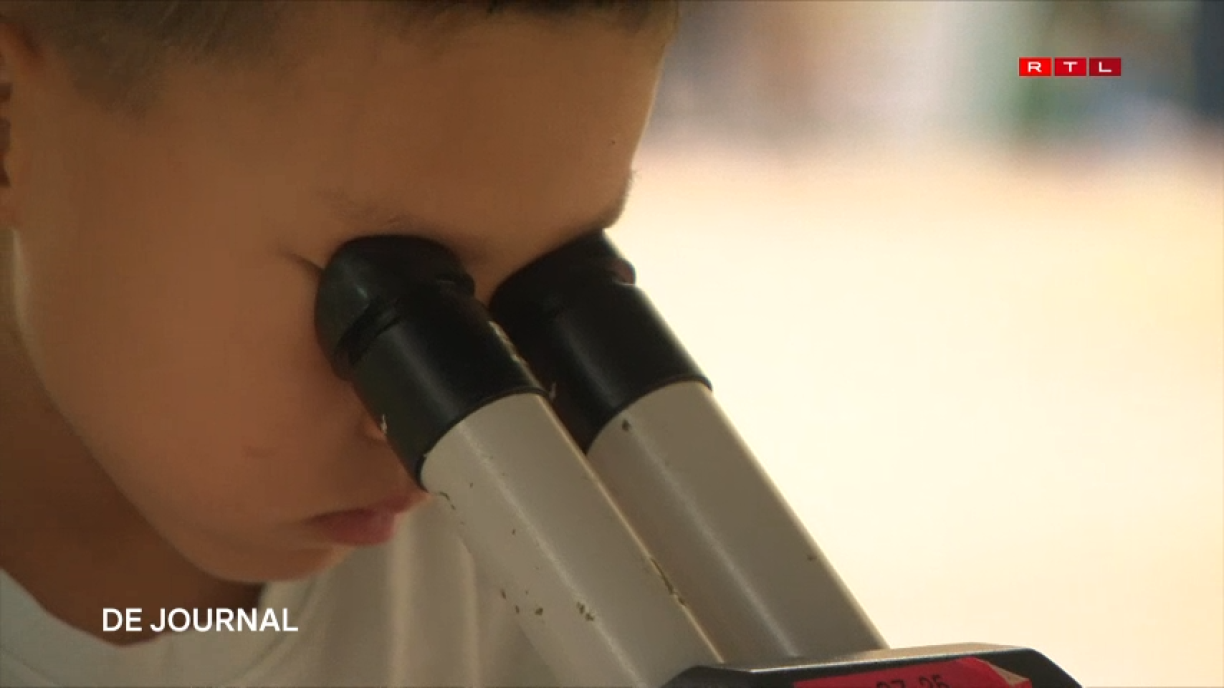
Visitors to Luxembourg’s Grund district on Sunday were invited to experience "nature" from a fresh perspective, as the National Museum of Natural History took its annual museum festival outdoors.
For this special occasion, the museum moved its laboratory and exhibits into the courtyard of Neumünster Abbey and offered practical demonstrations and activities focused on biodiversity and geodiversity.
As an added highlight, attendees enjoyed a rare and exceptional view of the Neumünster site.
Most people who attended may not even have known about the museum’s outreach initiative in advance, but that was not an issue for the museum’s director, who expressed enthusiasm for both the event and the direct contact with the public.
He emphasised the importance of presenting these topical subjects in a straightforward, approachable manner and encouraging visitors to explore and discover the themes for themselves.
The event also offered insights into the museum’s work on geodiversity, with experts on hand to discuss fossils and rocks, sometimes those that visitors had found by chance.
Taking time to engage personally, one expert explained about extinct animals, showing the fossilised skull of a fish-like marine reptile and describing the thick bones that protected its eyes.
Visitors were encouraged to bring in their own finds, whether stones, fossils, or even suspected meteorites; though, as museum director Patrick Michaely noted, the museum has never yet received a genuine meteorite from Luxembourg.
The same open-door policy applies for unfamiliar insects: the museum’s laboratory is ready to investigate and identify any mysterious specimens brought in by the public.
A particular focus for the museum is ticks. In partnership with museums in Strasbourg, Paris, and Brussels, Luxembourg’s Natural History Museum has developed a project called "Arthropoda".
As director Patrick Michaely explained, the project includes a digital image archive of ticks and other arthropods, highlighting the museum’s expertise in this field.





