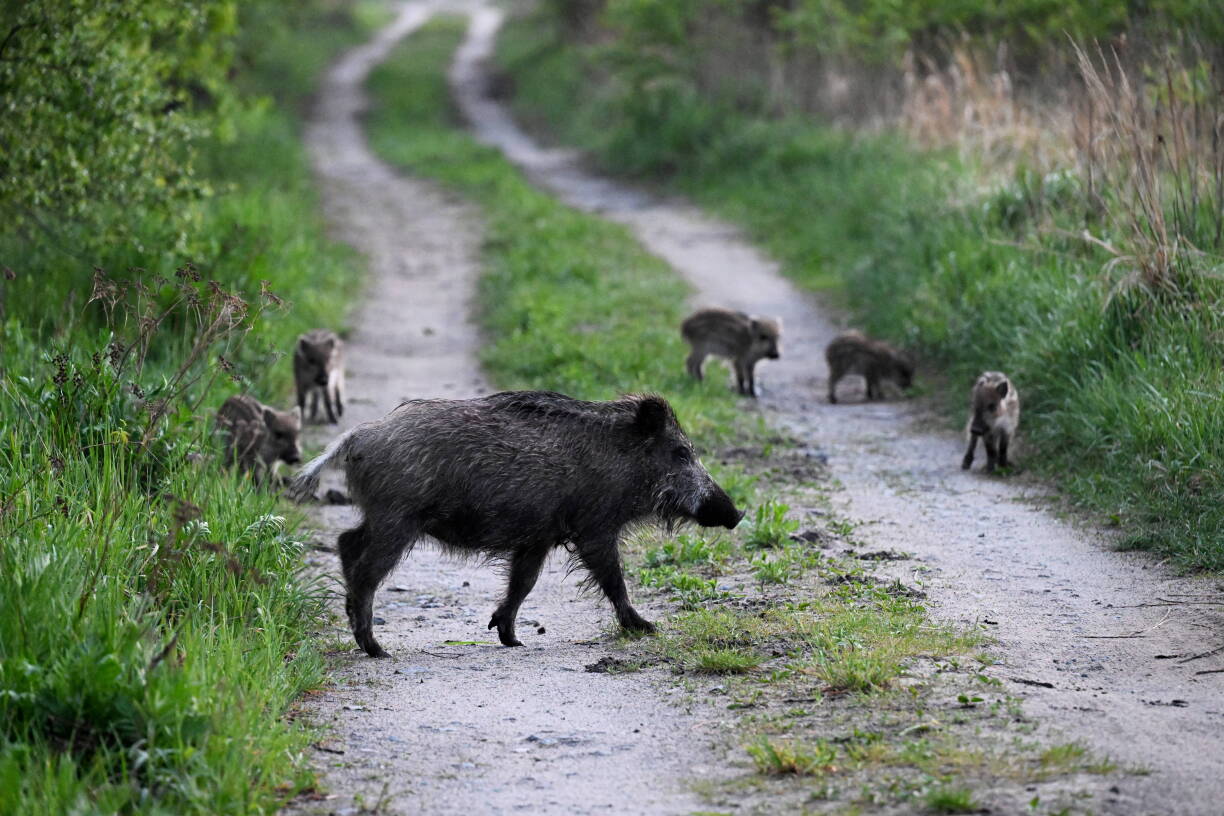
As summer temperatures soar, German hunters are increasingly bringing water into forests and fields to assist wildlife during the heatwave, a practice widely reported in German media. In Luxembourg, however, the approach is more reserved.
According to the Luxembourg Hunters' Federation (FSHCL), wild animals can still find sufficient moisture in nature, and there is currently no need for human intervention, a statement the federation says applies nationwide.
Marc Reiter, who hunts near Nachtmanderscheid, describes the landscape as parched but surprisingly resilient to the changing climate. Evidence of wildlife visiting the area is visible on the leaves along well-trodden animal trails leading from the forest to the stream.
There is no doubt that wild animals are feeling the effects of high temperatures and experiencing stress, Reiter notes. Still, he emphasises that there is enough moisture in Luxembourg's forests and that when deer or wild boar seek out water, it is not primarily to quench their thirst but rather to wallow.
For these species, in particular, wallowing – covering themselves with mud or water – is important for their hygiene.
The sight of a roe deer resting in the meadows in the early morning has become rare during this period of intense drought. Nevertheless, the FSHCL's vice-president insists that, even if hunters were to bring water into the wild, it would be intended for wallows rather than drinking.
He cannot recall ever having to do this himself, and maintains there is still no need for such measures in Luxembourg.
Across the border, however, opinions differ. In a recent ARD report, a German hunter explained that between 1,000 and 1,500 litres of water are regularly brought out to support wildlife.
Footage from a wildlife camera shows wild boar with wet flanks, clear evidence they can wallow. Other animals also appear on night-vision images, and the wild boar in particular seem to be coping well.
Marc Reiter says his hunting area contains several springs and streams, all monitored by wildlife cameras and through his own daily observations in the forest.
Other hunters, such as Alain Jaans, are active in different regions. Jaans covers an area near Kuborn in the Grosbous-Wahl commune, about 40 minutes from Nachtmanderscheid.
Yet Jaans cautions against generalising conditions nationwide. He disagrees with the federation's vice-president, pointing out that about eight years ago he provided water for wallows during a less severe drought.
Despite currently managing a large hunting ground in the Oesling region, he has so far not had to bring water to wildlife, even though the Dirbach stream in his area has dried up. Thanks to modern technology, Jaans is able to closely monitor wildlife in his area, and says that if stress levels among animals become too high, he and his team would intervene and deliver water to wallows where feasible.
Reiter, however, believes such interventions should be avoided wherever possible, as bringing water into the wild is a direct interference with nature that could cause further stress to animals.
The question as to why German hunters see such interventions as necessary – when the landscape does not seem so different – remains unanswered.





