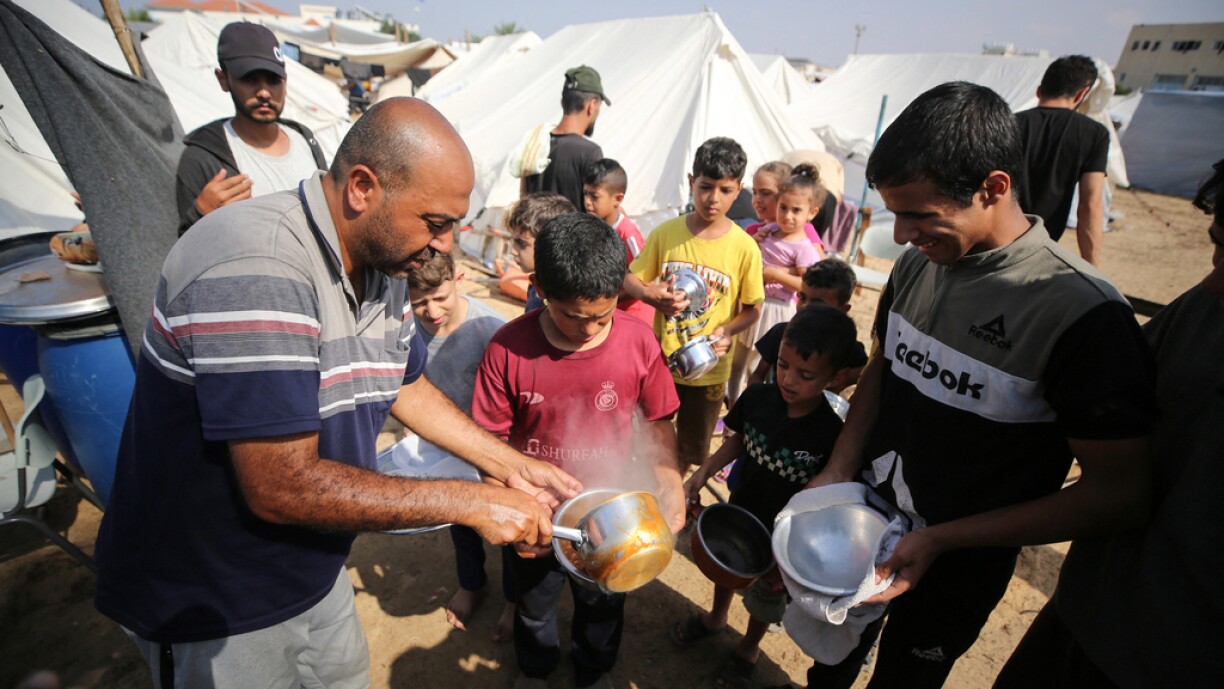
Israel has once again allowed aid deliveries to cross into Gaza – but what is the current humanitarian situation?
Following the Hamas attack on 7 October 2023, Israel's war in Gaza has resulted in an estimated 50,000 Palestinian civilian deaths. In recent weeks, the humanitarian crisis deepened after Israel completely blocked aid shipments – though the government has now reversed that decision.
In a segment on RTL Radio, our colleague Marc Hoscheid examined the situation. While aid organisations welcome the resumption of deliveries, he noted, the current volume falls far short of what is needed. Gaza requires 500–600 aid lorries daily, yet only around 100 are currently entering.
Hoscheid spoke with Paul Heber, UNICEF Luxembourg's communications lead, who described conditions as "catastrophic." Though 116,000 tonnes of food are stockpiled near Gaza, Heber explained, Israel permits only minimal quantities to pass through – raising the risk of famine, particularly among children. He also dismissed Israeli claims that Hamas diverts large portions of aid to the black market, though he acknowledged that desperation among starving Gazans complicates fair distribution.
Heber emphasised that food alone cannot resolve the crisis. Malnourished children require specialised medical care over six to eight weeks – meaning sporadic aid shipments will do little to alleviate the emergency.
In mid-May, Gaza's last remaining hospital capable of treating cancer patients ceased operations. The Nasser Hospital in Khan Younis is now the last functional hospital in Gaza.
Meanwhile, Israel's recent declaration to expand its control over Gaza – from 40% to 75% of the territory within two months – has drawn sharp criticism from aid groups.
Hoscheid warned that the move would bring "nothing good," emphasising that such an expansion would necessitate mass forced displacements, exacerbating the humanitarian crisis. Heber echoed these concerns, noting that mass relocations would disrupt aid efforts, making it "much more difficult to get aid to the kids" as organisations lose track of vulnerable children. He reiterated UNICEF's opposition to the plan, recalling their longstanding warnings against such a scenario.
If implemented, the move would compress roughly two million people into just 90 square kilometres. In comparison: In Luxembourg, around 700,000 residents occupy 2,500 square kilometres.
Aid organisations have reacted coolly to Israel's announcement of a new actor in aid distribution: the Gaza Humanitarian Foundation, a US-initiated entity registered in Switzerland. The foundation's model – outsourcing deliveries to private companies, with aid dispersed at just four pickup points – has drawn scepticism. Caritas International condemned the approach, warning it would undermine independent humanitarian operations. Hoscheid summarised the response from aid organisations as ranging from "scepticism, in the best case, all the way to very negatively."
Despite the uncertainties posed by the new aid foundation, Heber downplayed its potential disruption to UNICEF's operations. "We're used to doing everything ourselves," he said, describing the organisation's approach as a "proven system that allows us to control everything." For UNICEF, he stressed, the priority remains ensuring Gazans know aid is available – regardless of external structures. "The only thing that matters is that hunger isn't exploited as another weapon of war," he added.
The exact role of the new foundation remains unclear, prompting UNICEF to monitor developments closely. Currently, UNICEF Luxembourg has dozens of staff in Gaza, but Heber noted that number could rise significantly if access improves. However, he emphasised that a ceasefire is the essential first step.
"It's a very simple approach, really," Heber explained. "First, a ceasefire. Then, unfettered access for aid groups across the entire territory so they can work in peace." He called for multiple, permanently open aid corridors, followed by a second phase enabling medical evacuations for critically ill children.





