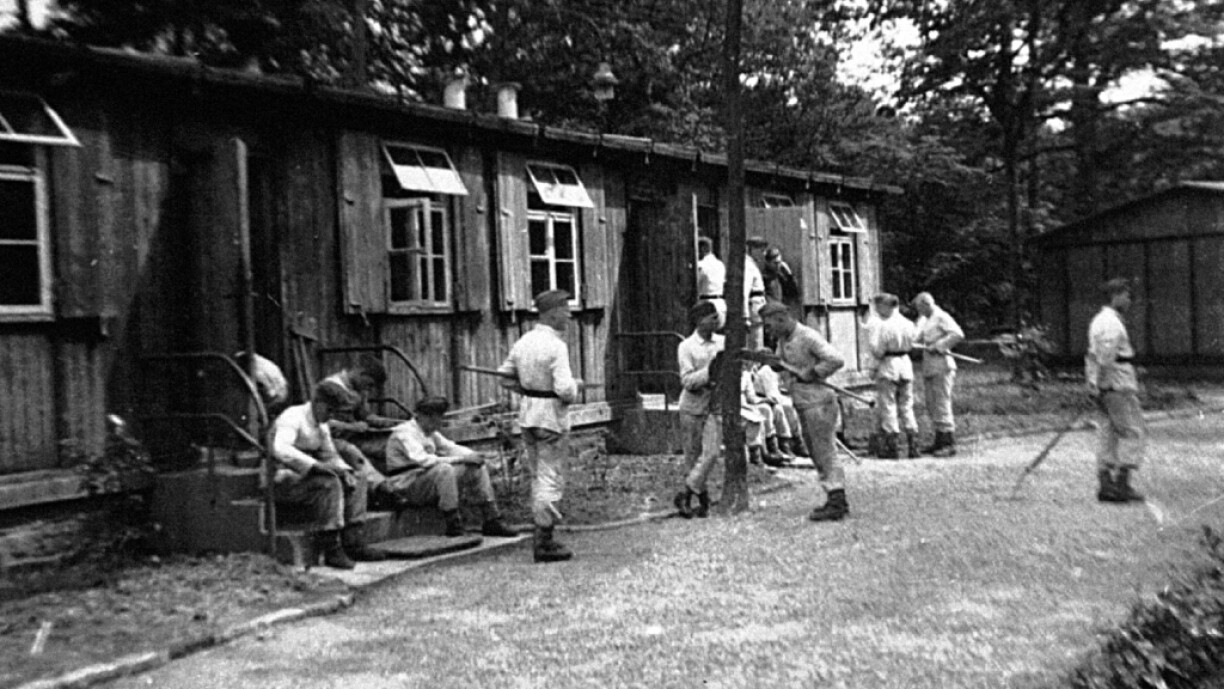
To this day 80 years ago, Nazi Germany capitulated and the Second World War came to an end in Europe. In Luxembourg, battles had already ceased after the liberation of Vianden in mid-February. However, despite Germany's capitulation, the Second World War had not yet concluded. The restoration of towns and villages was extended into the 1950s. A lesser known fact is the role German war prisoners played in it – a couple of them were held in the same camps as Luxembourgish prisoners.
In fact, Luxembourg had already been liberated by the Allies in September 1944. Then, during the German Ardennes attack, the Eastern and Northern parts of the country were gravely affected again from December 1944 to January 1945. Some villages were completely destroyed. In addition, agriculture was lacking farmhands, which is why Luxembourg decided to make use of German prisoners on the fields, explains Benoît Niederkorn, the head of the National Museum of Military History.
"During the war, the number of farmhands had drastically decreased from 2,500 to 150. Nicolas Margue, the Minister of Agriculture at the time, thought about the situation and wrote a letter in May. His best idea was to ask the Americans for war prisoners. The request was handed to the Allies' Chief of High Command and they accepted it. Where did they go to get their prisoners? Straight to the French departments, as they acted as transit camps for a myriad of German soldiers who ended up in prison during the remaining months of war."


In early 1946, an estimate of 4,500 war prisoners were residing on Luxembourgish territory. At the beginning, they were mostly restricted to camps, either in Moutfort or Ettelbruck. Since the army did not have sufficient means to watch the prisoners, many were sent to farms where they had to work. It was here and on some of the camps, Germans were able to escape.
The RAD camps, instated by the German army during their occupation of the Grand Duchy, appeared to have better surveillance. RAD is short for Reich Labour Service which particularly targeted young men and women aged 18 to 25 years old. The main aim was the indoctrination of Nazi ideology.
"They did not only want them to understand the ideology through books and frontal instruction, they insisted on indoctrinating them in group settings and during sports. We can see that throughout Nazi ideology, toughening the body is only possible through training in groups and adhering to a tight schedule."
One RAD site in Schrassig was repurposed after the war to detain both Luxembourgish collaborators and German POWs. By mid-1946, the Luxembourg Army had also begun using the facility. Due to overcrowding, the Walferdange castle – now a teacher training centre – was converted into a temporary army barracks to house soldiers and their vehicles.
The barracks in Bitburg, still undergoing restoration, were not ready as expected. As a result, the Schrassig camp remained in use until 1947, when it was dismantled. Its modular structure allowed the barracks to be reassembled elsewhere: one was relocated to Diekirch for use by the scouts, and another was moved to Senningerberg, later incorporated into the Loretto Chapel.
Today, remnants of the Schrassig camp remain visible. Near the forest entrance, visitors can spot the concrete foundation of the barracks and part of the original staircase. The commune of Schuttrange has installed historical information panels to commemorate the site’s layered past.





