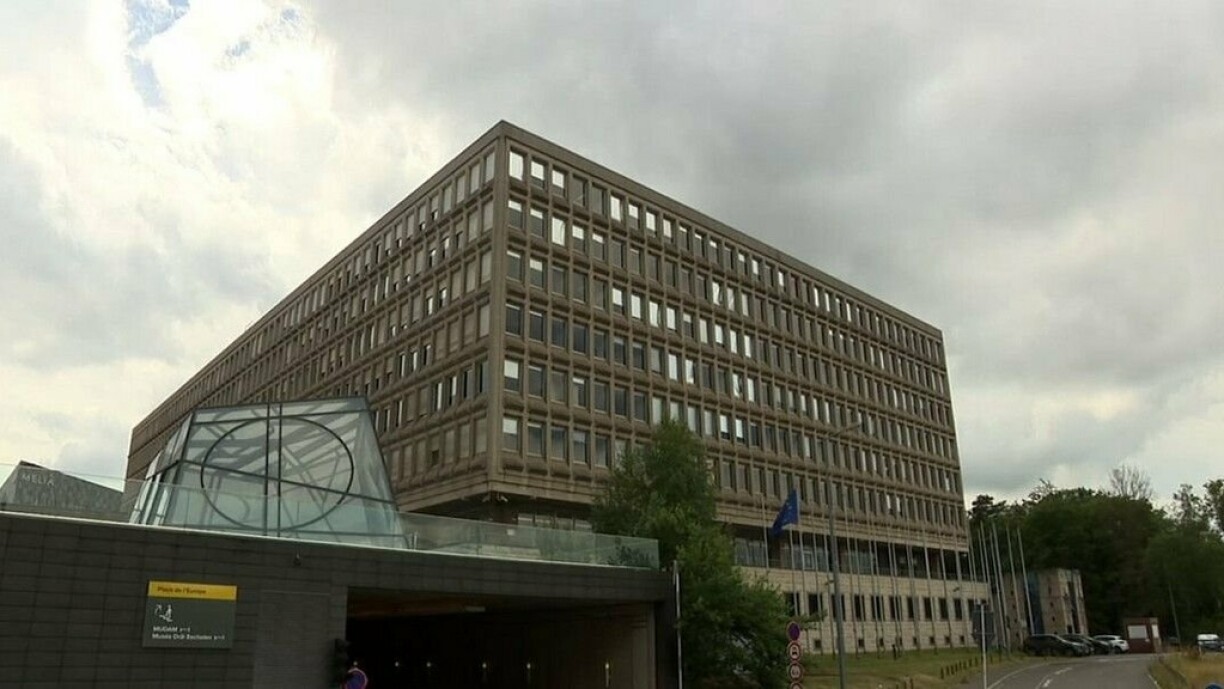
Tucked away at Place de l'Europe, in the heart of Luxembourg's European quarter, stands the Schuman building – a brutalist, concrete relic that has long faded from public view. While its modest appearance pales beside the towering Alcide de Gasperi building or the sleek Philharmonie, Minister of Culture Eric Thill sees it differently: for him, it is a foundational symbol of European identity and a structure worthy of protection.
Thill made his stance clear earlier this year when he formally notified the municipality of Luxembourg City of his intent to place the building under national heritage protection. At a Luxembourg City Council meeting on Monday, the proposal was met with unanimous support.
The minister explained that, as custodian of national heritage, it was his responsibility to initiate the classification process and that he expects to officially sign off on the protection order within the coming weeks.
He stressed that the building's importance goes beyond architecture, as its identity is inseparable from European history. He argued that the plenary hall in particular has retained its authenticity, with original furnishings, equipment, and décor intact.
Whether the rest of the interior should be renovated is still an open question, but Thill made clear that the government will explore meaningful ways to breathe new life into the building while preserving its core identity.
Built in the early 1970s, the Schuman building was designed by architect Laurent Schmit, a proponent of Brutalism who worked with raw concrete and favoured geometric forms. Its inward-facing courtyards echo those of the Michel Rodange secondary school, another of Schmit's works.
The building served as one of the first seats of the European Parliament, housing its original plenary hall until the opening of the Hemicycle – affectionately known in Luxembourg as 'De klenge Kueb' ('The little crow') – which was purpose-built to host the Parliament's sessions. Though it has stood vacant for years, it still represents a formative stage in the EU's institutional development.
Under the previous government, then-Minister François Bausch had floated the idea of demolishing the building – retaining only the plenary hall – due to the high cost and complexity of a full renovation. That plan now appears to have been abandoned in favour of preservation and thoughtful reuse.
City councillor and historian Robert Philippart, representing the Democratic Party (DP), voiced his support for the heritage listing but added a word of caution. While he welcomed the initiative, he stressed the importance of integrating the building meaningfully into the surrounding urban fabric, warning that it should not be allowed to become a static monument to the past.
With the City's backing and momentum from the Ministry of Culture, the Schuman building now seems set to enter a new chapter – this time, not as a centre of EU decision-making, but as a carefully preserved piece of European heritage with potential for renewed purpose.





