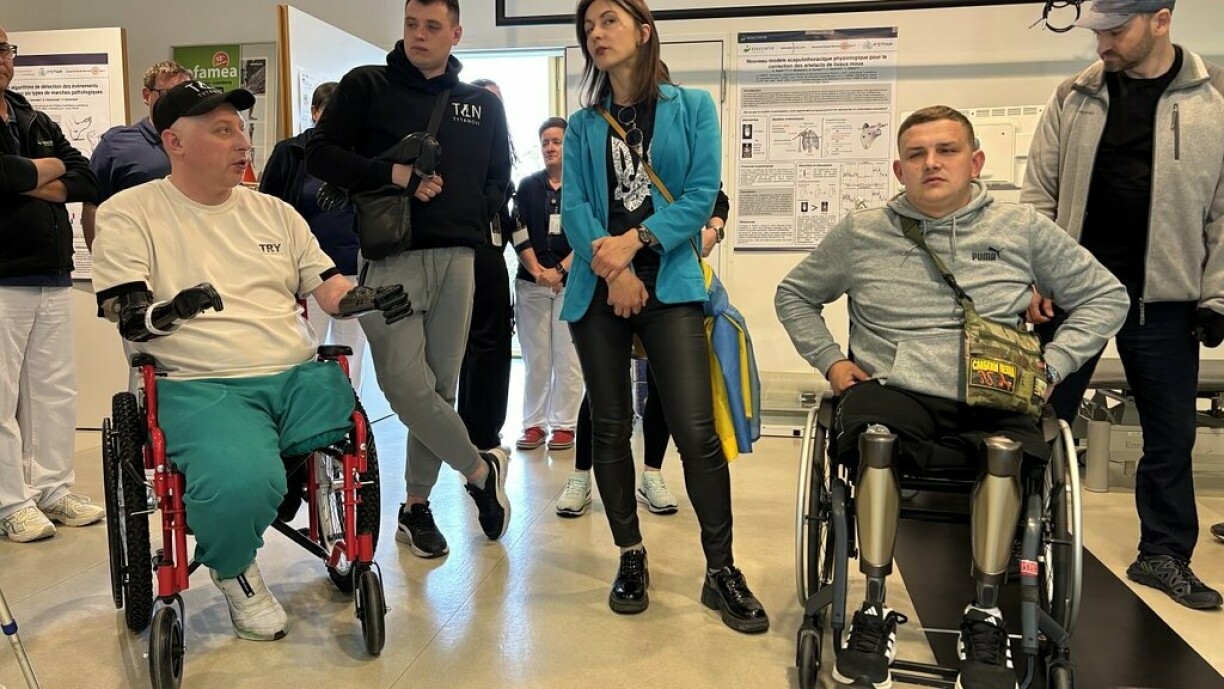
Wounded Ukrainian soldiers during a recent visit to Luxembourg exchanged insights with staff at the National Centre for Functional Rehabilitation and Re-education, also known as the Rehazenter, as severely injured veterans might receive rehabilitation treatment at the facility in the future. The aim of the visit was to learn how patients in Luxembourg are supported on their path back to everyday life after serious injuries.
Anton, Alexander, Sasha, and Vlad had many questions for the staff, including how exoskeletons are used in therapy, how high-tech gym equipment works, and what therapeutic approaches can be taken when working with war veterans.
Anton, a now 41-year-old soldier, was struck by artillery fire on 2 May 2023, a blast that ended up costing him both arms and a leg. Two years later, he drove himself from Kyiv to Luxembourg in a vehicle he had personally modified to suit his physical needs.
Proudly, he shared that he used a 3D printer to make some of the components himself, highlighting how Ukrainian resilience has often meant adapting quickly to the most extreme circumstances.
Alexander was disfigured in a Russian attack back in 2015, shortly after the war in Crimea first broke out, loosing his left arm. Since then he has received a bionic arm, developed through the 'Tytanovi' project, which supports soldiers in regaining independence and reintegrating into society.
His prosthetic features 16 sensors in his shoulder that pick up neural signals and translate them into movement – an advanced limb that costs around €125,000. He beams with pride as he shows a video of himself shooting a bow.
In 2018, Alexander won a silver medal at the Invictus Games, a global sporting event for wounded veterans.
These two stories reflect just a fraction of the immense challenge facing Ukrainian soldiers, as the ongoing war has left tens of thousands wounded. Ukrainian authorities estimate that around 100,000 soldiers currently require rehabilitation due to amputations, with both the physical and psychological tolls proving long-term and difficult to address.
On Tuesday evening, during a gala hosted by LUkraine until the end of the month, a call for donations was launched to help finance the rehabilitation of injured Ukrainian soldiers. One hope is that more of them may receive direct treatment in the Grand Duchy in the near future, particularly at the rehabilitation centre and its advanced motion capture studio, which analyses patients to design the most optimally customised prosthetics.
Frédéric Dierick, a researcher at the National Centre for Functional Rehabilitation and Re-education, even drew a striking comparison: "It's like Disney", he noted, referring to the use of motion capture technology, commonly used in animated film making, to improve mobility and prosthetic precision in the field of rehabilitation.
Nicolas Zharov, president of the Luxembourg-based association LUkraine, underlined the scale of the crisis: there is a critical shortage of qualified professionals to treat both physical and mental trauma. He emphasised that the rehabilitation of wounded soldiers will take years, and that LUkraine is stepping in to provide such services in Luxembourg while also supporting centres within Ukraine itself.





