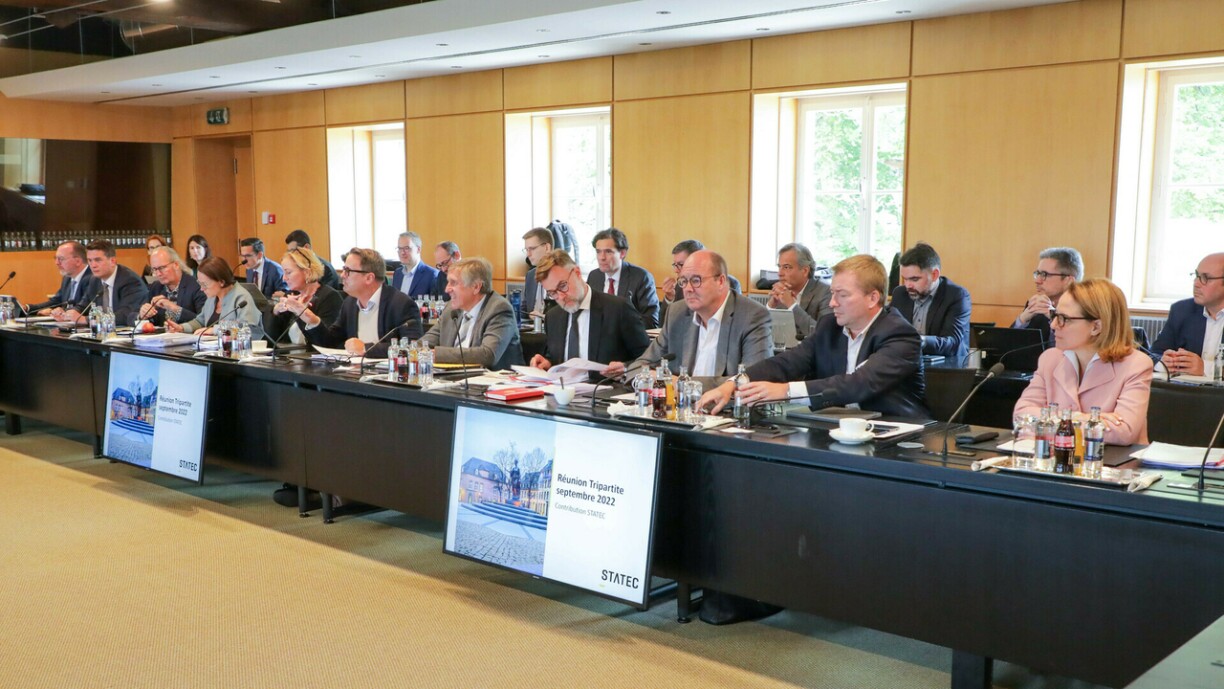
On the first day of negotiations, the government proposed to its social partners to limit energy prices. At 10pm and after approximately eight hours of discussions, Prime Minister Xavier Bettel explained that it is the government's priority to counteract inflation.
We have not yet come to an agreement, announced the politician from the Democratic Party (DP) at the end of the day. He was the only person to address the press after day one of negotiations and outlined the government's intention of limiting energy prices.
Bettel stated: "This would limit inflation and I think it would be a direct support to citizens who are concerned about the next bills and advance payments. It would be a direct response. Same for businesses, as it would slow down inflation and not damage individual buying power as much."
The DP politician further noted that the first day was mainly used to analyse the situation and allow social partners to lay out their propositions. On Monday, the National Institute of Statistics and Economic Studies (STATEC) will then provide yet another estimation.
Overall, the atmosphere was "very good", underlined the PM: "Well, we are not always on the same page, but that is the principle of the tripartite meeting and reason for why it takes a little longer. It would be nice to be done after five minutes. But, everyone has a chance to present their interests. Employers have different interests than employees. And for us it is about helping the country, helping the citizens, and not letting the economy down."
When it comes to major opinion differences, it seems as though the postponing of index cuts, as well as the wage increase itself are at the centre of negotiations.
PM Bettel acknowledged: "Yes, opinions on the matter differ. But, I am not the spokesperson of unions or of employers. Propositions were made, but they were not in agreement." Neither unions nor employers were willing to provide official statements after the first day of negotiations.
Asked about a supposed disagreement within the government on whether or not the public debt can or should exceed 30% of the gross domestic product, PM Bettel avoided giving a direct response and referred to the coalition agreement.
He said: "We set a limit for ourselves and it is the job of the prime minister to remind people of it."
Shortly before tripartite negotiations kicked off, Minister Claude Haagen from the Luxembourg Socialist Workers' Party (LSAP) took to social media to warn of "budgetary dogmatism".
When pressed on the matter, Minister Haagen responded with the following: "Are the Maastricht criteria still in effect? I do not think that they are. If you look at other countries and if I think about what I hear about the Maastricht criteria, it is not the case."
It follows that at least in terms of the state debt, the government coalition is not aligned.






