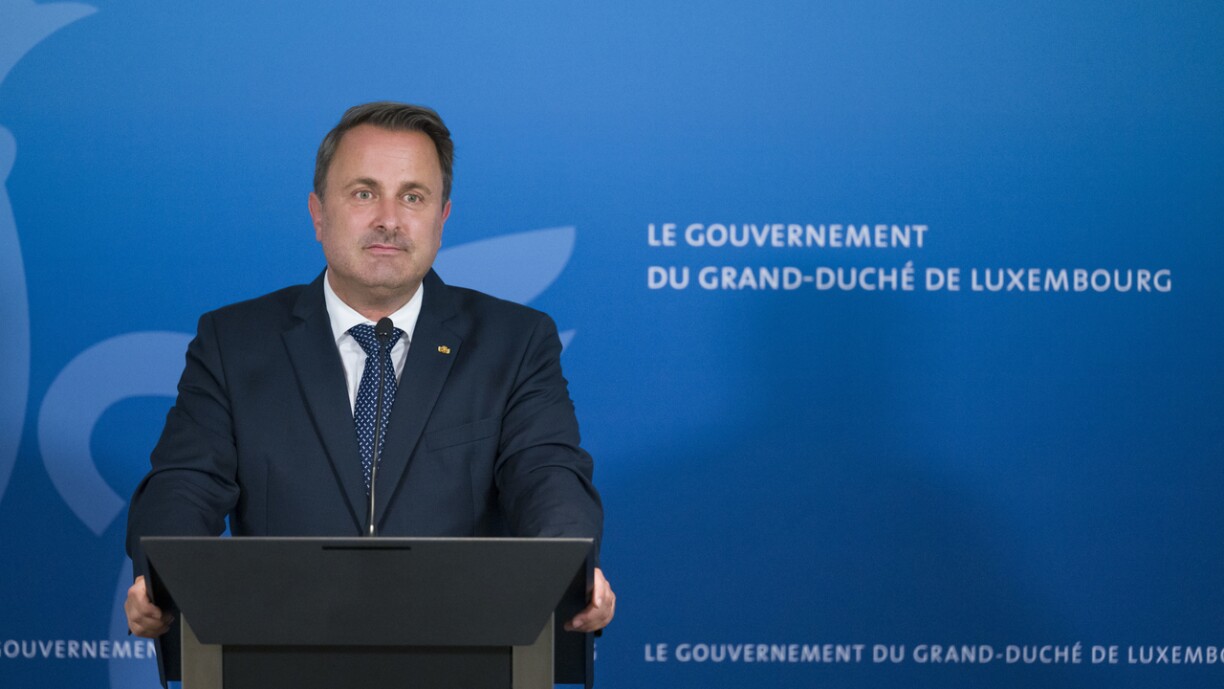
The briefing got underway after a short delay and saw Minister Bettel address the press alone. He explained that officials from the National Institute of Statistics and Economic Studies (STATEC) presented key statistics to all the parties, which everyone now has to evaluate.
According to STATEC estimations, inflation will clearly be high in the coming months and might lead to four index cuts being necessary in the span of just ten months. Additionally, there is a postponed index cut of 2.5% that is supposed to be made in June next year.
Read also: Luxembourg's unions present united front
STATEC envisions three different scenarios.
In the first one, inflation will be 6.6% next year, which would require four index cuts to be made: November 2022, March 2023, September 2023, as well as the postponed one.
Another scenario estimates that inflation will reach 8.5% next year, which would require a total of five index cuts: end of 2022, February 2023, April 2023, another one in the third trimester, plus the postponed one.
In the most optimistic scenario, inflation will go down to 4.4%, which would then require three index cuts: January and June 2023, plus the postponed one.
"Today, we live in a world that is very different from the one that we had during the last tripartite meeting", said PM Bettel during the press conference and explained that the last agreement cannot simply be taken over.
The state council will convene on Thursday to decide on a direction that the government is to pursue during Sunday's tripartite meeting. PM Bettel noted that it would be irresponsible to create a situation where people feel left behind by employers, the government, and social partners simultaneously.
The politician from the Democratic Party thus advocated for open-mindedness ahead of Sunday's meeting. He further pleaded to conduct negotiations in constructive and solidary manner, hoping that a solution can be found by early October at the latest.
PM Bettel also said that further tripartite meetings might be necessary due to the severity of the situation and due to the fact that businesses and households undoubtably need support. In any case, the agreement signed during the last meeting has become redundant as it no longer meets the demands of the current situation, he argued.
Luxembourg's PM also acknowledged that it is not possible to postpone several index cuts, even if they have to be made in short succession. He described the crisis as "exceptional" given the level of inflation, which is at a four-decade high. People need reassurance and cannot be left behind, said Bettel.
He concluded by promising that the government is ready to spend, but remained unwilling to announce specific numbers. The government also intends to defend the Triple A status of Luxembourg's financial market.





