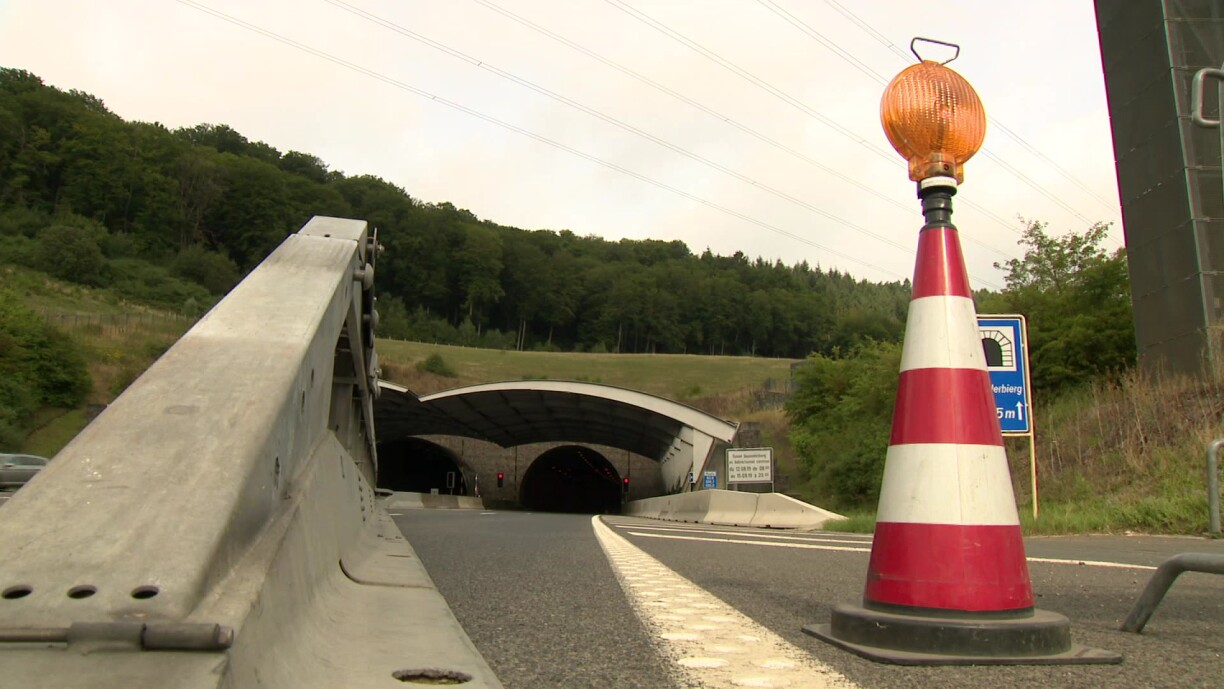
The Roads and Bridges Administration strives to ensure the safety of roads and tunnels through regular maintenance work.
Luxembourg has 31 road tunnels which allow rapid transit across the country. The longest is the Grouft tunnel, which stretches for about three kilometres. The tunnels are distinguished in particular by their method of construction, explained the director of the Roads and Bridges Administration, Roland Fox:
"You can tell the difference between a dug tunnel, where a hole was drilled in the earth, and a covered trench, where basically, a trench was opened and then the tunnel was closed. We have nine dug tunnels and 22 covered trenches."
When added together, all the tunnels cover a length of around 15 kilometres, and require regular maintenance checks, said Fox.
"As far as tunnel maintenance is concerned, elements are replaced every six months, worn parts or things that have come to an end. Twice a year, our inspectors travel to the site and check whether everything is in order. A visual inspection is done every three years and if it appears then that there is a problem, we conduct a more detailed inspection to get to the bottom of it. Proper maintenance work is then programmed as a priority. As for the biggest issues, we carry out an overhaul of the tunnels every 10-15 years, mainly because the engineering has become obsolete."
The most important thing is security, according to Fox. The tunnels are planned and built on the assumption that accidents can occur there, enabling people to seek shelter, as well as guaranteeing space for the intervention of safety and rescue teams. In order to be better prepared for the worst-case scenario, exercises are regularly carried out in cooperation with firefighters and security personnel, added Fox.
"The exercises are important, both for our staff and for the emergency services. There are obviously staff fluctuations and every tunnel is different. We have procedures for each tunnel, but it is helpful to put these into practice rather than just rely on theory. We have observers on site for every exercise, who then draw up the results so we can analyse what works and what needs to be improved."
Motorists who are involved in an accident in a tunnel are advised to put on their hazard lights and move the vehicle to the side of the road if possible. It is also advised to switch off the engine and get to safety where possible. Further information can be found here. Video report in Luxembourgish:





