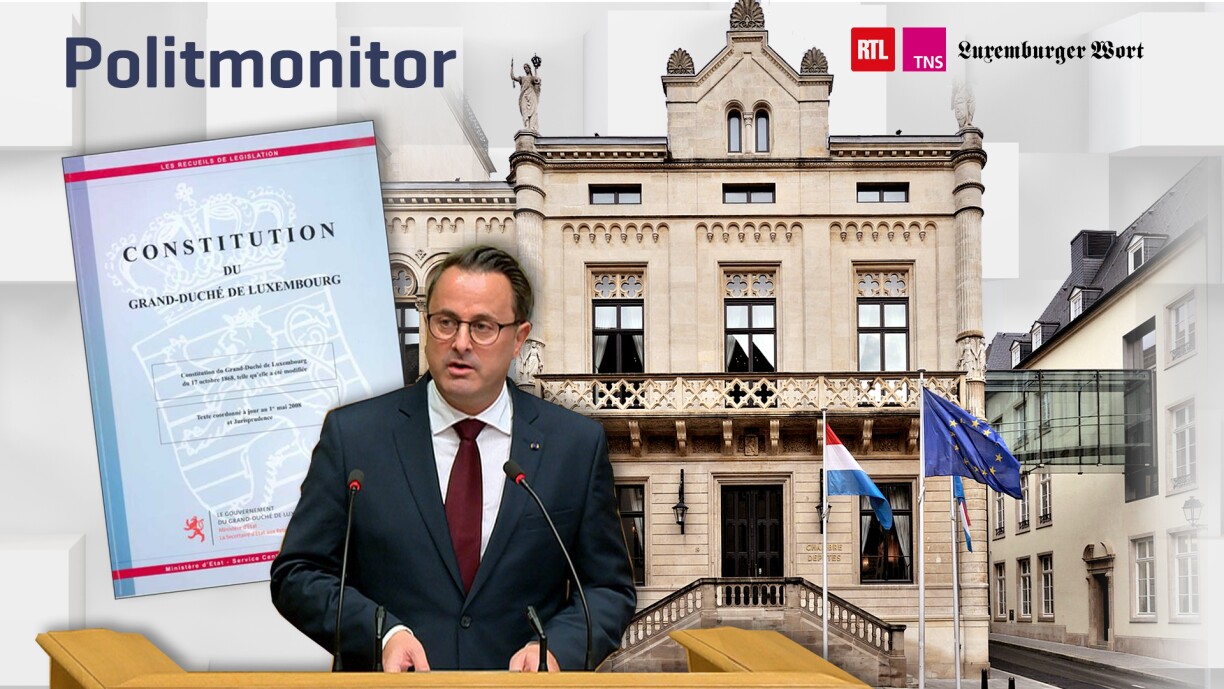
70% of citizens do not consider themselves well informed about the potential changes to be brought about by a constitutional reform. As a result, 63% stated that they do not know whether they would be in favour or opposed to such a reform. The respondents were also questioned for the first time after the State of the Nation Address.
57% of the respondents followed the State of the Nation address live or read about it in the media. However, this also means that the remaining 43% do not know exactly what was announced or have not heard of a state of the nation speech. Young people in particular fall into the latter category, explains Tommy Klein of TNS Ilres.
According to Klein, this is an issue that "should probably be addressed at some point". Luxembourg has a problem when it comes to the younger generations' interest in politics, Klein explains. The State of the Nation address is another example of this, with two thirds of young people between 18 and 24 years of age either being unaware of what has been announced, not showing interest in the first place, or heard nothing at all about the state of the nation. Another example, Klein continues, is young people's awareness of political figures. Younger generations often score very low when they are asked whether they know the country's politicians.
Despite the hectic news of the last few weeks, 72% of respondents still describe the political situation in Luxembourg as stable. This can be related to a high level of satisfaction with many of the measures announced. For example, 95% of respondents are in favour of the production and consumption of regional and seasonal products.
According to Tommy Klein, practically all social measures are viewed favourably by respondents, including free homework help (86% approval), and free school meals for children from low and middle-income families (81% approval). As for the professional world, a large majority of respondents stated that they approve of the introduction of a right to part-time work (79%) or teleworking (79%).
The approval ratings are less high when it comes to housing measures. When asked whether the state and the municipalities should be the main actor when it comes to creating affordable housing space, thus excluding the private sector, 63% stated that they approve of this statement, while 17% disagreed, and 20% were unsure. Regarding penalty taxes on empty flats or undeveloped plots of land, 13% stated that they are undecided, while 63% expressed their approval of the measure. Still a clear majority, which also increases to almost 80% among voters of the Luxembourg Socialist Workers' Party (LSAP). Even 69% of the Democratic Party's (DP) voters are in favour. The measure seems to be least appreciated by voters of the Christian Social People's Party (CSV).
However, there are also some measures that are not well perceived. For example, the one that foresees that in the future, foreign residents will no longer have to live in Luxembourg for at least five years to be able to register on the voters' list for municipal elections, a measure which is only approved by 25% of the electorate. A "clear message from the electorate on how they view these measures", according to Klein.
There are still two other measures that are not at all well perceived by the respondents. Only 21% support the decision that from 2030 onwards, only new registrations of vehicles without internal combustion engines will be allowed. The decision to allow every household to grow up to four cannabis plants at home is also largely rejected (only 40% support). The legalisation of cannabis in Luxembourg is still the subject of an ongoing debate.
On the other hand, one thing that did not surprise Tommy Klein of TNS Ilres in this survey was that 70% of respondents admitted that they were not well informed about the constitutional reform.
According to Klein, the poll shows that there is a "great lack of information" when it comes to various aspects that are to be changed in the constitution. Only a quarter of respondents stated that they would actually vote 'yes' in a referendum. A large majority, 63%, still do not know how they would vote. Klein explains that this also means that there is no automatic 'yes' reflex in the population based on a single vote in the Chamber of Deputies.
The fact that people are so uninformed could prove to be very problematic, as the referendum vote could be instrumentalised as a kind of protest vote. Klein pointed out these people generally felt that society was unfairly stacked against them, such as people who have turned down the opportunity to get vaccinated, or people who think the political situation is unstable. The group also includes opposition voters who are most likely to push for a referendum.
Alia.lu
The third and final part of this Politmonitor survey will be published on Thursday, with analysis on the country's key politicians and how the public views them.




