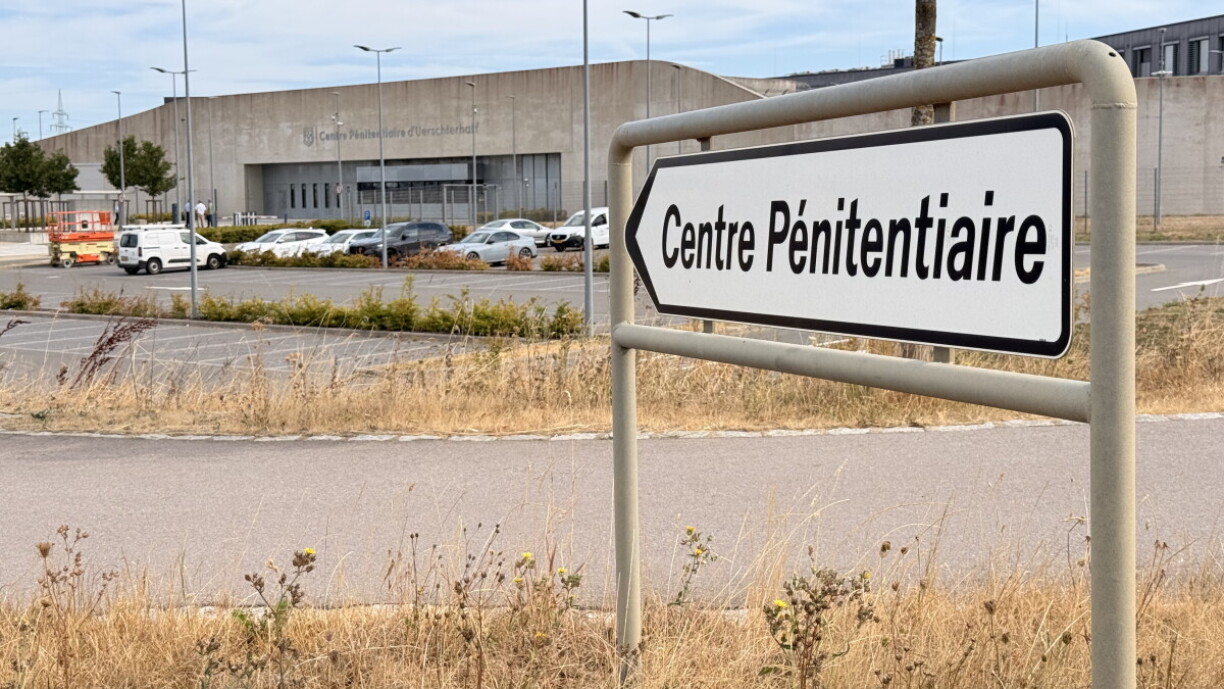
In 2024, five minors were placed in adult prisons in Luxembourg, increasing to 27 in 2025 and 43 in 2026 to date. This is in spite of the fact that various international organisations have reminded the government for decades that children do not belong in prison. To exchange ideas and raise awareness, a meeting was held on Monday evening at the Human Rights House in Belair.
Laurent Seck, Deputy Principal Prosecutor at the Luxembourg Public Prosecutor's Office in the Youth Department, explained that minors placed in adult prisons are often in custody following violent robberies. He said many have to be examined to see where they come from and if they are the age they claim, while others belong to crime families and have often been brought up to carry out burglaries or muggings.
"If they decide to go and assault someone, we can't just put them in Dreiborn [the youth detention centre] or let them go home, we first have to place them somewhere where we can see what's wrong with them, how dangerous they are, it's also a matter of victim protection. In addition, the Unisec facility in Dreiborn only has 12 spaces, so if it is full, our only alternative is the CPL." The CPL is the prison in Schrassig.
Children and young people often end up in prison more quickly than would be conceivable or possible for adults, said Charel Schmit, the Ombudsman for Children and Young People. It is not just about numbers and infrastructure, but also about guarantees of the rule of law.


"The big principle among us adults is that we have to be brought before a judge within 24 hours, to be able to explain ourselves, together with a lawyer, to be able to assert our rights. We don't have that principle with minors, and I think we need to get better at that", Schmit said.
"We can definitely do that now with the current law. Even if we could adjust it to a month's time, from the perspective and experience, and the perception of the young person, it's basically undignified treatment, inhuman treatment, to not actually know, for a month, whether you'll see a judge or not."
Not knowing what will happen in such a situation is unbearable, commented psychologist and honorary president of the Human Rights Commission, Gilbert Pregno. He believes there is a need for opportunities, in "early childhood" and alternative structures to prison.
"It exists elsewhere, why don't we have that here? I think our politicians are not interested. They create things that apparently make people happy, but they don't take the suffering of children and young people into account. This enrages me."
In April 2022, the then Minister of Justice, Sam Tanson, tabled a bill that, among other things, would create a specific penal procedure for minors and prohibit the imprisonment of children. It was amended in May 2026 and was added to the agenda for the parliamentary justice committee, but, four and a half years later, it has not yet been subjected to a vote.
This is in spite the fact that the Council of Europe's Anti-Torture Committee has been issuing recommendations to the Luxembourgish authorities since 1993 - that is, for 33 years - to ensure that no children are placed in adult prisons.


