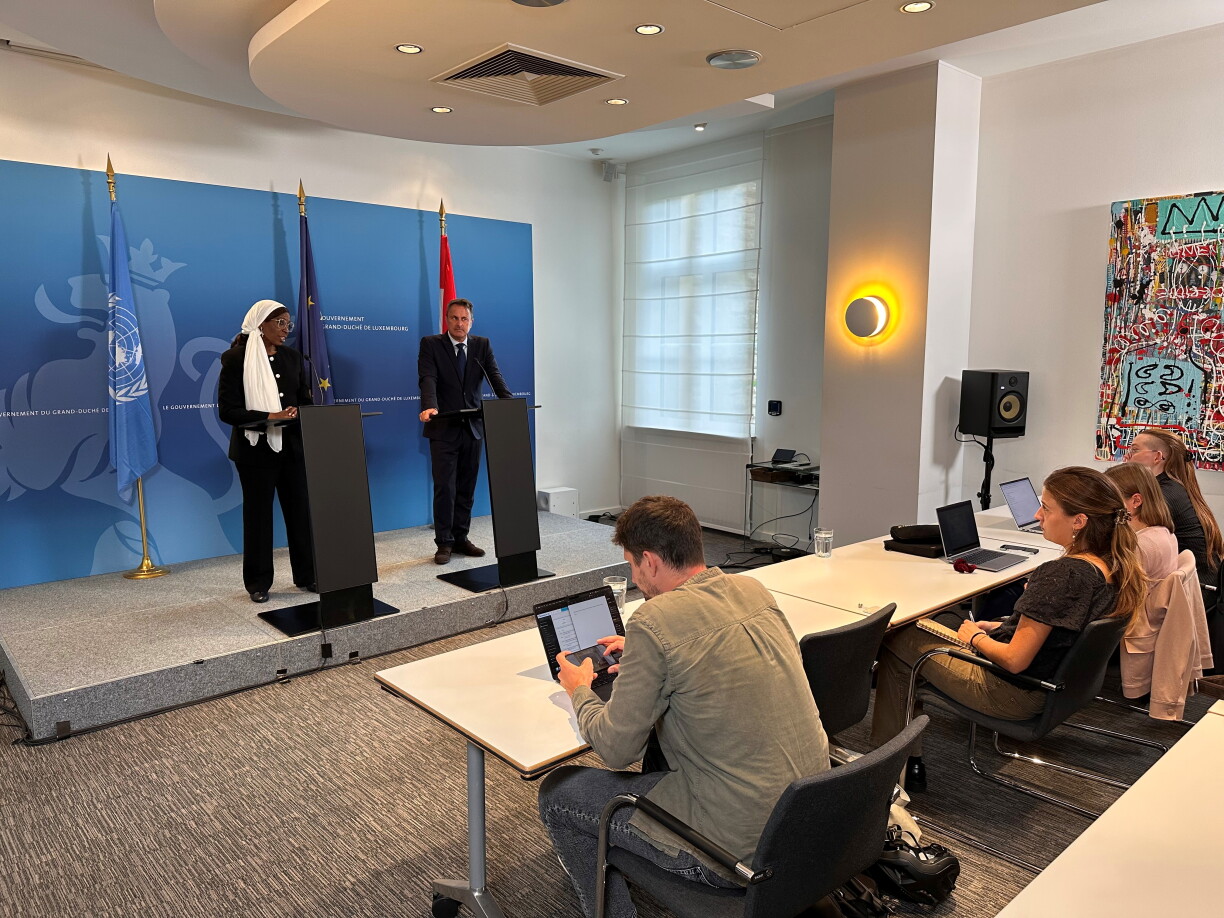
Luxembourg stands for multilateralism. That was the message at a press conference on Thursday afternoon featuring Democratic Party (DP) Foreign and Cooperation Minister Xavier Bettel and Diene Keita, director of the United Nations Population Fund. The agency works in 150 countries and territories around the world on health, access to contraception, and against gender-based violence.
The lives of 400 women, Keita said, had been saved thanks to Luxembourg's financial support.
She invited the audience to consider that the agency had been able to save the lives of 400 women who might otherwise have died just because they lacked access to the services provided by its midwives and counsellors in their communities. Almost 500,000 people had been reached on issues linked to sexual and reproductive health, she said, and most of them were young people, young men and young women who wanted to ask questions and to make use of certain services to protect themselves and give themselves a more decent life.
Thanks to Luxembourg's support, close to 850,000 people had also been able to choose contraception.
Multilateralism, Bettel argued, is under threat, and international solidarity can no longer be taken for granted. The point, in his view, was still to prevent women from dying and girls from being mutilated. Luxembourg, he told the press, would continue to be a partner, to support the UNFPA and to defend multilateralism, and would go on investing in equality and in rights.
The UNFPA is currently struggling to raise sufficient aid money, particularly after the United States drastically scaled back its support, Keita said.
The agency, she noted, is 70% short of the billion it is currently seeking, and that billion is only part of the picture, since the overall need runs to two billion. For humanitarian aid, in particular, 70% of the funding is missing, and that shortfall matters enormously, since people die when the agency cannot step in.
Every life, according to the director of the UN agency, deserves to be saved. She praised Luxembourg's support, especially in the Sahel region.
As part of the United Nations reform plans, there is debate over whether the Population Fund should merge with UN Women. Alternatives are still being explored, however, according to Keita.
Member states in Luxembourg, she said, had asked the agency to propose alternative solutions rather than pooling resources, given the potential consequences and costs of such a step. The question, she added, was ultimately about what mattered more: using resources to save lives, or using them for administrative bureaucracy. Those were her words during her visit to the Grand Duchy.






