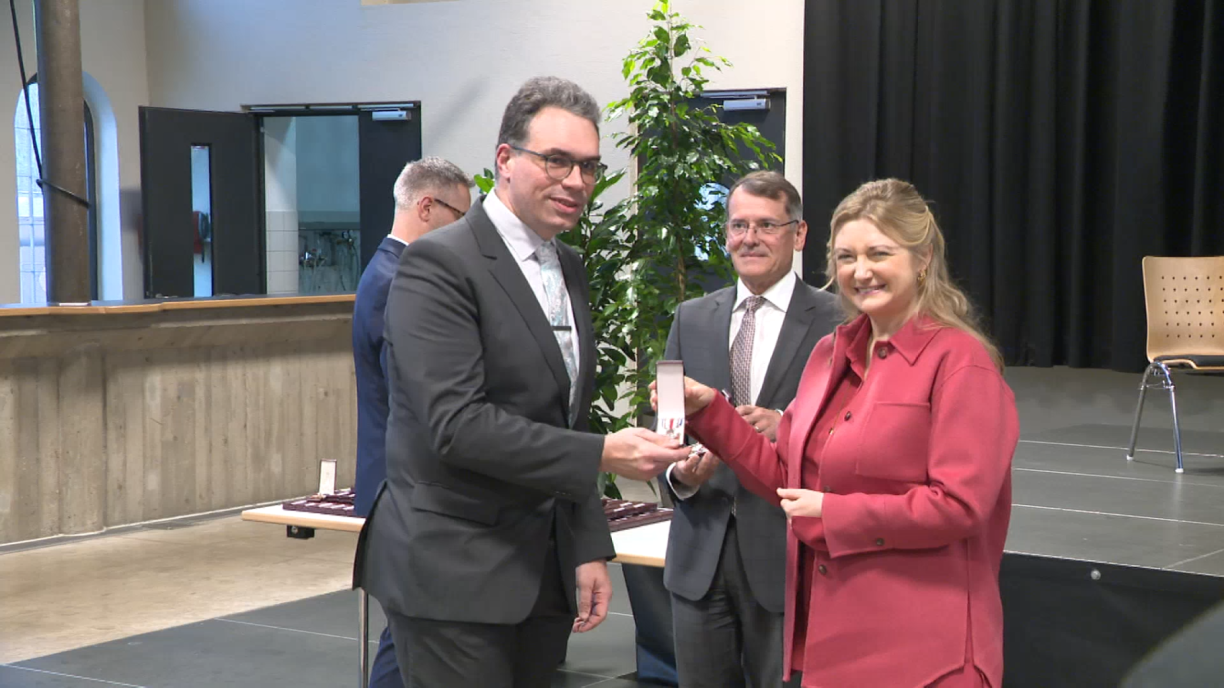
Over the course of their lives, those honoured on Saturday have donated blood or plasma 20, 40, or even 80 times.
The ceremony aimed above all to convey a clear message: blood donation is a voluntary gesture without which Luxembourg's healthcare system could not function.
Sonja Hoffmann of the Red Cross said Luxembourg benefits from one of the most loyal donor bases in Europe, adding that donors who return year after year show an exceptional level of commitment.
Blood donation is not an everyday act. Each single donation can help up to three people, whether through red blood cells, platelets, or plasma. Last year, around 15,000 people were registered as blood donors with the Red Cross, contributing more than 20,000 donations in total.
For many donors, giving blood is simply second nature. Mike Thies, who received a silver medal, said he had been introduced to blood donation at a young age by his father and immediately saw it as something worthwhile, a simple way to contribute to a good cause.
Another silver medallist, Marie-Andrée Hoffmann-Weber, described donation as a modest act with meaningful consequences, noting that each time someone gives blood, they are directly helping others.


Despite the strong commitment of donors, demand for blood remains high every day. The Red Cross says shortages occur particularly when it comes to plasma. While donor numbers are currently stable, there is an ongoing need for new volunteers willing to donate blood or plasma.
Sarah Holz, who was awarded a bronze medal, said shortages are felt across the board. She encouraged more people to come forward, pointing out that the process is straightforward, takes around 15 minutes, and can make a real difference.
Plasma plays a crucial role in medical care. Hoffmann, from the Red Cross, explained that it is the liquid component in which red blood cells circulate and contains essential proteins needed for the immune system and for transporting medication in the bloodstream. In medical terms, plasma is just as important as red blood cells, she said.
Donating blood usually takes no more than 15 to 20 minutes, a small gesture with no fanfare. Yet on Saturday, medals were awarded to those who consistently step forward when needed. For many patients, this commitment makes the decisive difference between life and death.





