You might think that Waze is the property of a small start-up hoping to compete with giants like Google, but you'd be wrong. The application already belongs to Google. The internet giant purchased the application in 2013 for almost a billion dollars. The app, created in Israel in 2006, came about as one of the co-founders of the app was disappointed with the GPS offering at the time, as it lacked precision and up-to-date information.
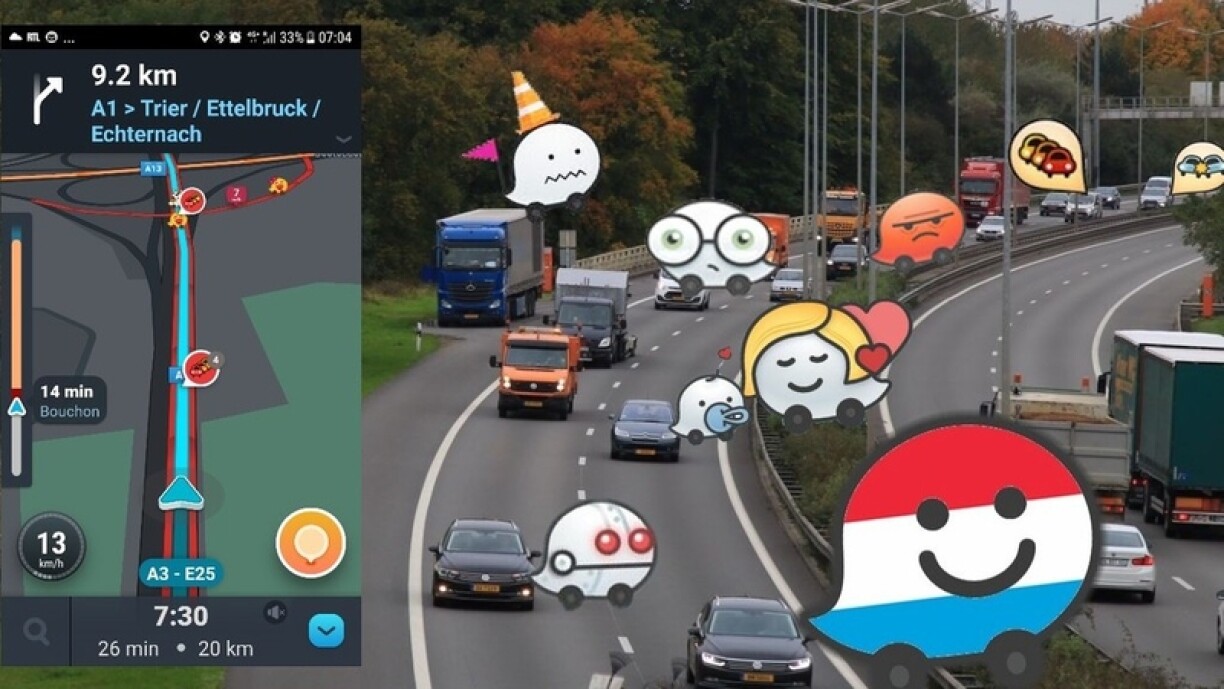
Waze stands out due to its crowdsourcing feature - each user can add information on routes, namely whether there is a traffic jam or an unreported construction site. The name is a play on words of the word "ways", which has multiple meanings such as being a method or a road. As a result, Waze uses these multiple meanings to reflect its core ethos, which is to provide users with different options to reach a destination. The app uses the geolocalisation of users, allowing Waze to adapt journeys in real-time based on traffic status. However, the app also makes use of its "wazer" community, who report accidents, traffic jams, speed cameras, and detours.
The app has certainly had a significant amount of success. Worldwide, nearly 120 million people use the app. After the United States and Brazil, the app is most popular in France. While drivers in Germany seem more cautious, the number of "wazers" is growing in Luxembourg.
The app's success is due to its community aspect. In turn, the app creators have developed the community by creating categories in order to personalise the app experience and compensate those who participate the most.
Different categories include:
What is most interesting is that this army of smartphone users do this on a voluntary basis.
The app is free and offers its services thanks to millions of volunteers. This could make people suspicious, as offering a free service often makes people suspect they (or more specifically, their data) may be the product in question.
And that does appear to be the caveat. Wazers' data, such as journey preferences, lengths, habits, holiday destinations, and more, are worth gold as the app monetises it by selling advertising space to businesses.
As a result, Waze will suggest businesses that are close by to the user. Usually, the businesses at the top of the list will pay the most to the app. Given its algorithm which quickly learns all your habits, it's no surprise that the app has become very popular with advertisers.
Waze's strength lies in its role similar to a police officer who distributes traffic in an even manner. As an example, if an accident occurs on a motorway, Waze will not redirect all users to the same route, as this would lead to another traffic jam. Instead, the algorithm sends its users on different detours. The algorithm attempts to personalise its GPS as much as possible, bearing in mind whether the user likes to drive slowly or prefers to avoid motorways, for instance.
An issue does emerge from this traffic redirection, as certain municipalities could view Waze as a curse. The distribution could turn small, quiet villages into main thoroughfares. In France, for instance, the commune of Lieusaint (Seine-et-Marne) happens to be located near the famous saturated and busy "Francilienne" ring road. As a direct consequence of Waze's traffic distribution, Lieusaint has become inundated with cars driving through during rush hour. The commune counting 13,000 residents did introduce counter measures, such as a one-way street and traffic lights, but these have not been very successful.
So how does the app face this sensitive issue? Some wazers have become more involved in public relations in areas, anticipating events such as festival or marathons and as a result, collaborating with public authorities.
If you're heading on holiday tomorrow and would like to know what time you need to leave in order to arrive at the airport, Waze can tell you exactly what time you need to leave. If you put in your destination and press the "find the best time to leave" button, the app will provide journey times based on the time of day. The app usually seems to be reliable in this sense, but cannot account for any issues during the journey, so it is best to add some time to your journey.
Waze shows you how fast you're driving, but can also warn you when you go over the speed limit (if you wish, of course). The app allows users to choose a warning sound based on going over the speed limit by 5, 10, or 15% or by 5, 10, 15 km/h.
Waze allows users to change the voice of the app with both entertaining options and your own voice.





