There are plenty of horror stories about renting in Luxembourg, and the aim of this quick guide is to ensure that you don't end up in one of them.
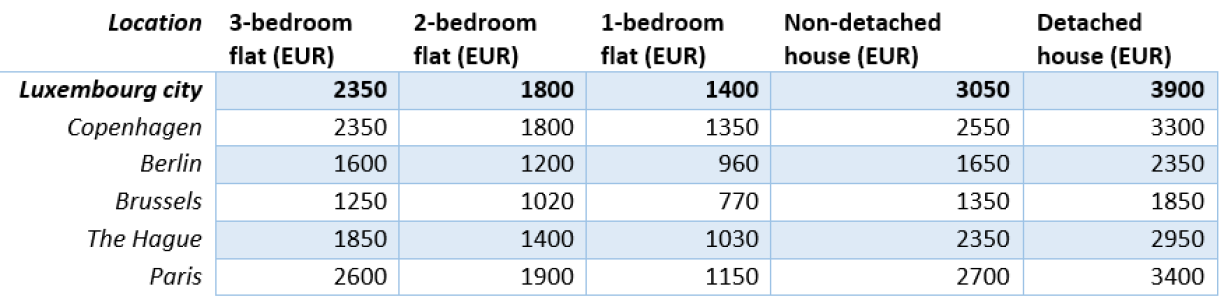
Housing is notoriously expensive in Luxembourg. Data from Statec (the national statistics agency) suggest that the average household spent €23,356 per year on rent, charges, heating and lighting in 2017. Unfortunately this is the most recent data available.As a means of comparison, Eurostat also provide average data for various housing types for major European cities (2017):
There’s a link to the full dataset below, but to save you some time I can reveal that Luxembourg tops the chart for most expensive detached house if we discount London – which seems only fair given current circumstances. It’s also in the top-3 most expensive cities for all other housing types. Buying is generally seen as advantageous if this is an option for you, and we’ll have a whole separate guide on that in due time – so stay tuned!
Most rental properties in Luxembourg are managed by estate agencies, rather than by landlords themselves. This unfortunately brings with it an additional cost to the tenant, and on average renters will be subject to an agency fee corresponding to one month’s rent plus VAT (17%).
In addition to the agency fee, you will also have to pay a deposit to cover any damage you may cause to the property during your tenancy. The deposit cannot exceed 3 months' rent by law, so be wary if you are asked to provide a deposit that exceeds this amount. You should also never pay a deposit or any form of down-payment before viewing the property.
Fee type | Cost in EUR |
First month's rent | 2350 |
Agency fee | 2749,5 |
Deposit | 7050 |
Total | 12149,5 |
While the standard rental duration in, for example, the UK is usually around 1 year, you will need to plan a bit further ahead in Luxembourg. Most homes are rented on a 2 or 3-year lease, with a renewal notice issued 3 months before the end of the first rental period.If you don’t want to commit yourself to staying somewhere for quite that long, the rental period is negotiable – but you may find that trying to agree on a shorter lease will limit your options, as landlords naturally prefer longer leases, and there is no shortage of potential tenants in Luxembourg. With population growth outpacing that of new construction, it's a landlord's market.If you wish to move out at the end of your rental period, you should notify your landlord or agency a minimum of 3 months before the end of your lease. You are legally liable to pay 3 months rent following the date of your notice.Another thing to keep in mind is that rental agreements in Luxembourg do not have a so-called diplomatic clause, which in some other countries gives you the option of moving out at any time during your agreed rental period if you give a 3-month notice. If you wish to move out early, you should discuss this with your landlord or agency who may offer you the option of moving out if you find a replacement tenant.
The actual payment of the deposit can be done in many different ways, as Luxembourg does not have a standardised safe deposit scheme. Again, it’s important that you are aware of the different options here and what they mean in practical terms. Let’s give them a quick run-through:
…is sometimes easier said than done! If you’ve done some research on renting in Luxembourg already, or made the mistake of asking about it in for instance an expat group on Facebook, you will no doubt have encountered several horror stories with tenants who had to fight tooth and nail to get their deposits paid back. This can of course happen, but the best way to ensure that you don’t end up in this sort of situation is to know your rights and obligations before you sign anything. If you’re only going to take one thing away from this article, I would suggest that you make it this part.
The first thing you should do is make sure that you are happy with how you are paying your deposit. We covered the various schemes above, and if you reach agreement on using a simple bank guarantee this will certainly provide some ease of mind. Even then, however, you should keep a close eye on the rest of your rental lease and entry inventory.Many leases include a clause wherein you as the tenant declare that the property was in good condition when you moved in. By signing a lease with this clause, you essentially waive your right to raising any issues down the line when you move out, regardless of the evidence you provide. Moreover, unless an inventory is drawn up it is assumed under law that the property was in good condition when the tenant moved in. In other words, you will want to make sure that any issues whatsoever are noted in a rental inventory.While very common, rental inventories are not a legal requirement. It is very much in your interest as a tenant that one is agreed, however, and as such you should make sure to draw one up jointly with the landlord or their representatives.Things to keep in mind when drawing up an inventory:
Assuming that you have paid a deposit, an inspection will be carried out when you have left the home and returned all keys to the landlord. Remember that you have agreed through the lease to return the premises in the same condition as you found them at the start of your lease, so this is where that entry inventory comes in handy should a dispute arise!Many landlords will apply a fresh coat of paint to their properties before a new tenant moves in, and will ask that you either do the same or pay for it through the deposit when you move out. With that said, you should know that you are not responsible for damaged resulting from normal use, dilapidation, or wear and tear.
In theory, you can demand the return of your deposit if (1) an exit inventory has been carried out, and (2) you have returned all keys to the property. Do make sure that the exit inventory is signed and dated, and keep in mind that the landlord can deduct unpaid rent or charges from the deposit before returning the remainder.If you owe the landlord for any additional expenses at the end of your tenancy, you will have to wait for an annual breakdown of costs before you will receive your deposit. There is no time limit within which this has to be provided to you by the landlord, but in the first instance you should send them a formal demand for this document if you have not received it within a reasonable amount of time. Should this fail, you can pursue legal options through the judiciary.
Eurostat data on rental costs
Further official guidance on renting in Luxembourg





