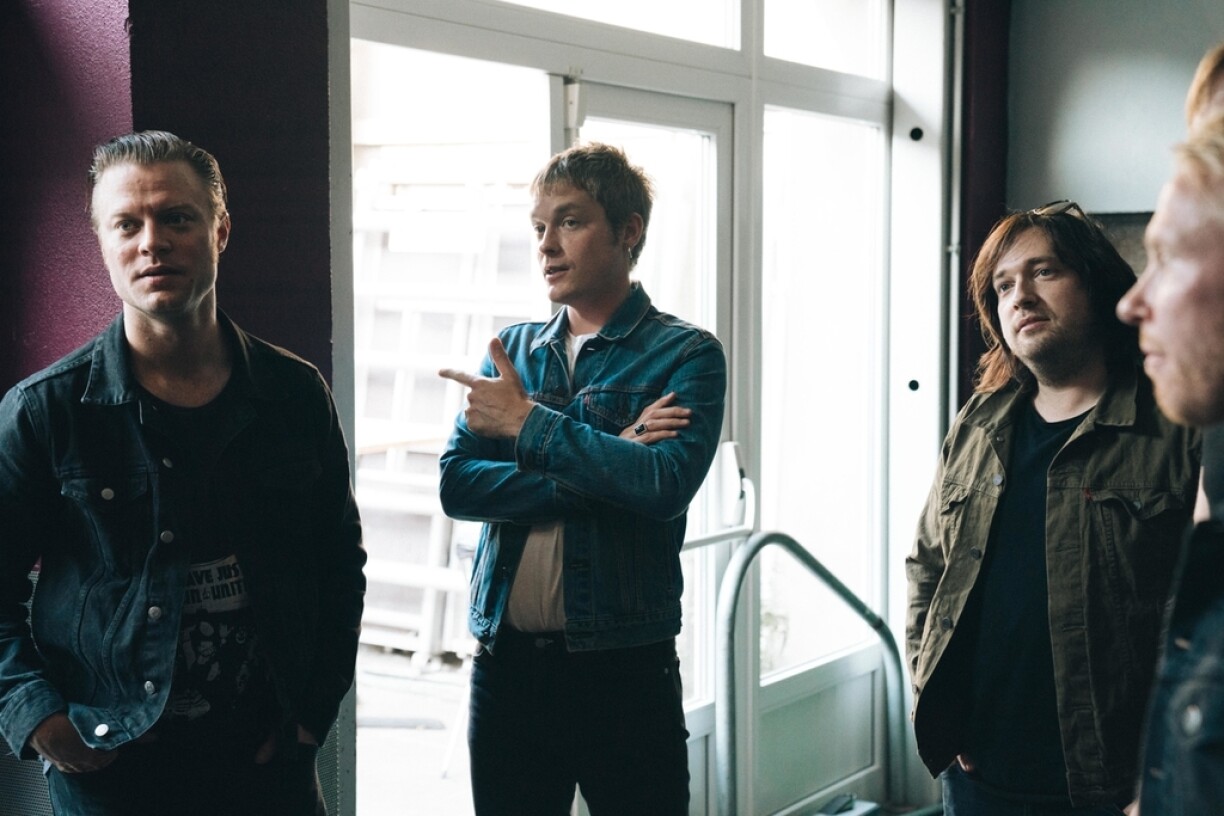
TM - Quite a lot has happened throughout your 20 year career...line-up changes, media platforms, the business at large, how difficult is it for band's to adapt to changes like these?
CFJ - We've always been a kind of touring band, really, so we haven't felt much of all that. We live for playing music live as well as recording live, of course but we've been travelling for almost twenty years. That means there's been no big change for us...I think.
PH - You do have to tour a little bit more these days than you did before, that's maybe the main difference.
TM - Why does that require more touring?
PH [laughs] - to earn more money. Basically that's the main thing....
TM - What's the issue in that regard?
PH - Well, you don't earn much money on the streams, it's not something we complain about. It's a fact and you have to adapt and deal with how things are now. So we go with the flow and keep on playing music live. That's a BIG difference to how it was 15 years ago.
TM - So, what would you say is the main issue that comes up as a result of a busier tour schedule?
CFJ - More time away from family of course. And less time to make music.
PH - Less time in the studio, for sure, but as you get older you get a little more efficient. As soon as you get family and kids you need to become super efficient. Now we record during the day, we get up early to head to the studio - when we are actually home. So, all in all there's pros and cons.
CFJ - We are far more productive than in our younger days for sure.
TM - That's something I wanted to ask you as well, how has the way you produce music changed, then?
CFJ - That's a very big difference, when we started out, the first tracks we did we had a porta-studio that we recorded on and we actually released them but when we went into an actual studio there was like this big fucking tape machine and a producer shouting at you 'playing fucking better' and it costs you a fortune to go there and you were not in control of what you were actually doing. I mean, you would ask the produce to do this or to do that and he would try it out. Today we are doing it all ourselves - we have at least three producers in the band. Patrick is qualified as a sound engineer, so, you know, we could make a record without really spending any money at all.
TM - Without using a producer as a sounding board for ideas, how easy it, then, to get some decent quality control or an outside view?
CFJ - Well, I mean for the last five years we've been doing everything ourselves - I think we trust our experience, I've been working as a producer for almost 20 years and we've done big shows in and outside Sweden, so I think we know when we have a good take, when we have a good song. We never go out and ask the public or friends if it's good enough; we make the decision in the band and if we're happy, we're happy, so we release it. What the worlds thinks, that's another story.
PH - It'd probably be fun to work with a hotshot producer at some point as well but, you know, we're kind of control-freaks, so we think that we're better than anybody else! [laughs]
TM - So how do you control your music, what are your different steps? When do you say 'this is how it's supposed to go'?
PH - Well we just go to the studio, we set it up ourselves and we have a vision and an idea before we start recording how it should sound, what kind of mic-ing technique we're using, how we want the sound to be. We work on our guitar sounds ourselves, the bass sounds and everything, so I think we are in complete control. And then we have someone who presses record for us and that's basically it. So I think we are in total control all the time, actually.
TM - After producing the music, after working on it, it's really hard for many bands nowadays - especially when having been in the business for quite some time - to stay relevant. Is that something you guys think about? Something you guys work on?
CFJ - There's two sides to that, because I think if you want to stay relevant, one think you cannot do is listen to current music too much and see what's hip right now, because you have to create the new trend, and for us, on this record, it's been really important to show people what we really are - I mean, we're a rock 'n' roll band and we wanna stay a rock 'n' roll band, like it or not. But this is Mando Diao and this is how we sound, and to us that's super relevant. I think that rock music is sort of an 'underdog' these days, but I think people miss that - you know, going to rock concerts. Two years ago, if you wanted to be relevant, you made EDM, and today, if you want to be relevant, you have to come up with something different, new. Or, take something from the past and make it new again. But to be relevant, I think is to be who you are.
TM - You have been experimenting a lot in the last couple of years, with 'Good Times' as well in 2017, what can people expect?
PH - Rock music!
CFJ - Rock music, yeah. Playing honest rock music I think. The difference with 'Good Times', I mean, we've playing a couple of hundred live shows since - well when we made 'Good Times', we were a new group: Jens was new in the band, Gustaf left. So it was little more, not trial an error, but we were fresh, it was like a fresh start for the band. Since then, we have matured together, we have played together, and we have found our sound again, somehow. So I think this record is more honest; there's no guesses or anything, it's just us.
PH - 'Good Times' is a great record, but it's a bridge between what we used to be, and what we are now. After 'Give Me Fire', we became very experimental. We made a Swedish record, we did MTV Unplugged, and then we came up with 'Aelita', which was like an electronic sort of rock album. That was a super fun period and exhausting at the same time, but we were really trying new things, breaking new boundaries. When we came to 'Good Times', we wanted to go back and see what it was like to be a rock band, but we still needed to make that conversion between what we used to be and what we wanted to be. I think 'Good Times' is the bridge between this record and 'Aelita', so to speak.TM - How difficult is it for a band to not copy-paste a sound over and over again, especially when it comes-
(interrupts) PH - You have to ask AC/DC that! [laughs] [in an Australian accent] - I mean, it's not difficult at all, we've done the same song for fucking fourty years!
TM - Beautiful Australian accent!
PH - Thanks! [in an Australian accent] - That's not a rock song, this is a rock song! [laughs]
TM - This is my last question (it isn't Ed.): what do musicians do, or specifically, what do you guys do when you're not working on music, when you're not touring? You said earlier on it's actually difficult to find time for family etc. - what do you do in your spare time?
CFJ - Different music projects. Everyone in the band has other bands, other projects. So that's about it.
PH - Yeah, but I mean, it's not all about that; both you and I enjoy going out into nature for example. If we're not talking about music, you like to ski, for instance, and I love cooking. You like working on building your house and you know, stuff like that.
CFJ - Like ordinary people.
PH - Yeah.
TM - So what's you speciality as a cook?
PH - Oh, it's lots of different things! Right now it's the crayfish season, so there's a lot of crayfish going on in Sweden - but mainly I would say Mexican food is one of them and Italian food, of course, East European food as well, Yugoslavian dishes have been a favourite of mine, so it's very diverse. I used to break a lot of bread before, but now I'm gluten intolerant, so I baked to much bread!
TM - Sounds like I should invite myself over one day!
PH [laughs] - Yeah.
TM - And what's your favourite skiing region?
CFJ - A place in northern Sweden actually, although I love the Alps, but there's a place called 'Riksgränsen', by the border of Norway to Sweden, above the Arctic Circle; it's magic, it's a magical place. The sun never goes down, and the snow is whiter than white!
PH - And in Winter it never comes up!
TM - I've heard about that! Awesome, thank you guys very much, your time is much appreciated!
CFJ - Thanks!
PH - No worries.
Interview - Mando Diao - Down in the past and looking to the future





