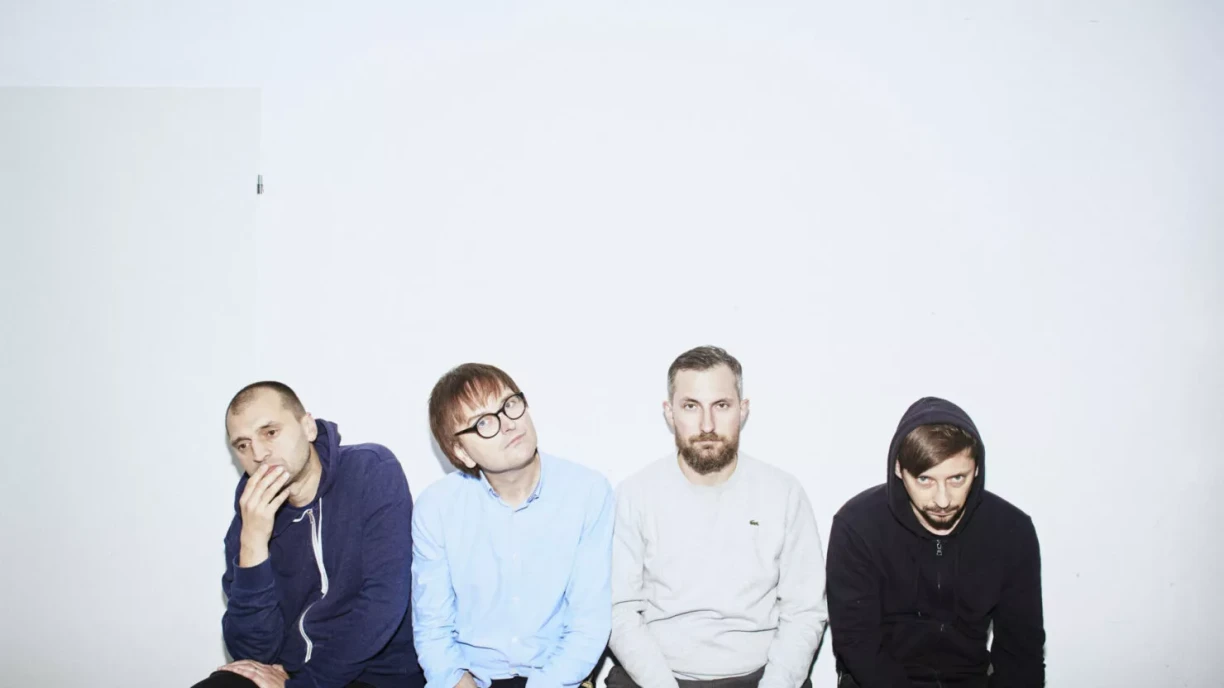
The group is playing Rotondes on 16 February. Grzegorz Kwiatkowski (aka Greg) sat down over Zoom with Josh Oudendijk to chat about the new record, growing up as a band in Gdańsk, and the advantages of having problems.
Tell me about Gdańsk. People frequently only visit Warsaw, but what is your city like?
I really think Gdańsk is something special. The way that it is surrounded by great nature, forests, a city by the Baltic sea. It's in the north of Poland, and it is very unique in terms of history. The Second World War started here in Gdańsk, as well as the solidarity worker movement in the 1980s. In some way this solidarity movement defeated communism in Europe.
In my opinion, this is a great place, both tragic and great. A city of transgression, and I think it's not a typical Polish city. It's more open-hearted, I would say.
Do you feel a difference in mindsets between people in different cities?
Totally, but I would say people living in capitals are often the same, often busy, you know. I prefer this calm style of living, I prefer not to be in the centre of action.
So are you all from Gdańsk?
Yes, we've all been living here for many years. Trupa Trupa has a democratic structure, which is not often the case in rock'n'roll groups. We don't have one leader, one frontman. I think that is all connected to the city of Gdańsk, the solidarity movement.
My friends have different ideas and opinions, we don't have the same influences. I'm pretty sure most of my friends would say Gdańsk has nothing to do with their music, but I have a different idea. But that's democracy. Our music is the result of...the process of arguing, in a way. We are still discussing things. I think our music is the result of that.
So tell me about your songwriting process in the band. If it is very democratic, then how does it work?
Yeah, that is the problem. Generally speaking, it is very problematic to have a democratic structure in the process of composing. What is more important is that the four of us have different ideas of music. We love Fugazi, The Beatles...but then our paths are different. For example, for me the most important this is classical music. Glenn Gould, Beethoven, string quartets. For Wojtek Juchniewicz it is Sonic Youth and such. So it's very hard to compose something without hurting anyone, you know what I mean?
But I think we succeed in the way of problems. Every problem for us is successful, we have an ability to work with problems. And because of these problems we create good successful stuff. There are a lot of great, professional indie rock bands in the world. I like them, I respect them. But there are not a lot that have got tonnes of problems, and from these problems nice songs are born.
You need a challenge, a struggle, to get something out of it.
A challenge is a great word.
You want to respect everyone's tastes for music, does that happen in the songwriting process or only in the studio when people become more opinionated?
The important thing is we're discussing composition and arrangements. For example, if you're a member of Trupa Trupa, and we're starting to jam, and you are playing some notes I don't like, then I will tell you to please consider changing it. So maybe you consider changing it, or you say: "No, I like it". But after all we've got a producer, a fifth member of the band, which is crucial. Because he takes our problems to his room, and I think he is making the final versions from this problematic situations. I think he's got an intuition. He is saving us in a big way.
In some way we are not in the right place, in some way this band shouldn't exist. But this is one big challenge. One cause of that is that we create some different, strange stuff. I know that we are good in problematic situations.
I remember that one time we were recording an album for Sub-Pop Records and we were in a great, very expensive studio, and I really didn't feel comfortable there. For me it was too professional, too nice. Anyway, I was so bored in this recording session! I was so bored, because it was all so clean, so dead. After the all, the album was very boring, so slow, in a radical way. By accident, we achieved something we didn't expect. We created very slow, depressing music. But after all we succeeded with this album because of these "too good" circumstances.
As you can see we are searching for problems. Even if we've got a great studio, something is wrong with our behaviour, and then we have other problems. As long as we have problems, everything is well.
So is that why you prefer to be in the dark basement, the one we could see during your Tiny Desk concert from home? Tell me about that space.
Now we have a new studio. But this was our home for many years, in one of the oldest parts of the city. I guess the building was from the 16th or 17th century. We really loved this place. I think Tiny Desk is a good example of Trupa Trupa. Tiny Desk and NPR asked us for an acoustic set, and we don't really play an acoustic set. So we had a problem. But on the other hand, when we started to record, it was so depressing, the studio is so ugly and so dark. The music is suddenly very repetitive. I think it was the perfect combination and mix. Something with John Lennon in the vibe of music, and the darkness of our studio. This is Trupa Trupa, a mixture of joyful vibes and depressing vibes, we always have these two layers.
Is the acoustic sound something you will play live?
Live we are not playing acoustic. But we can always change our mind, it was only an episode. But the other important thing is that we live in a state of freedom, we can do whatever we want to do, in an artistic way. We can change the way we are playing, our instruments, and we are first creating music for us, and then the audience. It doesn't have anything to do with arrogance. But we have to first like our stuff, and then we can share it with others.
So the album is out now, how do you feel about it?
I am very excited, we are very proud of this album. We are proud of every album, if we aren't then we wouldn't share it with the audience, but we are especially proud of this one because it was written and recorded in the pandemic. It was an especially hard time. Our tour dates were cancelled, and suddenly we had a tonne of free time for composing and recording. So we really focused on it, suddenly it was a totally unexpected situation.
Of course we were all in a state of paranoia and fear, we were afraid of the future. So I think these hard circumstances created the mood of this album, the intensity of it. Something that is not very good for life, a human, can paradoxically be good for art.
Would you say this is your best album, or just different?
We are proud of every album, but the Headache album from 2015 was very special because it was very dark, intense and direct, and we recorded others, but we always loved this Headache album. So we thought that maybe this would be a good step. You cannot record an album like that again. We didn't want to record Headache number two, but I think we recorded an as intense album now as we did with Headache.
Where does the title come from?
It's a mystery...I am not an author of it, it's the title of the last song. As far as I understand it, it's a song about the destruction of identity. This album is about the disintegration of personality of someone, B FLAT A is the last song, the last step.
Trupa Trupa's new album B FLAT A is out now. They're playing Rotondes on Wednesday, 16 February.





