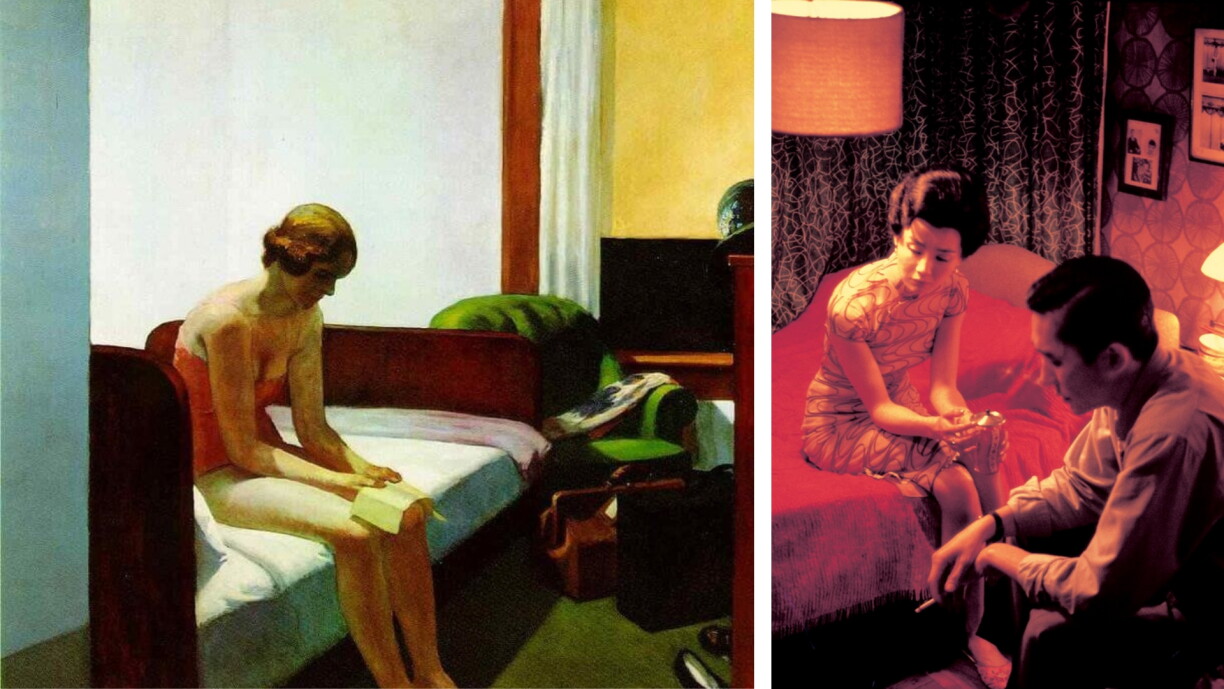
Edward Hopper is known for being one of the most influential realist painters of the 20th century. His art captures the quiet, reflective, and lonely feelings of modern urban life in America. He depicts mundane, everyday scenes, most famously diners, gas stations, or hotel rooms.
These captured moments exist outside of time, moments in between past and future. In these ambiguous scenes, the viewer is left wondering what's to come next.
Art has often been a source of inspiration for movies. In order to create or reference iconic visual languages, movies can borrow thematic elements and extend them into motion picture stories. Hopper has never made a film, yet a lot of movies reflect a 'Hopperian' essence.
In cinema, filmmakers can choose to slow the pace down so much that the frames start resembling a Hopper painting.
What follows is a comparison of a number of movies and how they relate, reflect, or take inspiration from famous Edward Hopper paintings.
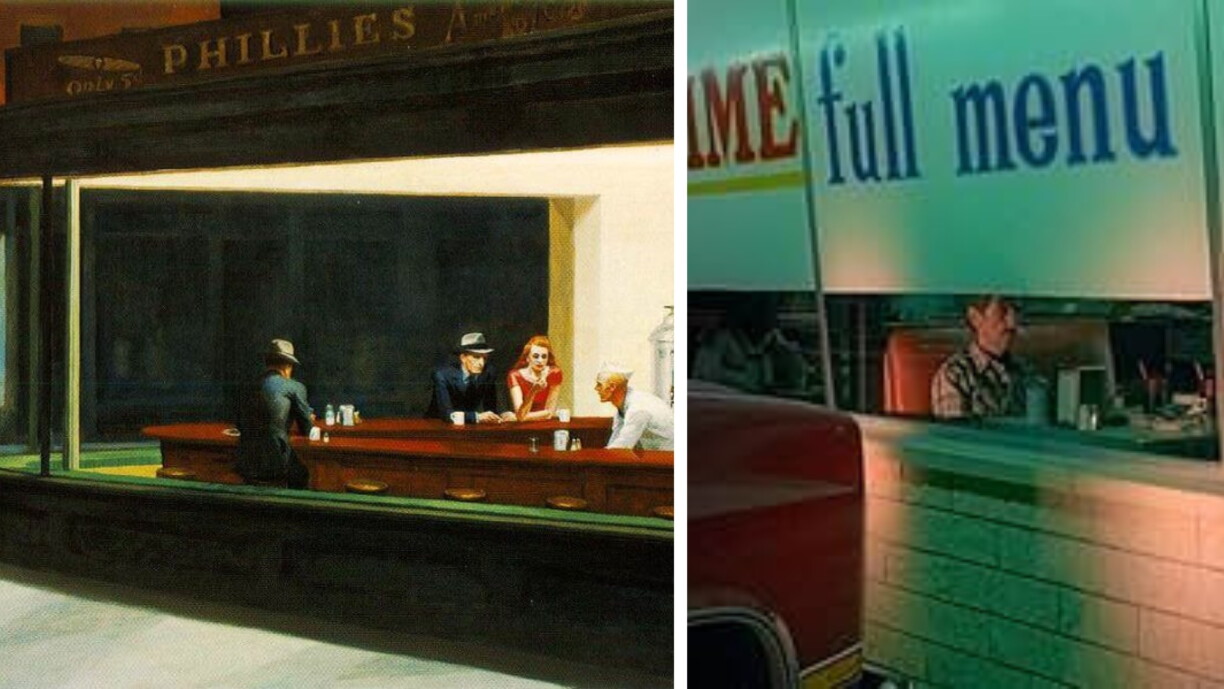
In Paris, Texas, director Wim Wenders transforms ordinary settings into isolated grounds. The American roadside comes to signify a journey that starts in isolation and ends in the acceptance of emotional estrangement.
The main character, Travis, wanders through the desert after having been missing for the past four years. The audience is not given much background information. With the help of his brother, amnesic Travis eventually tries to piece his life back together. He first wants to reconnect with his son, then find his wife again. The movie is ultimately about coming to terms with the reality of not being able to turn back time, and the relationships that tear in the process.
While not explicitly referencing Hopper, Wim Wenders has voiced his admiration for Hopper's work several times. Both worlds share a sense of silent spaces. Both are alike in their depiction of empty landscapes, and solitary figures like Travis, who embodies the Hopper-esque, reclusive archetype.
Hopper famously paints from the perspective of an outsider looking inside private spaces, most often having windows in the frame to make the private-public distinction clearer. Paris, Texas similarly uses windows to display emotional blockades, most notably when Travis meets his wife in the peep show booth.
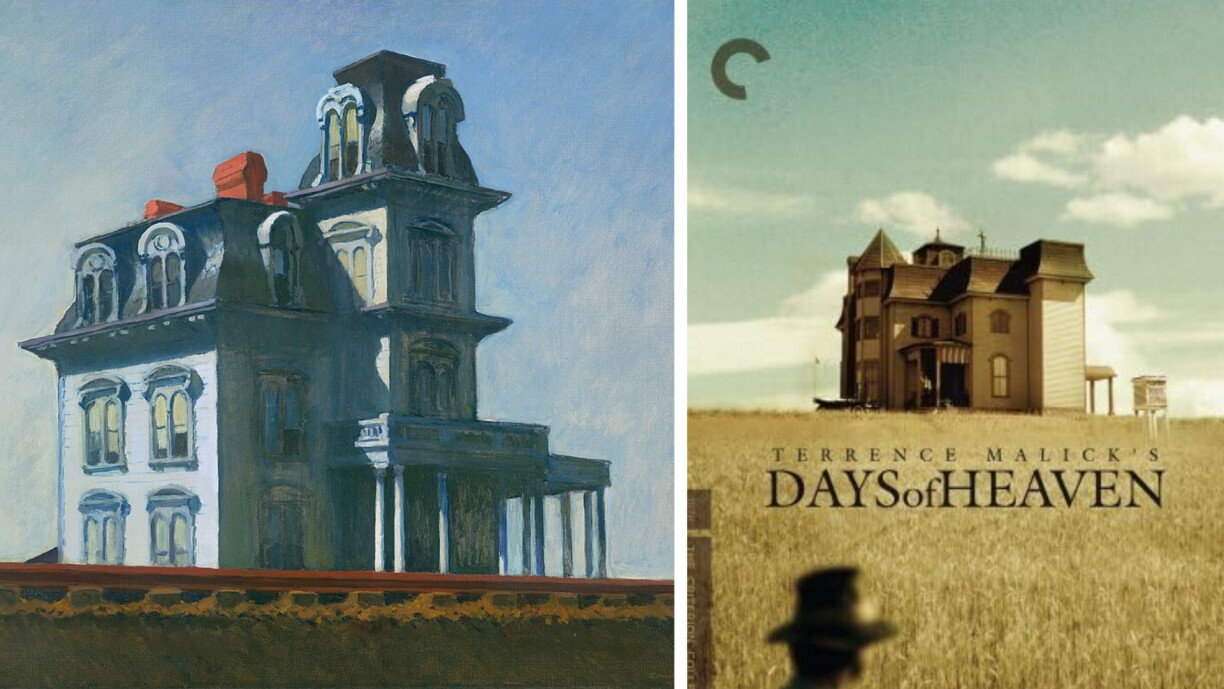
Similar to Paris, Texas, Days of Heaven finds meaning in deserted landscapes. In it's focus lies the rural Midwest, and the vast wheat fields within.
Set in the Texas Panhandle during the early 20th century, the protagonist Bill flees Chicago with his girlfriend Abby and his younger sister Linda in search of work. They find work on an estate of a wealthy farmer, whose solitary house looks a lot like the building from Hopper's painting House by the Railroad.
Terrence Malick's film visually draws on Edward Hopper's painting. What stands out most, besides set design, is the use of lighting. Similar to Hopper, Malick uses natural light, and dramatic shadows, which ends up giving the movie a painted aesthetic.
The cinematographer Nestor Almendros drew inspiration from painters like Vermeer, Andrew Wyeth, and Edward Hopper to imitate the style of early 20th century photographers.
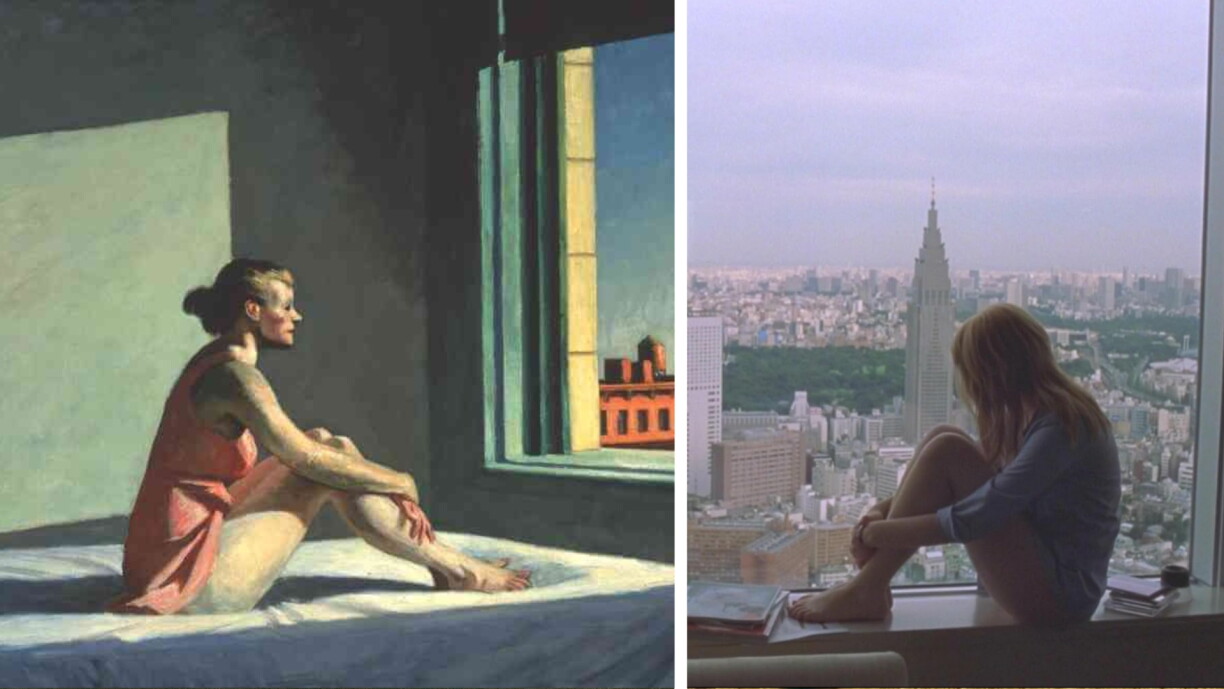
Edward Hopper also finds his likeness in the movie Lost in Translation, directed by Sofia Coppola. Similar to the paintings, the movie finds its characters unable to connect with their surrounding.
Lost in Translation is set in Tokyo, where the two characters Bob and Charlotte find solace in each other's company, while otherwise completely alienated from the city. The theme of isolation in the movie is both meant in the physical but also the emotional sense, as both characters seem confused in their own lives.
There is not a lot of dialogue in the movie; similarly to the Hopper paintings, the meaning is conveyed through body-language. Charlotte spends most of her days in the hotel room looking at the city through the window, much like the protagonist of the painting Hotel Room. Both seem to not be at home, but more so in a transient space.
In both the movie and the painting figures linger in the frame, with no rush of exiting the scene. The audience perceives them in an almost voyeuristic way.
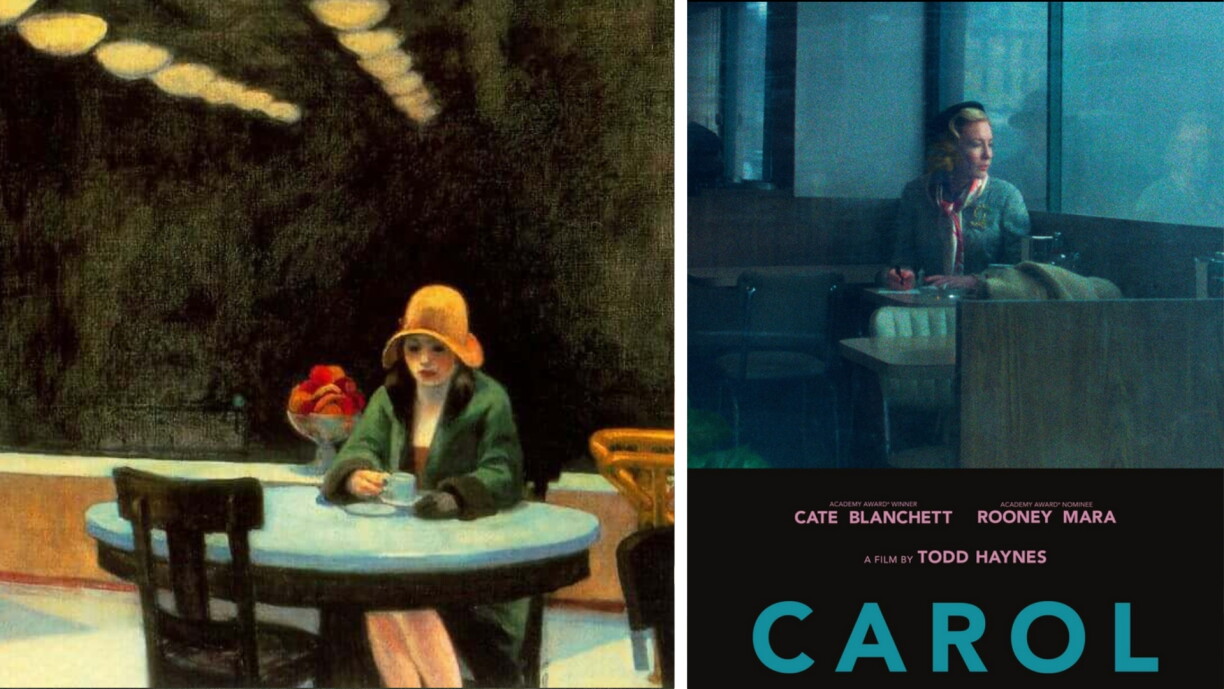
The movie Carol is a romantic drama set in 1950s New York. The movie follows an aspiring photographer called Therese, and an elegant lady Carol, who is trapped in her marriage. The story explores themes of forbidden love, and the cost of living authentically.
A recurring similarity to Hopper lies in the way we get to observe the main characters. Most often cut off from the outside world through windows, both the director Todd Haynes and Hopper depict introspective women. Both invite us to peak into a private and hidden world.
In the painting Automat (1927) a woman sits alone in what looks like a cafe. It is dark outside and the clothes suggest that it is cold. The viewer can't exactly make out what she is feeling, except that she might be a bit self-conscious. The viewer can only image what brought her to this very moment.
Might it be a story like Carol? The set-up looks similar at least. The parallels of urban solitude provoke an alienation of the self or, like in Carol, societal expectations.
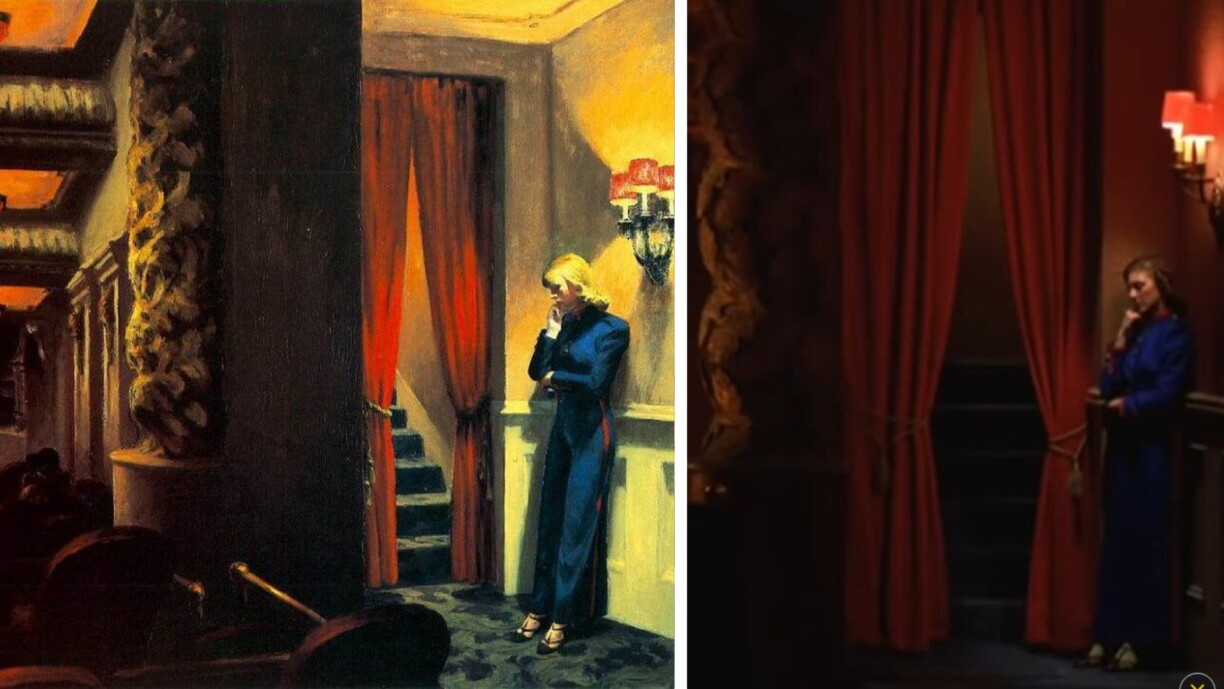
With a more explicit take on Edward Hopper, the movie Pennies from Heaven catapults the audience into a vision of Depression-era America. The painter's unique aesthetic is captured by recreating the paintings in the form of movie sets. In contrast to the previous examples, this movie pays homage to Edward Hopper and faithfully replicates his paintings.
The dark musical drama follows sheet-music salesman, Arthur Parker, who is going through financial troubles in Chicago. In order to escape his miserable life, Arthur escapes into whimsical musical fantasies, but his real world remains lonely. Dreams and aspirations clash with harsh realities.
By recreating Hopper's composition, the movie fixes its fantasies in the emotionally disconnected and somber reality of the Depression. Hopper's worried woman in the cinema captures wider themes of economic hardships and social isolation.
Other than just recognising Hopper's world, here the audience is allowed to step inside and see the paintings come to life.
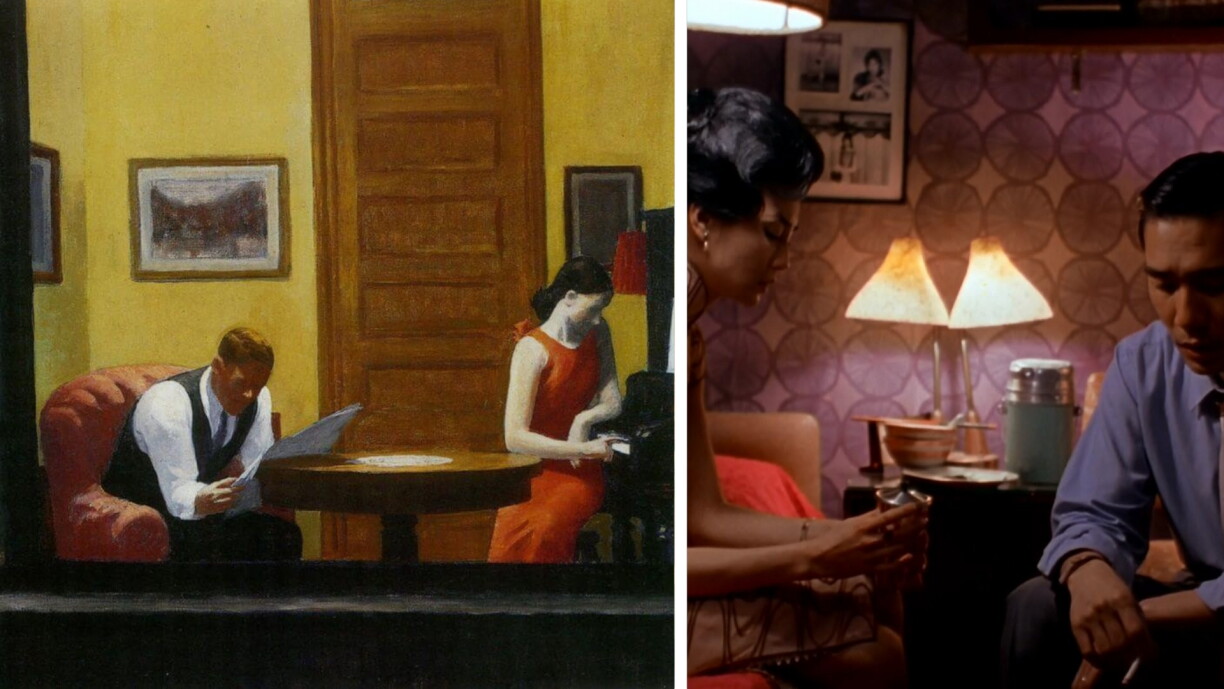
Rather than in America, like Hoppers paintings, In the Mood for Love, directed by Wong Kar-Wai, is set in 1960s Hong Kong. The romantic drama follows two neighbours, Chow Mo-wan and Su Li-zhen, who discover that their respective spouses are having an affair. The two main characters grow fond of each other's company, through a common bond of betrayal, yet vow to keep their relationship platonic.
In Hopper's painting New York Hotel the protagonists sit together in the same room, and around the same table. Yet there seems to be an insurmountable distance between them. The woman seems reclusive while the man is busy reading his newspaper, suggesting that loneliness can exist in the closest of spaces.
Parallels between the painting and the movie are striking in terms of the shared isolation and emotional detachment despite physical closeness. Throughout the movie, both characters are continuously together in confined spaces, but these intimate moments never blossom into romantic satisfactions. The spaces around them, like tight apartments and narrow corridors, bring them together but also keep them apart.
Instead they embody restraint, a burden that is also felt in the Hopper paintings. In both instances, people communicate through silence and let the space between them speak for itself.
While all the above mentioned paintings and movies are concerned with urban isolation, the distance between the characters seem to transcend physical restrictions. The viewer can't help but imagine that the same estrangement would likely endure regardless of place. The scenes depicted by Hopper don't just translate onto the big screen aesthetically but also in terms of mood.





