As part of its 20th anniversary celebrations, Mudam Luxembourg – Musée d’Art Moderne Grand-Duc Jean is presenting the project “Dodeka: 12 Works for 12 Cantons”, an exceptional initiative through which twelve artworks from the museum’s collection will travel across all corners of Luxembourg.
Hosted in museums, town halls, libraries and cultural centres, the initiative brings contemporary art closer to the public and into the heart of local communities.
Beyond the exhibitions themselves, the project will also feature guided tours, performances, workshops and concerts, inviting visitors on a true cultural journey through the country’s twelve cantons.
And that’s not all: visitors who complete all twelve stops of the project and collect the twelve stamps will be rewarded with one year of free admission to the Mudam.
Discover below the 12 artworks featured in the project “Dodeka: 12 Works for 12 Cantons”.
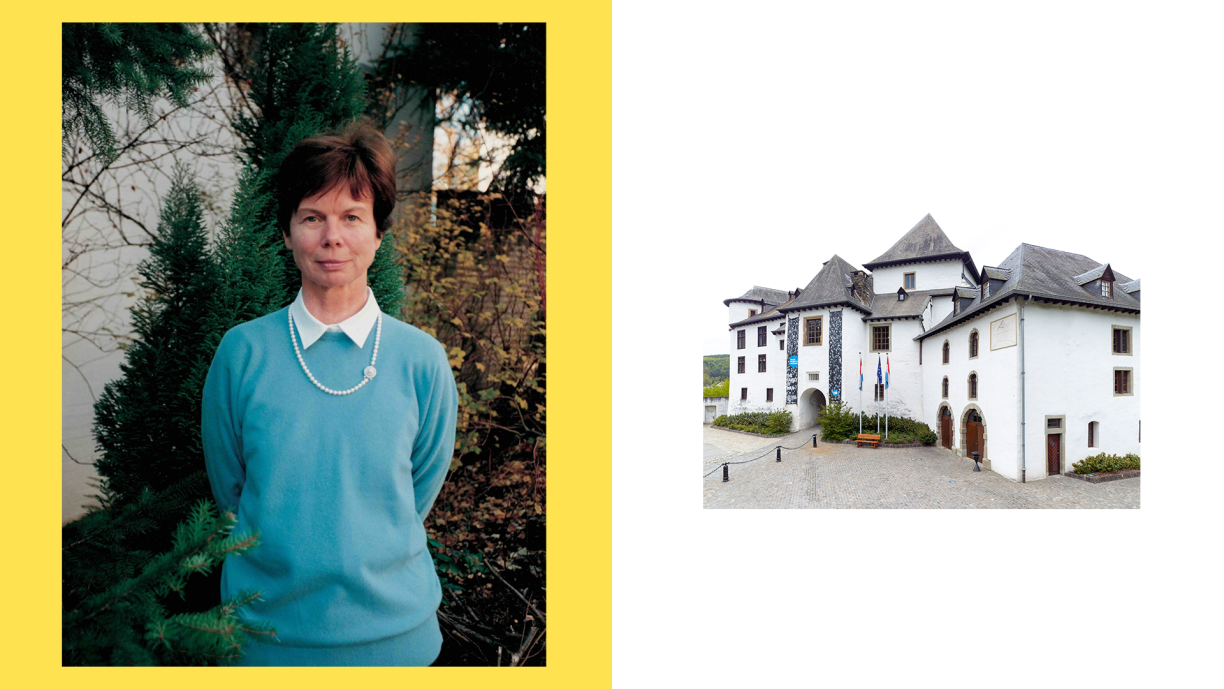
Wolfgang Tillmans has photographed his surroundings with immediacy and precision since the late 1980s, developing a practice that experiments with scale, printing techniques and presentation. After gaining attention in the early 1990s through portraits of friends and the London underground scenes, he went on to redefine contemporary portraiture by capturing fleeting moments with subtle and deliberate compositions. Across his work, which cultivates what he describes as an ‘unprivileged’ gaze that ‘anybody can adopt’, Tillmans positions photography as a space for connection beyond language.
Mami (1994), an intimate and unembellished portrait of his own mother, resists any idealised notion of motherhood. Instead, it presents a singular, personal presence – direct, vulnerable and deeply human – that stands in marked contrast to more generalised or symbolic representations of the maternal.
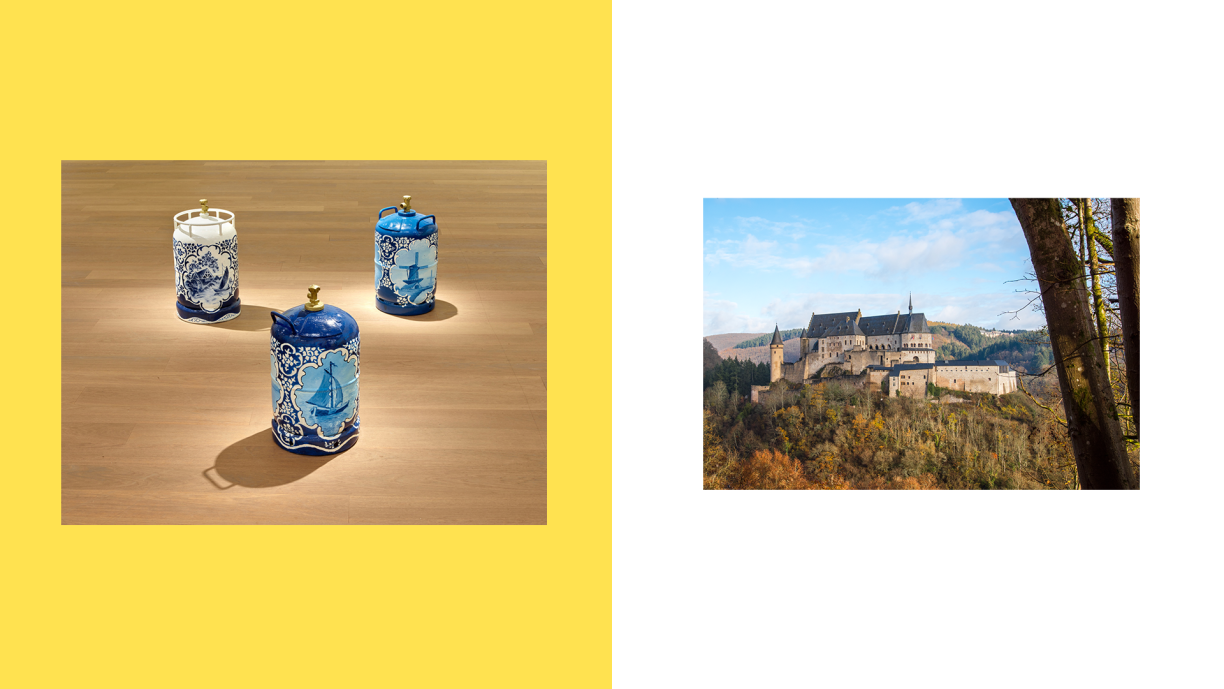
Wim Delvoye’s practice is characterised by the ironic elevation of everyday objects through elaborate traditional forms of craftsmanship. Dutch Gas-Cans is an early iteration of the artist’s late-1980s ‘displace-ments’, in which he adorned utilitarian objects with motifs drawn from the decorative arts. Here, ordinary gas canisters are meticulously painted with Delft Blue patterns inspired by seventeenth-century Dutch faience.
This anachronistic iconography evokes the Dutch Golden Age of the seventeenth century – an era of extraordinary economic prosperity, worldwide maritime trade and cultural export, during which Delft Blue itself became a globally successful commodity. Delvoye’s enamel techniques transpose motifs found on tableware or kitchen tiles onto industrial surfaces, thus bringing folk tradition, craftsmanship and the aesthetics of mass-produced objects into conversation with one another.
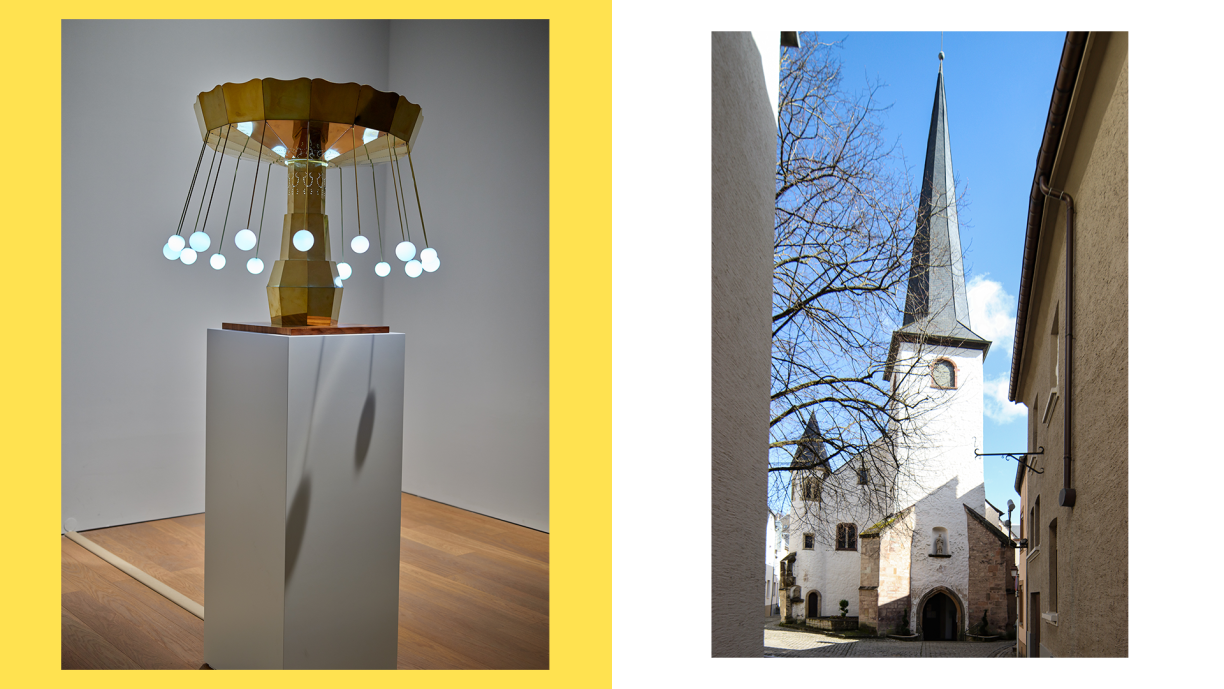
Su-Mei Tse’s installations, video, photography and sound works explore notions of time, memory, silence, rhythm and perception. Vertigen de la Vida (Dizziness of Life) (2011) is an animated sound sculpture that meditates on flashbacks and projected time travels.
It is based on the artist’s recollection of a few shots from Man Ray’s 1923 experimental film Le Retour à la raison that show a fair at night, lingering on the lights of a spinning carousel. In Su-Mei Tse’s piece, white spheres light up in sync with music composed by Giancarlo Vulcano, thus generating a circular and ethereal experience that evokes nostalgia, memory and the porous boundaries between memories and dreams.
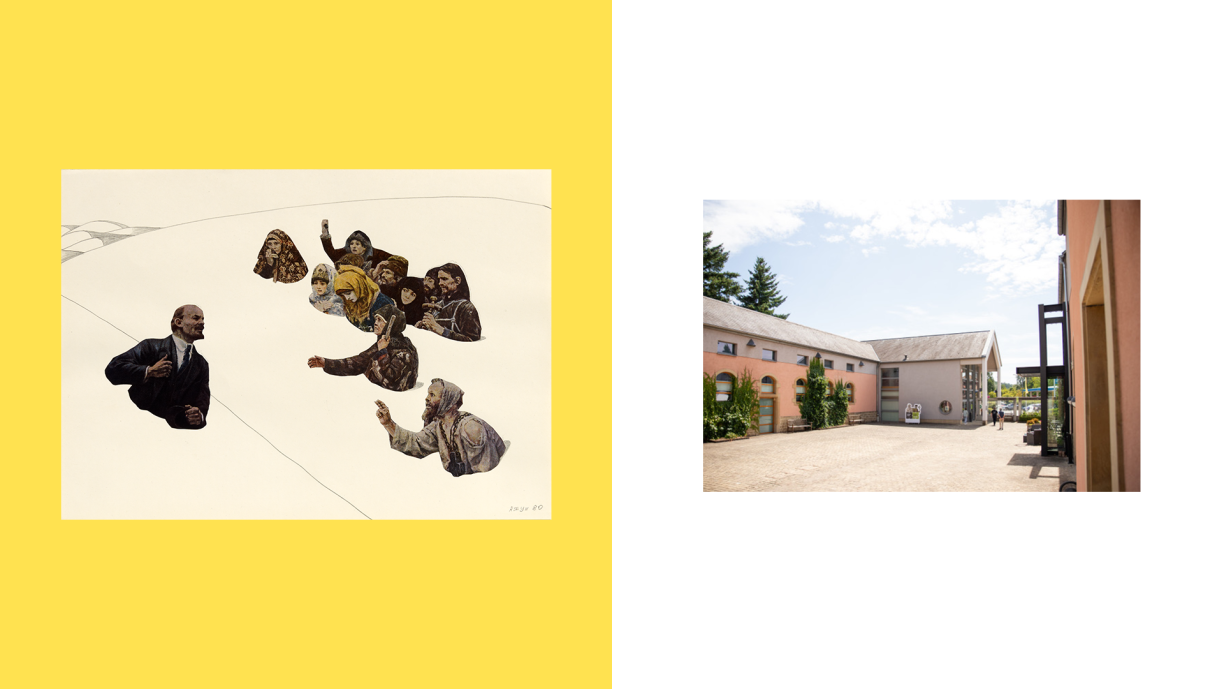
Through visual fragmentation and juxtaposition, Vyacheslav Akhunov’s conceptual practice critically engages with Soviet ideological legacies and inconsistencies of totalitarian propaganda. Lenin-Art (1977–82), also known as Leniniana, reflects on Lenin’s 1918 decree mandating the removal of tsarist monuments and the creation of new artworks to educate the masses in socialist ideals – the Plan of Monumental Propaganda.
During the 1970s, Akhunov explored this legacy through collages made from Soviet magazines, posters and reproductions of officially sanctioned artworks such as Vera Mukhina’s Worker and Collective Farm Woman (1937). By placing these ideological symbols within vast desert landscapes, he revealed the growing disconnect between propaganda and lived reality, thus exposing the internal contradictions of Soviet ideology.
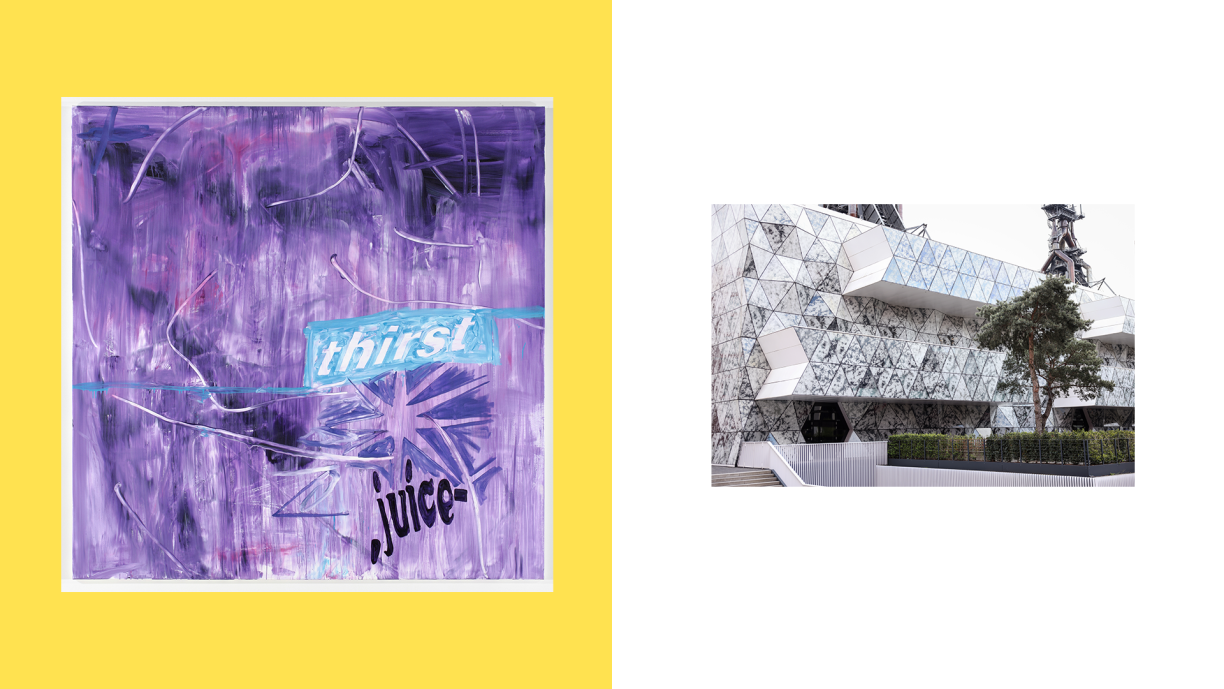
With a style that blended painting with digital media and the visual language of popular culture, Luxembourgish artist Michel Majerus became a key figure in the Berlin art scene of the 1990s. He sampled imagery from art history (from abstract expressionism to Pop Art), popular culture, advertising, video games, comics and brand logos to create a hyper-mediated visual language that reflected the hybrid spaces of the information age and consumer culture.
The painting Halbzeit (2002) appears as if freshly brushed; the purple layer is nervously scratched into the still-wet paint. Two inscriptions resembling supermarket product logos complete the composition, reading together like a commercial slogan that instantly links desire (thirst) to a product (juice).
The title, Halbzeit [Half-Time], symbolises this brief pause: a split-second interval in which a solution is presented as self-evident, without allowing time for reflection. It also evokes the half-time break in sports, when audiences are flooded with advertisements. More broadly, the work reflects on a hyper-mediated consumer culture in which images, brands and desires circulate at high speed, collapsing reflection into reflex.
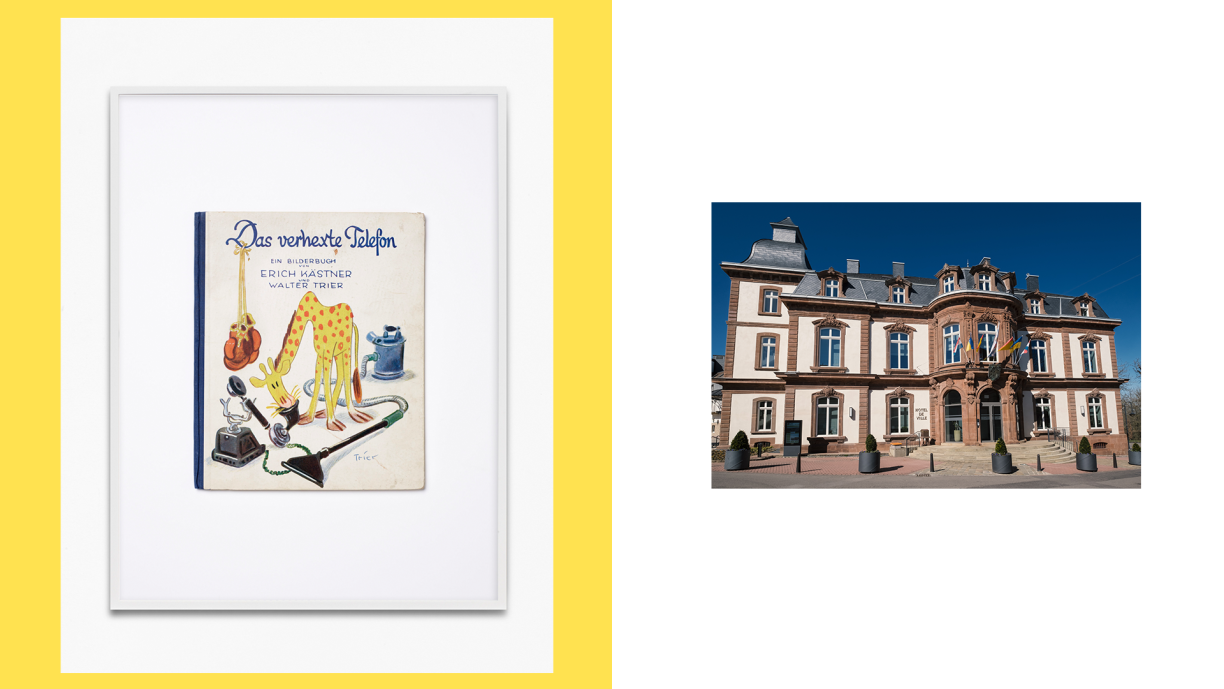
Annette Kelm’s conceptual photography draws on classical genres of the medium – still life, portraiture and documentation – while subverting conventions through precise staging, repetition and subtle interventions.
Die Bücher (2019-2021) is a growing series of photographs depicting the covers of books published between 1913 and 1945 by authors persecuted in Nazi Germany for their political views, Jewish origins or modernist aesthetics.
Now comprising over a hundred works, the series documents titles banned or burned during the May 1933 ‘Aktion wider den undeutschen Geist’ (Action against the Un-German Spirit), including celebrated and lesser-known authors across genres such as political essays, scientific texts, novels, poetry, children’s stories and popular fiction. With exacting attention to colour, texture, wear and ageing, Kelm reproduces each cover in large-scale prints, preserving traces of time and use, while cataloguing them as a quiet, archival act of remembrance and resistance to cultural erasure.
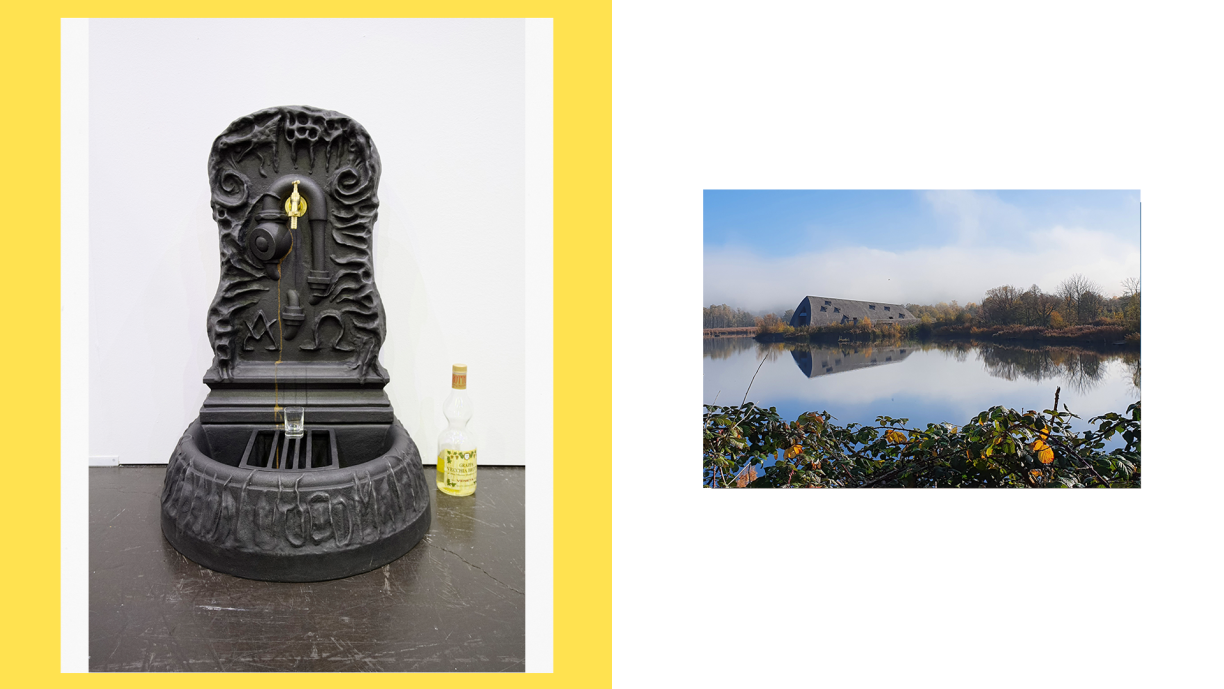
Drawing on the history of the readymade, Serge Ecker, Catherine Lorent and Claudia Passeri reframe questions of authorship and gender in art history, while testing the boundary between artwork and functional object.
sHe Is the future (2018) is a sculpture in the form of a drinking fountain, referencing Marcel Duchamp’s readymade Fountain (1917): a porcelain urinal that the artist purchased from a plumbing supplier, turned upside down, signed and designated as art.
Cast in iron with piping and configured to dispense grappa, the work foregrounds the significant yet often overlooked role of Baroness Elsa von Freytag-Loringhoven in New York’s Dada movement, where the readymade came to prominence; it also alludes to research indicating she may have been the true creator of Fountain.
The title reclaims a phrase Duchamp reportedly used about the Baroness (‘she is the future’), repurposing it to challenge conventional notions of authorship and appropriation.
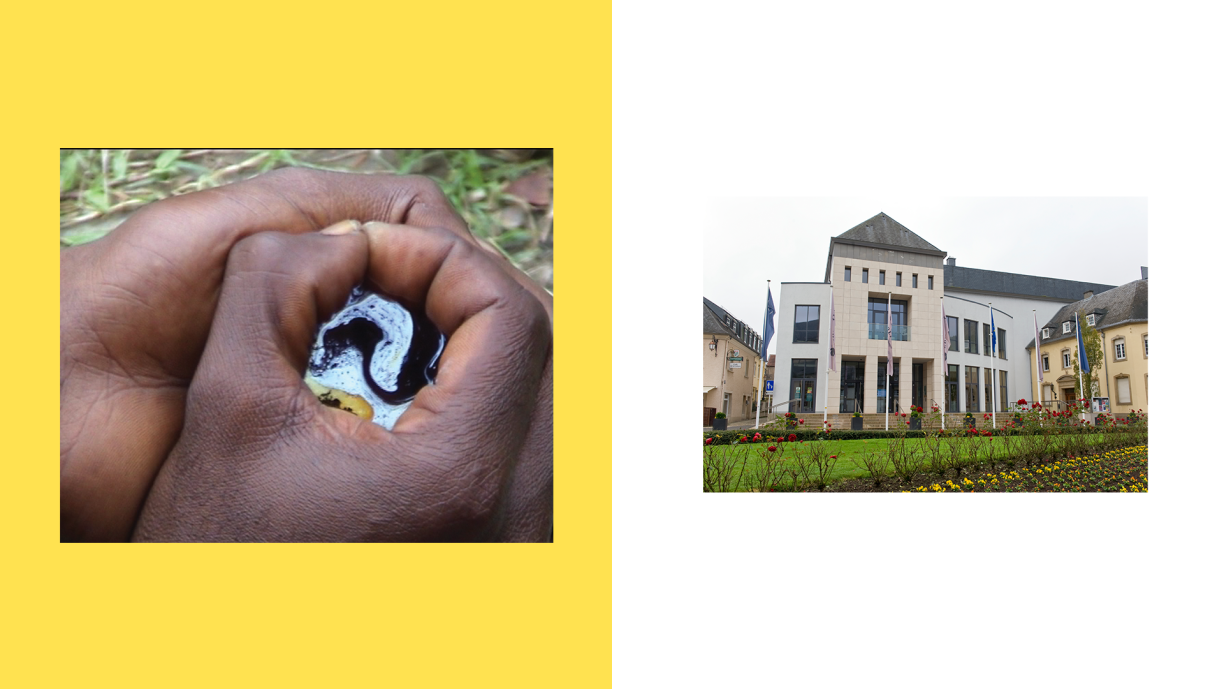
Edith Dekyndt’s minimalist art spans video, sculpture, installation, drawing, sound and performance. Through physical and chemical transformations such as oxidation, evaporation, corrosion and exposure, her investigations of natural and cultural phenomena expose the ephemerality of objects, images and sound.
Provisory Object 03 (2004) is taken from a series of short films showing a thin soapy membrane and the colourful, iridescent effects of light landing across its surface. Although shot under varying conditions – from the artist’s kitchen to the Arctic Circle – each video captures a close-up of hands holding the thin, fragile film until it suddenly bursts.
Like the soap membrane itself, the series explores impermanence and fragility. The films capture moments suspended between presence and disappearance, thus reflecting on fleeting states that hover between the two.
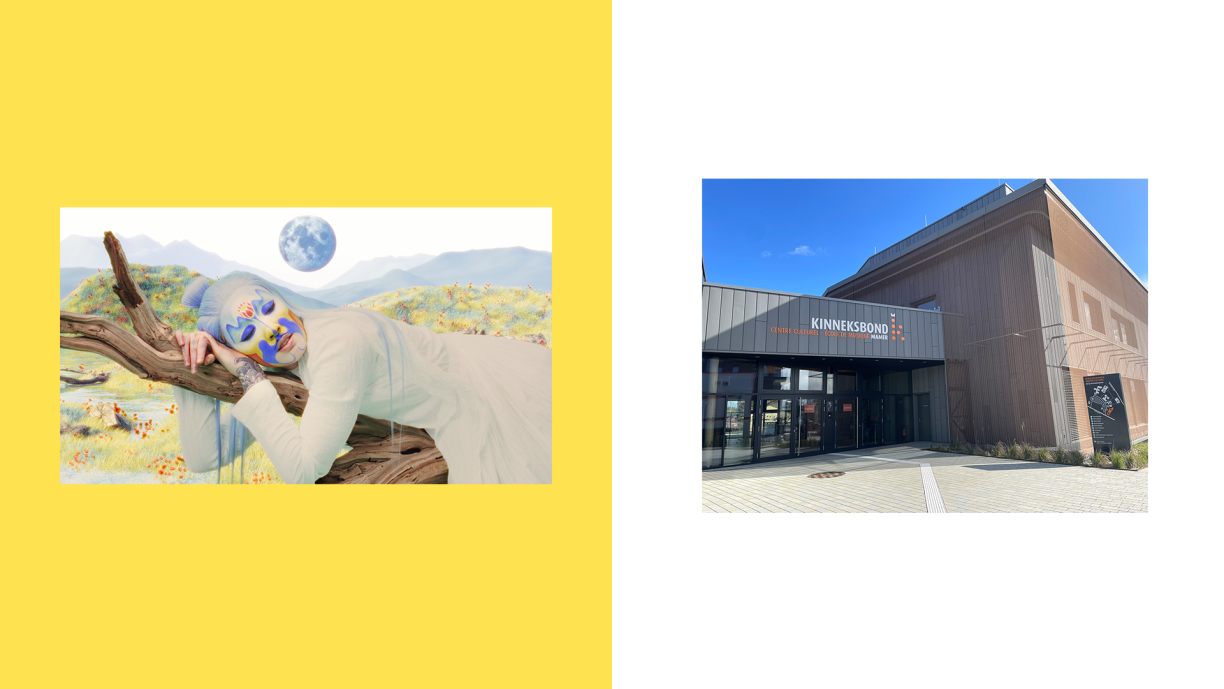
Sin Wai Kin’s practice spans performance, moving image, writing and print. Departing from fictional narratives about alternate worlds, the artist deconstructs ideas around gender, identity, consciousness and reality, often through recurring archetypal characters that evolve across works.
Their single-channel video The Universe (2023) explores the gap between dream and reality through a central character inspired by the masculine Jing role in traditional Cantonese opera. The work directly references a painting by the sixteenth-century Chinese artist Lù Zhì, which illustrates the Daoist parable ‘Butterfly Dream’ from the Zhuangzi, a foundational Daoist text: the narrator dreams of being a butterfly and, upon waking, questions whether he is a man who dreamed of being a butterfly or a butterfly dreaming of being a man.
By invoking this parable, Sin Wai Kin stages an immersive scenario that examines transformation, the fluidity of identity and the coexistence of multiple realities.
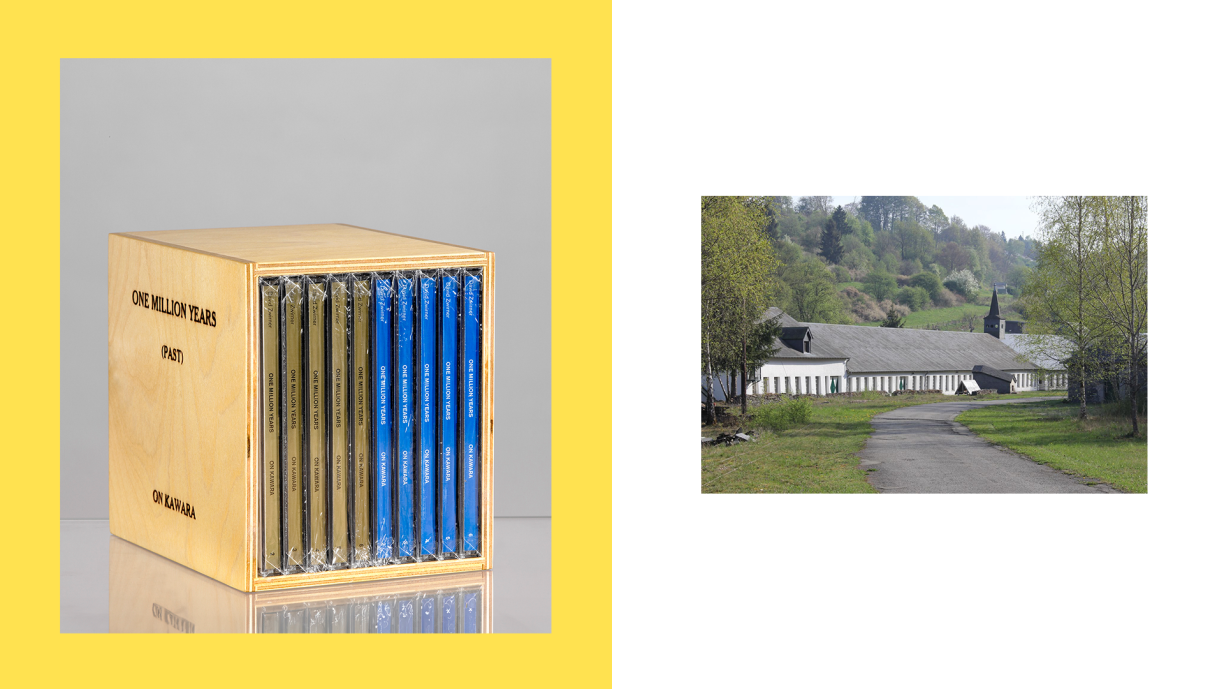
Japanese-born conceptual artist On Kawara, who was based in New York, sought to locate the viewer within history by giving material form to the passage of time. Through a series of dates rendered in an exacting, rigorously consistent format, he made time itself both tangible and elusive.
One Million Years (1969-2000) is a project in two volumes, One Million Years: Past and One Million Years: Future. Both contain ten binders, each of which holds 2,000 typed pages of consecutive dates; Past lists dates from 998,031 BC to 1969, while Future lists dates from 1980 to 1,001,980.
At the Musée de l’Ardoise, visitors do not see the physical books or binders. Instead, the exhibition presents a sound installation derived from the project: an audio recording of public readings during which two voices alternately recite the seemingly endless sequence of dates.
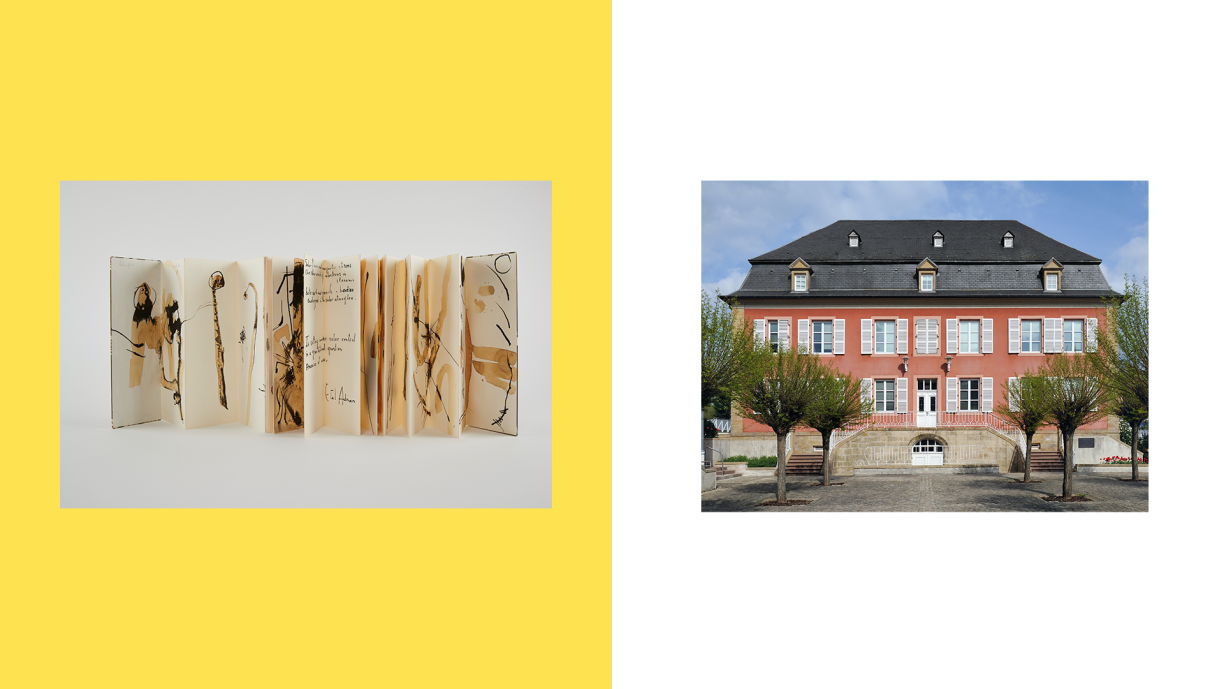
Lebanese American artist Etel Adnan intertwined painting and philosophy to explore themes of war, exile and light – and the landscapes shaped by them. After encountering leporellos (folding accordion books) in the early 1960s, she adopted them as an artistic format, drawn to their position at the intersection of language and image.
Describing these works as sites of fluidity, transformation and translation, Adnan compared them to ‘a kind of musical score that each person, including their maker, translates into his or her own inner languages’. Untitled (1965), one of her earliest leporellos, incorporates a short poem written by the artist that same year.
Best known as a poet and novelist until the mid-2000s, Adnan used the leporello format to combine painting and writing, while also expanding the physical parameters of her work. Created in 1965 at the height of the Vietnam War, the poem ends with the line ‘America at war’ and stands as a pointed act of resistance.
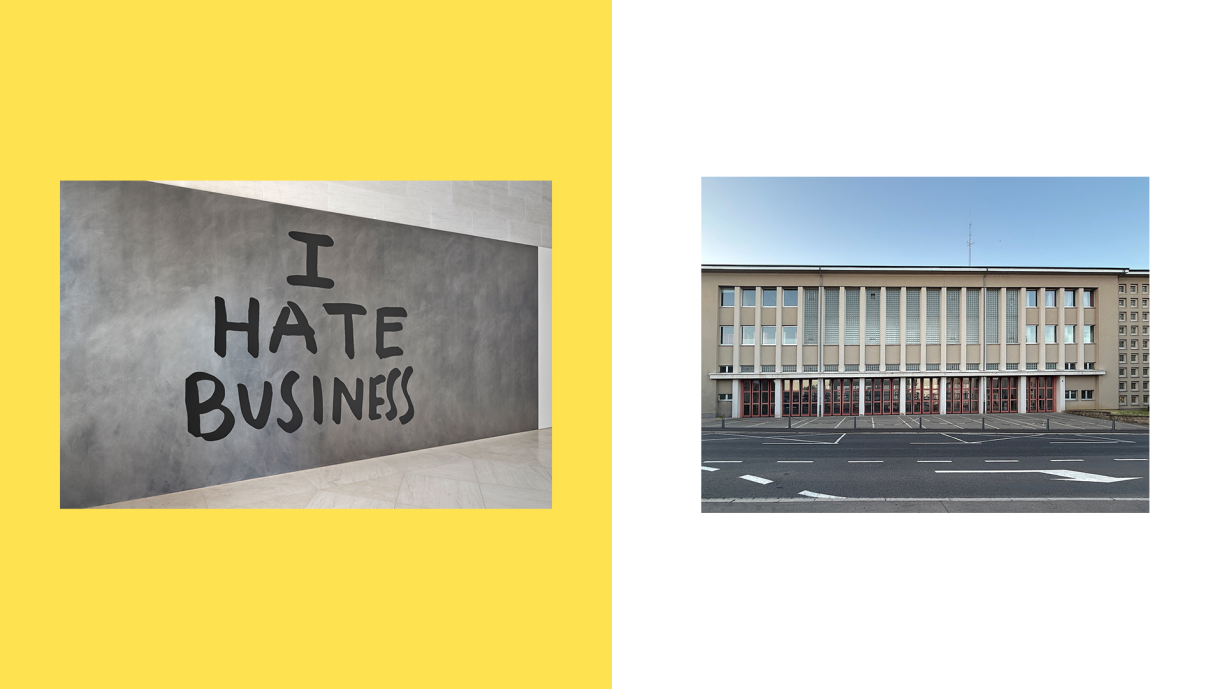
Jessica Diamond is an American artist who lives and works in New York. Her practice centres on text-based wall drawings and interventions that deploy language as a direct, confrontational tool that critiques power structures, consumerism and the art world itself.
In 1989, she painted the words ‘I HATE BUSINESS’ on a brick wall in New York. The message is blunt, the critique uncompromising. She emerged as an artist during the 1980s but resisted the era’s commercial imperatives by turning to site-specific mural painting, drawing on the immediacy and subversive spirit of urban graffiti.
Jessica Diamond credits the urgency of the work to language itself, which she displaces onto the controlled environment of the gallery.
When presented in a museum or commercial gallery, I Hate Business (1989) openly questions the very economic systems that sustain such institutions.
More information: Dodeka, 12 Works for 12 Cantons | The Contemporary Art Museum of Luxembourg



